
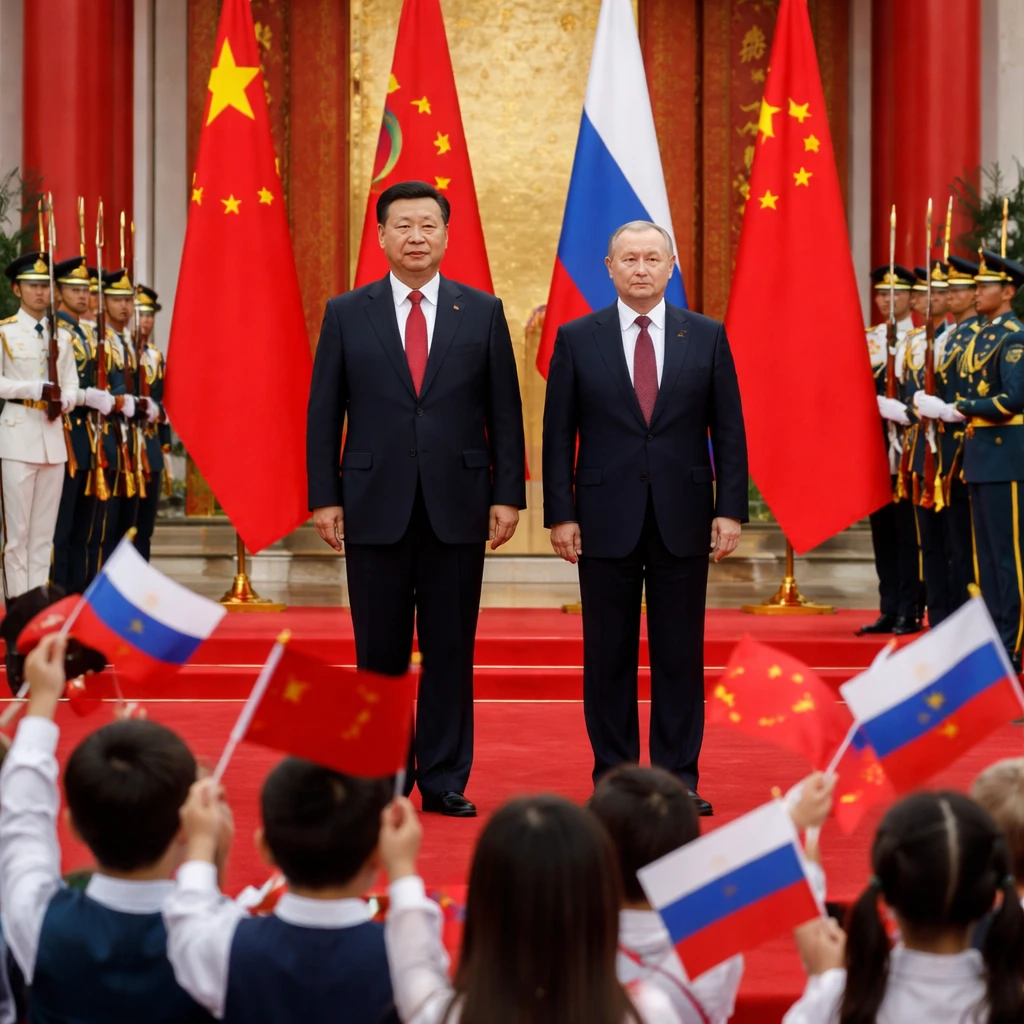
Chinese President Xi Jinping and Russian President Vladimir Putin held a summit on Wednesday that emphasized the breadth of their strategic relationship while stopping short of concrete, headline-grabbing commercial deals. The leaders used the occasion to criticize U.S. President Donald Trump's Golden Dome missile defense plans and to present a unified diplomatic posture.
The opening of the visit carried traditional ceremonial trappings: Putin was met with an honor guard and a formal gun salute at the Great Hall of the People, and children in the crowd waved Chinese and Russian flags. The meeting followed a similar ceremonial reception given to President Trump in Beijing several days earlier.
After their talks, Xi and Putin signed a joint declaration totaling 9,935 words that addressed a range of subjects, explicitly including nuclear security, Taiwan, and wildlife conservation. In addition to that detailed declaration, the two governments signed about 20 further instruments covering areas from sanitary norms to nuclear energy cooperation. Despite the number of documents, no major bilateral deals had been finalized at the time of writing.
The Kremlin reported that negotiators had reached a general understanding on the Power of Siberia 2 natural gas pipeline, a proposed project that would move gas from northern Siberia to China via Mongolia. However, the statement from Moscow made clear that important details and a timeline for the pipeline remain to be agreed. Russia and China have been negotiating that project for years, with pricing and other commercial issues still unresolved.
In a joint declaration issued after the meeting, the two governments warned against what they described as attempts by some countries to dominate global affairs in a colonial spirit, saying such efforts had failed and that the world faces the risk of returning to a "law of the jungle." The declaration singled out U.S. plans for the Golden Dome missile defense shield as a threat to strategic stability, and criticized Washington for not working on a replacement for a landmark nuclear treaty.
On technology and trade, Sberbank CEO German Gref was quoted saying Russia hopes to run its GigaChat artificial intelligence model using Chinese-made chips, as Western sanctions continue to limit Russia's access to advanced hardware.
Economic ties between the two countries remain substantial. According to figures cited by the Kremlin, China is Russia's largest trading partner with roughly $240 billion in bilateral trade and is the largest buyer of Russian crude oil. Russia, in turn, is listed by the Kremlin as China's fifth-largest trading partner, behind the United States, Japan, Korea and Vietnam.
The summit produced a broad diplomatic declaration and multiple formal documents but left open several operational and commercial questions, most notably the full set of terms and timetable for the Power of Siberia 2 pipeline and outstanding pricing matters. For observers tracking energy flows, technology cooperation and geopolitical alignments, the meeting reinforced the two governments' intent to deepen ties while underlining how negotiation details remain pivotal to concrete outcomes.