
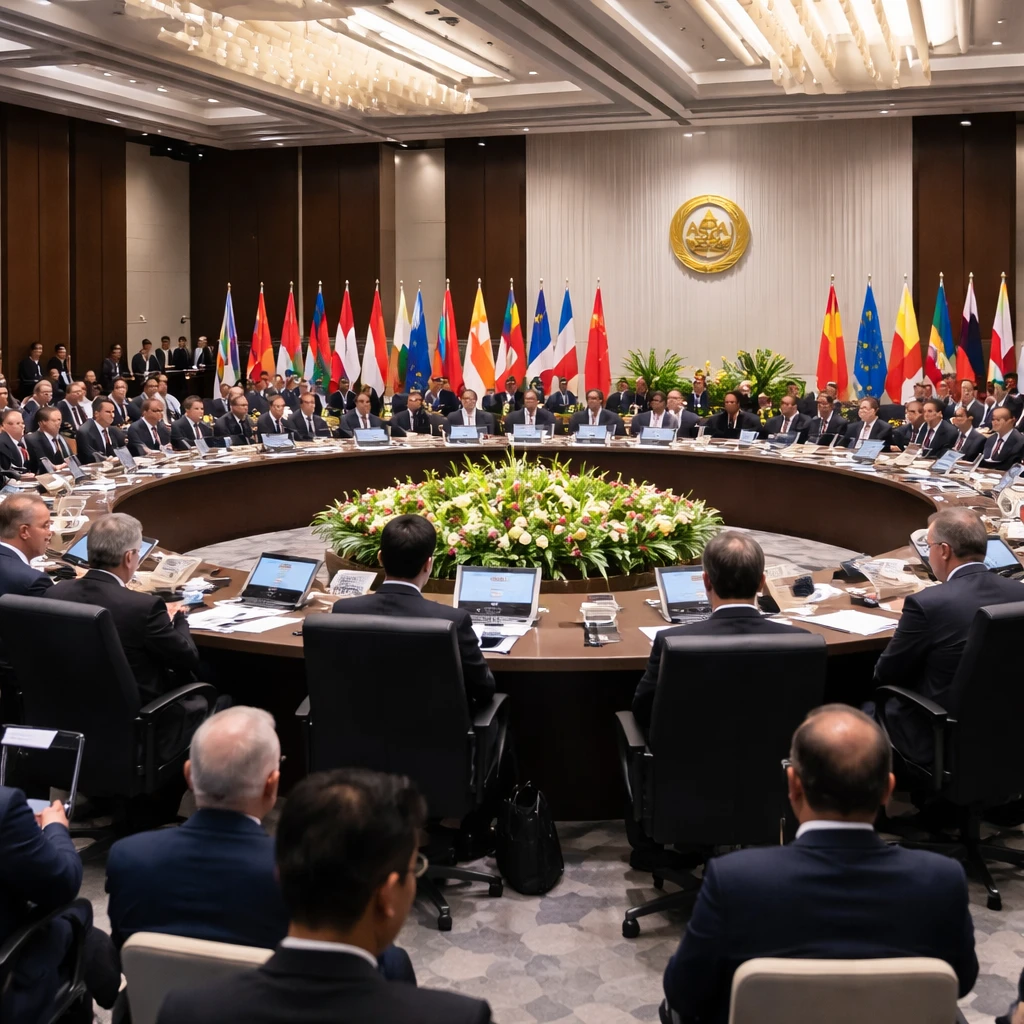
Top diplomats from across Asia, Europe and North America assembled in Manila on Thursday for the security-focused ASEAN Regional Forum, where ministers were anticipated to urge peaceful resolutions following a resurgence of hostilities in the Middle East. The plenary meeting drew senior representatives from a broad range of powers, reflecting concern over disruptions to energy and supply chains that affect the region and beyond.
Attending officials included U.S. Secretary of State Marco Rubio, Russia's Foreign Minister Sergei Lavrov, European Union foreign policy chief Kaja Kallas, and senior envoys from China, Australia, India, Japan, Britain and other countries. The Philippines-hosted forum, convened by the 11-member Association of Southeast Asian Nations, brings together states whose economies have strong exposure to Middle East oil supplies and to disruptions that can stoke inflation globally. ASEAN members collectively account for a gross domestic product of about $3.8 trillion.
Delegates arrived with recent developments in the Middle East high on the agenda. The collapse of a ceasefire 12 days earlier has coincided with a continued sequence of U.S. military strikes, with the United States conducting attacks for a 12th successive night on Thursday. At the same time, Iranian-aligned Houthi forces have asserted strikes on two Saudi oil tankers, actions which form part of a blockade that risks creating a second major choke point for global oil shipments in the Red Sea, alongside the already fraught Strait of Hormuz.
China's Vice Foreign Minister Hua Chunying underscored the link between the conflict and broader disruptions in an opening address at a parallel forum on Thursday involving ASEAN, Japan, South Korea and China. Hua said the world has entered a "new period of turbulence and transformation" and added that the situation in the Middle East has spilled over into energy and food supply chains, reducing security and resilience and increasing the urgency of maintaining peace and stability.
U.S. Secretary of State Marco Rubio told ASEAN ministers on Wednesday that Washington seeks a diplomatic resolution, but said Tehran was not engaging constructively. "The problem we’re having right now is that they’re not serious about talks," he said. Rubio was scheduled to meet with Russia's Sergei Lavrov on Thursday, with Rubio indicating he would raise the war in Ukraine in that discussion and that Washington was aiming to play a constructive role in ending it.
The security talks in Manila also focused on long-running tensions in the South China Sea, an area of persistent dispute between Beijing and the Philippines, a U.S. treaty ally that the United States is obligated to defend if its vessels are attacked. A recent incident heightened those strains: China's coast guard, which has been deployed extensively far from the mainland, was involved in a brief altercation on Monday with Philippine navy personnel near a disputed reef located within Manila's exclusive economic zone. The incident prompted both capitals to summon each other's ambassadors.
China asserts sovereignty over nearly the entire South China Sea via a demarcation line that extends into parts of the exclusive economic zones of Brunei, Indonesia, Malaysia, the Philippines, and Vietnam. Beijing does not recognize a 2016 arbitration ruling that found those expansive claims to be without basis under international law. Speaking at a meeting with ASEAN counterparts on Wednesday, China's Foreign Minister Wang Yi described the South China Sea as "our common home" and urged a narrative of cooperation and friendship. He called on regional countries to resist outside incitement, oppose individual states using the sea to cause trouble, and to take the lead in safeguarding peace and stability in the waters.
Against this backdrop, ministers in Manila were expected to emphasize the need for diplomatic engagement and restraint. The convergence of concerns over the Middle East conflict, potential blockades affecting major maritime routes, and flashpoints in the South China Sea illustrates the overlapping security challenges on the ASEAN agenda, with implications for energy markets, shipping lanes and regional inflationary pressures.
Summary
Senior diplomats gathered at the ASEAN Regional Forum in Manila to press for peaceful solutions after renewed hostilities in the Middle East and escalating maritime tensions. High-level attendees included officials from the United States, Russia, the EU, China and other partners. Discussions focused on disruptions to energy and food supply chains, the risk to global oil routes posed by the Strait of Hormuz and Red Sea blockade, and an incident between China's coast guard and the Philippine navy near a disputed reef.
Key points
- High-level attendance: The forum drew top foreign ministers and senior officials from major powers, reflecting the international stakes of the security discussions. - Sectors impacted: diplomacy, defense.
- Energy and supply chain disruption: The Middle East war and maritime blockades have spilled over into energy and food supply chains, contributing to inflationary pressure. - Sectors impacted: energy, commodities, consumer goods.
- Maritime security tensions: The South China Sea incident between China and the Philippines, and the broader dispute over maritime claims, raise risks for shipping and regional stability. - Sectors impacted: shipping, insurance, trade.
Risks and uncertainties
- Escalation of Middle East hostilities: Continued military strikes and blockades could further disrupt oil shipments and global energy markets. - Affected sectors: energy, transportation, inflation-sensitive consumer sectors.
- Expansion of maritime blockades: The Houthi-claimed strikes and blockade in the Red Sea, together with tensions around the Strait of Hormuz, risk creating additional chokepoints for global trade. - Affected sectors: shipping, logistics, commodities.
- South China Sea confrontations: Naval and coast guard incidents between China and neighboring states could increase regional tensions and invoke treaty commitments, with consequences for defense spending and regional trade flows. - Affected sectors: defense, maritime services, regional trade.
Tags
- ASEAN
- MiddleEast
- Energy
- Security
- SouthChinaSea