
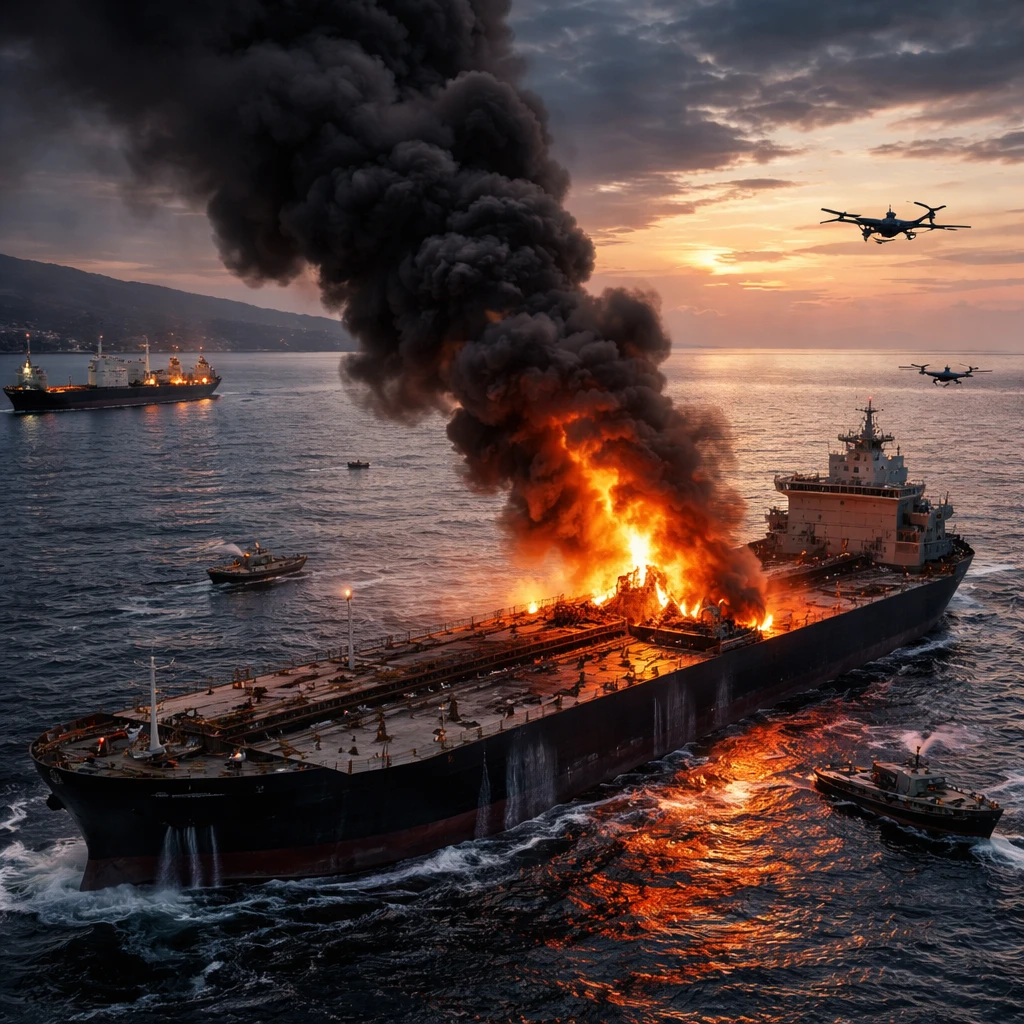
Iran-backed Houthi militants in Yemen said on Thursday that they struck two Saudi oil tankers in the Red Sea using missiles and drones, marking a new escalation in a wider conflict that has seen repeated exchanges between the U.S. and Iran.
The militants identified the vessels as the Encelia and the Layla. Saudi state news agency SPA, cited by Reuters, reported that the Encelia was hit and caught fire. SPA added that the attack on the Layla remained unconfirmed.
Houthi fighters control coastal areas around the Bab el-Mandeb Strait, the narrow passage that links the Red Sea to the Gulf of Aden, and earlier this week they warned they would impose a naval blockade on Saudi Arabia. The militants said their forces had used a combination of missiles and drones in the latest strikes.
Shipping disruptions and rerouting
In response to the threat of Houthi attacks, oil tankers transiting the Red Sea have been altering their courses. The report said five tankers changed direction on Wednesday to avoid potential strikes, and that three vessels carrying Saudi crude bound for China and India were forced to turn back on Tuesday.
Analysts cited in the original account argued that by attempting to broaden disruptions beyond the Strait of Hormuz, Iran may be seeking greater leverage in its confrontation with Washington. The prior closure of the Strait of Hormuz by Tehran had previously driven oil prices sharply higher and raised concerns that supply shocks could feed global inflation and prompt central banks to raise interest rates.
The piece adds that any prolonged obstruction to Red Sea or Bab el-Mandeb transits could compel oil tankers to reroute around the southern tip of Africa, a change that would lengthen voyages and push up freight costs.
Market reaction
With the prospect of disruptions to flows through the Bab el-Mandeb weighing on markets, Brent crude futures climbed above $98 a barrel on Thursday. The narrative notes that oil prices had briefly fallen to around $70 a barrel after a framework ceasefire deal was signed between the U.S. and Iran in June, but subsequent flare-ups in violence have driven a renewed rise in crude.
Diplomatic and military developments
U.S. Secretary of State Marco Rubio said on Thursday he hoped the Houthis would de-escalate, asserting that the militants had been "snookered" into joining the confrontation by Iran. Rubio made the remarks at a diplomatic conference in the Philippines following another night of strikes exchanged between the U.S. and Iran.
The U.S. military stated it had launched fresh attacks intended to degrade Iran's capacity to target commercial shipping, as well as to strike weapons storage sites and air defense assets. Iran, for its part, continued to respond to U.S. actions: Tehran's Islamic Revolutionary Guards Corps said it had attacked U.S. military targets in Kuwait, and Iranian authorities asserted they had control of the Strait of Hormuz, declaring the waterway "fully closed" and warning that oil tankers would not be allowed to transit without prior coordination with Iranian officials.
Implications for trade and markets
The developments documented here link directly to transport and logistics risks: increased attacks in the Red Sea and threats to the Strait of Hormuz raise the probability of longer routes, higher freight charges and supply disruptions for crude shipments. Those factors, combined with renewed military actions and political signaling, were associated in the report with recent upward pressure on global oil prices.
At the same time, some details remain contested in the immediate aftermath of the strikes - notably the confirmation of damage to the Layla - and market participants are responding to evolving security and military dynamics in the region.
This article summarizes reported statements and developments as presented in the original account. Where events or claims were described as unconfirmed by quoted sources, that status is retained here.