
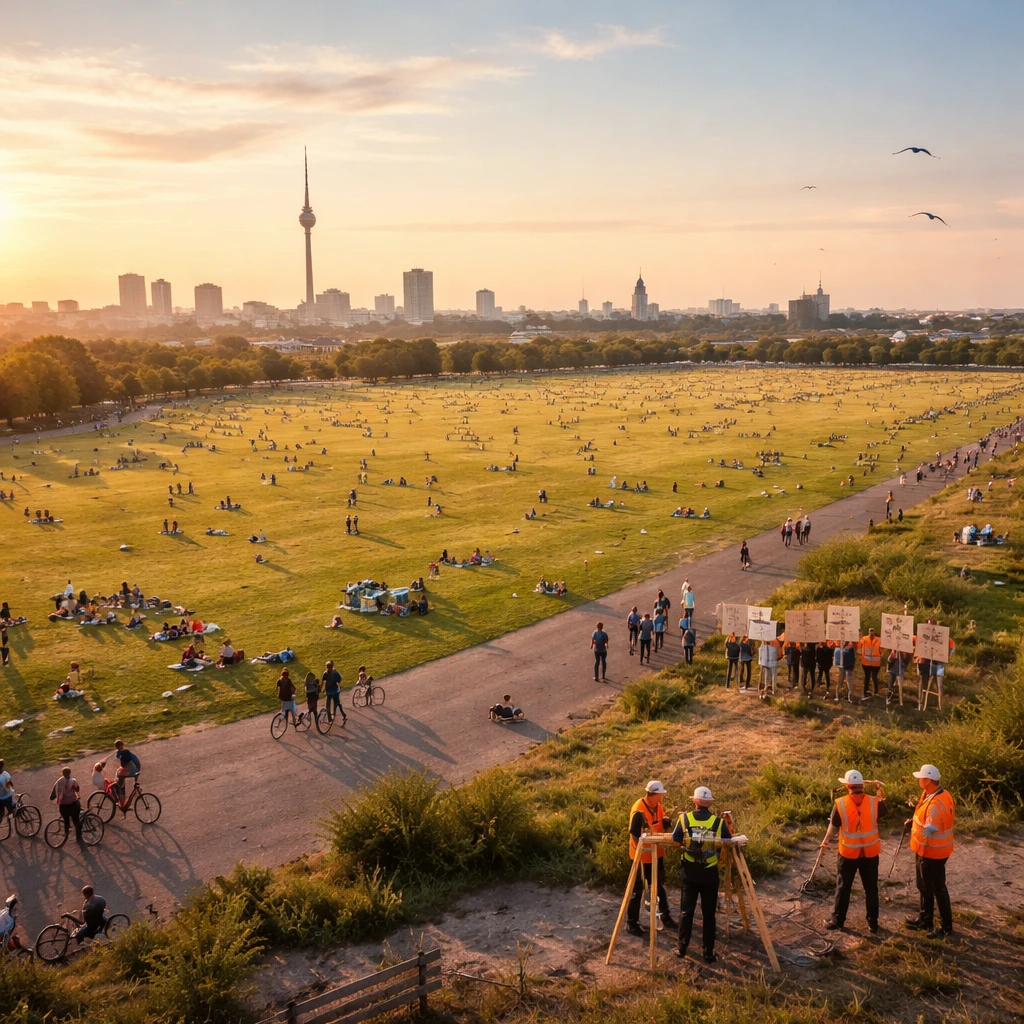
Berlin’s looming housing crisis and the fate of the city’s iconic Tempelhofer Feld have taken center stage as voters prepare to cast ballots on September 20. The debate contrasts the urgent need for new homes with strong public sentiment to preserve one of the capital’s largest open spaces, while political maneuvering around rents and development threatens to reshape the city’s governing landscape.
Top concern for renters
Unlike other German state elections where immigration has been a key driver of support for the far-right Alternative for Germany (AfD), the defining issue in Berlin is housing. The city, where 85% of households rent, faces a projection that it will need 211,000 additional homes by 2040. At the same time, advertised rents have nearly doubled since 2014, fueling broad dissatisfaction with the incumbent city government, which is a coalition of the centre-right Christian Democrats (CDU) and centre-left Social Democrats (SPD) mirroring the national alliance.
The vote on September 20 is viewed as another test of backing for Chancellor Friedrich Merz’s struggling federal government, coming two weeks after the AfD’s strong showing in the eastern state of Saxony-Anhalt. Neighbouring Mecklenburg-Western Pomerania also holds elections on the same day.
Current polling and party standings
According to a Forschungsgruppe Wahlen poll published on September 11, the far-left Left Party leads in Berlin with 23% support, followed by Merz’s CDU at 21% and the AfD at roughly 17%. The SPD and the Greens trail behind. Both the Left Party and the AfD have approximately doubled their support since the last Berlin election in 2023.
Tempelhofer Feld - contested ground
The debate over whether to allow construction on the former Tempelhof airport has crystallized broader tensions between housing supply and public green space. Converted to a park in 2010, Tempelhofer Feld is nearly twice the size of London’s Hyde Park and ranks among the world’s largest urban open spaces. Its past includes expansion during the 1920s, use under Nazi rule, and a pivotal role during the 1948-49 Berlin Airlift, when Western allies supplied the blockaded city by air. The airport itself closed in 2008.
Four years after the park opened, nearly two-thirds of Berliners voted in a referendum to keep the site largely free from development. Activists opposing construction at the site argue that open space is a form of social and ecological infrastructure. Anita Moeller, a member of the 100% Tempelhofer Feld initiative, said: "Open space is not land for development. It is social and ecological infrastructure - and Tempelhofer Feld is Berlin’s open space."
Political parties remain divided on the issue. The CDU, Free Democrats (FDP) and AfD back limited housing construction on parts of the Feld, arguing that development could help alleviate the city’s housing shortage. The SPD, Greens and Left Party oppose building on the site and prefer to focus on other development locations within the city. Stefan Evers, the CDU’s lead candidate in Berlin, noted that "the referendum was 12 years ago, the need was nowhere near as great then as it is today," emphasizing the changed context for housing demand.
Economic growth and its housing consequences
Over the past decade Berlin has outpaced Germany’s generally sluggish economy, largely on the strength of its services sector, which produces nearly 90% of the city’s economic output. The capital also remains a center for startups, with more than 600 companies founded in 2025 alone, and hosts digital consumer-services firms such as Zalando and fintech N26 among its corporate roster.
But economic momentum has sharpened pressure on housing. Population growth tied to services and startup activity has pushed up demand for housing, contributing to the nearly doubled advertised rents since 2014. Would-be developers argue that building on places like Tempelhof could help expand the housing stock. Yet many residents struggling with elevated rents say that more targeted measures are needed to make housing genuinely affordable.
For some longtime residents and cultural operators, the escalation in costs has altered the city’s character. The German capital, once described by a former mayor as "poor but sexy," now increasingly resembles other major European cities in living costs. Thousands turned out on September 5 to protest high rents. Among them, Mareen Harant highlighted the affordability squeeze, saying that in Berlin "you can easily end up paying €1,500 ($1,720) or more a month for a one- or two-room apartment. Who on earth is supposed to be able to afford that?"
Policy promises and campaign turbulence
Parties are proposing different paths to address the crisis. The Left Party’s platform includes pledges to build affordable new homes, implement a one-year rent freeze followed by a cap limiting increases to 1%, forcibly reduce rents that are 20% over the local average, curb holiday rentals in housing blocks, and offer vacated central flats to those entitled to social housing.
Meanwhile, the governing CDU and SPD have seen their campaigns disrupted. In July, CDU Mayor Kai Wegner withdrew as lead candidate amid criticism over his handling of a January power outage that left large parts of the capital without electricity for four days. The SPD has faced its own challenges after police raided the home and offices of its lead candidate, Steffen Krach, as part of an investigation into a tender process in the health sector; Krach denies any wrongdoing.
Wider social and cultural impact
Rising land and property prices are not only straining household budgets; they are also squeezing cultural institutions and nightlife. Martin Gornig, a researcher at the German Institute for Economic Research (DIW Berlin), observed that "growth also has a downside: prices rise and, above all, land prices rise, so space becomes scarce."
Berlin’s nightlife has felt the pressure. Jakob Turtur, managing director of Jonny Knueppel, a collectively run club, described the impact of rising rents on venues: "We had to move because we simply could no longer afford the rent." Such dislocations underscore the broader trade-offs at play between economic growth, urban amenities and affordability.
Outlook
The election will test the durability of the incumbent coalition and the appeal of parties offering more radical housing interventions. With both the Left Party and the AfD having gained ground since 2023, and with rent-related protests drawing public attention, Berlin’s contest illustrates how acute urban shortages and cultural pressures can drive political change.
As voters decide on September 20, the competing pressures of protecting public open space and expanding housing supply will remain central to how policymakers and markets respond to Berlin’s continuing affordability challenges.