
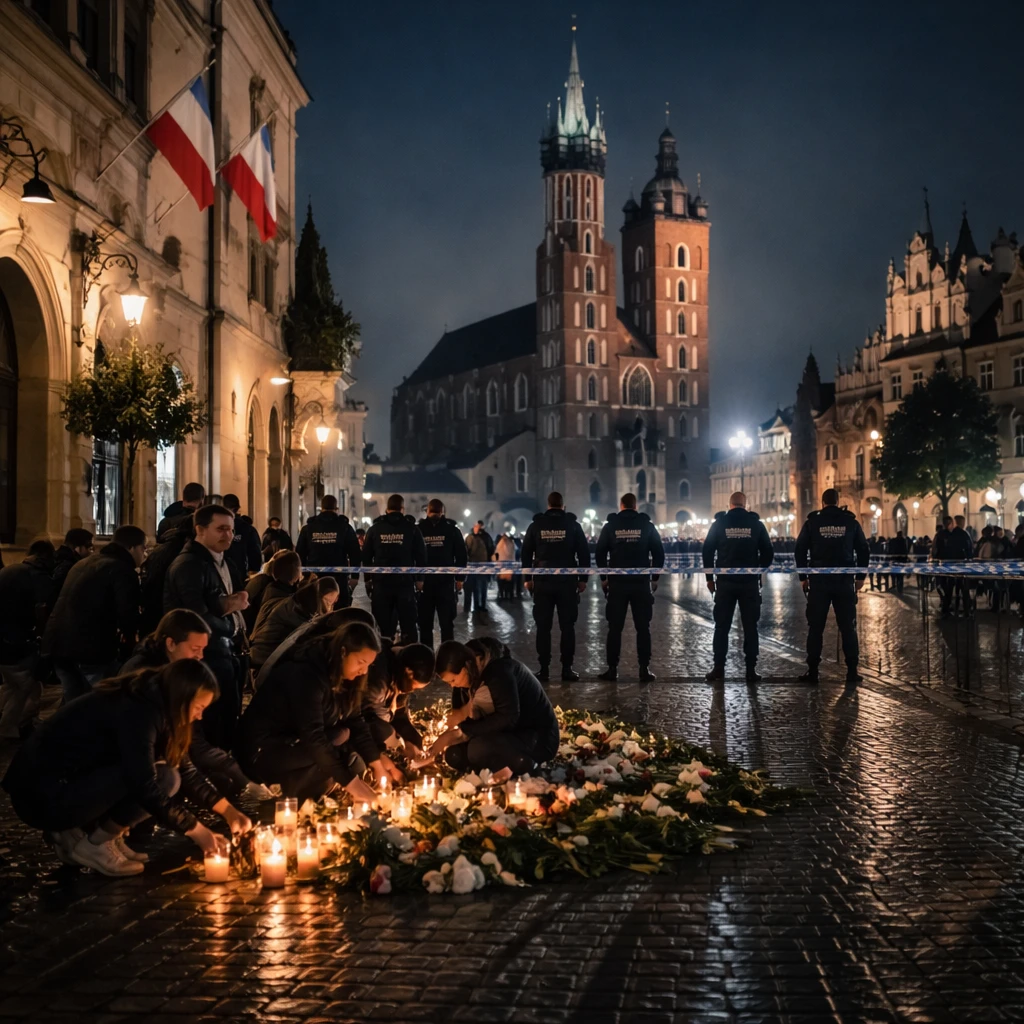
Poland began two days of national mourning on Sunday and deployed additional security measures after a mass shooting in Krakow's historic main square left six people dead, authorities said, in an attack they believe was likely inspired by far-right ideology.
The shooting, which occurred on Saturday in the old town's central market area, also wounded 17 people, including two police officers and the gunman. Officials said the 24-year-old suspect remained in hospital in critical condition. Authorities later reported the deaths of the suspect's parents and sister at their home in his hometown, and investigators said inquiries into that discovery were continuing.
Scene and immediate response
In Krakow, officials shut the main market square and surrounding streets, restricting passage to essential workers. Many nearby cafes remained closed and flags at the city hall were flown at half-mast as residents and visitors placed candles at several locations in the area.
The customary trumpet call from St Mary's church on the square was suspended for 12 hours in commemoration of the dead - an interruption authorities said had not occurred since 1939, according to state news agency reports.
In the capital, Warsaw, police announced stepped-up security in busy areas popular with tourists. Barriers were placed on streets leading to Krakowskie Przedmiescie in the historic centre as officers sought to reassure the public and protect key pedestrian zones.
Details from the suspect's hometown
Police in Ostrowiec Swietokrzyski, about 200 km (124 miles) north of Krakow, said they had found three bodies at an apartment in the centre of the town. In a post on X, authorities wrote: "Yesterday, before 22:00, we discovered the bodies of three individuals - a 53-year-old man and two women, aged 52 and 21 - in an apartment located in a residential building in the centre of Ostrowiec Swietokrzyski." Investigations into those deaths were reported to be ongoing.
Public reaction and concerns
The attack has shaken public confidence in safety. A 20-year-old Warsaw cafe employee, Maria, said she "almost burst into tears" upon hearing of the event and added that recent incidents had eroded people's sense of security.
National commentators and newspapers reacted strongly. One leading daily editorial described the mass shooting as bringing a "brutal end to an era in which Poland was considered an island of safety," reflecting a broader unease following other violent episodes earlier in the autumn.
Context and law enforcement response
Authorities drew links between rising concerns about public safety and a recent series of school stabbings in October that officials said were tied to extremist content online. In Krakow, the rapid police response to Saturday's shooting drew public praise for the officers involved.
Two police officers were wounded during the confrontation with the shooter. Police issued an urgent appeal for blood for one of the injured officers, who was described as "fighting for his life in hospital." Prime Minister Donald Tusk paid tribute to the officers, calling Senior Constable Jakub Kulik and Senior Constable Artur Moranski "true heroes" and saying they likely saved many lives despite the risk to themselves.
Ongoing implications
The combination of a deadly attack in a high-profile tourist area, the closure of commercial venues around the square, and stepped-up barriers and policing in major urban centres may have short-term effects on footfall in hospitality and retail sectors in affected areas. Officials continue to investigate both the shooting and the discovery of the three bodies in the suspect's hometown, while the public and city authorities contend with heightened security measures and mourning rituals.
As investigations continue, authorities and residents remain focused on immediate safety, medical care for the wounded, and the legal and forensic inquiries that will follow.