
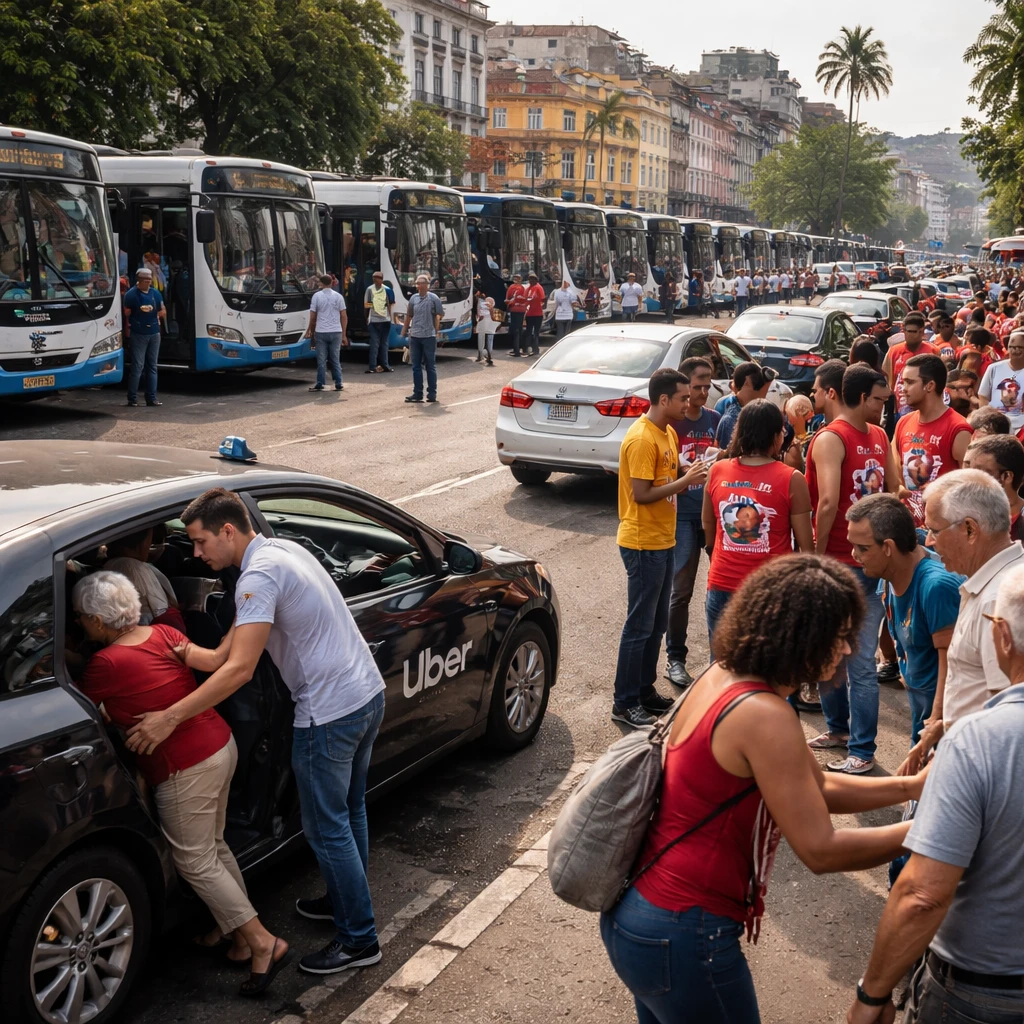
When a large portion of Salvador’s bus fleet stopped running on the final voting day, residents who feared voters would be stranded took action themselves. History teacher Martins Mafra, among many who responded, drove across the northeastern Brazilian city to ferry voters to polling places. His efforts were a small but visible piece of a wider get-out-the-vote operation that played a key role in consolidating leftist President Luiz Inacio Lula da Silva’s re-election in the runoff.
Supporters of Lula, alarmed by right-wing Senator Flavio Bolsonaro’s lead after the first round, organized aggressively ahead of the second round. They combined door-to-door outreach, social media initiatives, free transportation and grassroots fieldwork to increase turnout and swing undecided voters. The campaign’s efforts culminated in a swing of more than 10 million additional votes for Lula in the runoff.
Grassroots mobilization and personal appeals
Mafra, who said he offered rides to supporters of all political stripes, framed his activity as both civic duty and instruction. "I’m a father, and I work in education, so this was an opportunity to teach and show that we can make a difference," he said. "It’s one thing to stay home complaining about city hall or posting videos online; it’s another thing to get up, walk out the door, and actually do something." His approach mirrored actions in other cities, where neighbors, activists and private drivers mobilized to close the gap left by disruptions to scheduled public transport.
In Salvador, the capital of Bahia state, a densely populated Lula stronghold, volunteers and informal networks boosted participation. Bahia registered the largest drop in abstention between the two rounds nationwide, with nearly 400,000 more people voting in the runoff than in the first round. Almost a quarter of those additional voters came from Salvador, where Lula captured 73% of votes in the runoff in a city of more than 2.5 million residents.
Local organizers described a range of tactics. Gabriel Mercury, 41 and the son of pop star Daniela Mercury, invited undecided voters for coffee to discuss politics and later put forward a public challenge, offering up to 2,400 reais to anyone who could identify a Bolsonaro legislative proposal that had aided workers. According to Mercury, nobody took him up on the offer.
Campaign overhaul and digital expansion
After an underwhelming first round, Lula’s campaign team moved to reboot its approach. Campaign aides acknowledged internal divisions, mixed messaging and the typical hazards of incumbency had hampered earlier efforts. The 81-year-old president, for the first time, acquired a smartphone to engage with constituents on platforms that increasingly shape political debate.
Lawmaker Andre Janones expanded a WhatsApp channel called "Lula’s Army" to broaden reach. According to campaign accounts, the channel grew from roughly 50,000 members before the first round to over 10 million by the runoff, with followers encouraged to recruit friends and amplify campaign content online. Political risk consultant Creomar de Souza of Dharma said Lula’s team, and particularly Janones, capitalized on perceived missteps by Bolsonaro to persuade voters the latter would jeopardize democratic institutions, reverse social gains and cut welfare benefits that many Brazilians depend on.
Bus stoppage and immediate reactions
On election day, public authorities are required to provide free public transport. In Salvador, numerous reports suggested buses were not operating. Bahia consumer protection inspectors located 944 buses idling in depots, and the Bahia electoral court’s judicial analyst Jaime Barreiros Neto estimated that at least 30% of the fleet was not in service.
Bruno Reis, Salvador’s mayor and a supporter of Bolsonaro, attributed the delay to the presence of Lula campaign stickers on buses, which he said violated electoral rules and required removal. He said that once city hall realized sticker removal was creating a bottleneck, it ordered the fleet released. Reis confirmed his support for Bolsonaro in line with his party, UniE3o Brasil, and denied any intentional detention of public transport or hindrance to voter mobility.
The state electoral court ordered the arrest of Pablo Souza, the city’s transportation chief, over the absence of buses. The court later revoked the arrest order once voting ended the next day, while insisting on a probe into the incident. Souza, who was in Paris on an official trip during the vote, denied wrongdoing and told reporters the number of buses operating was the same as during the first round and complied with electoral regulations.
Volunteer networks and ride-hailing responses
As news of the idle buses spread, local activists and ordinary residents sprang into action. Mercury and a small group of friends asked followers on social media to drive people to polling stations; some volunteered their time and cars, while others contributed funds to cover fuel costs. Mercury estimated his group moved around 600 voters on election day.
Uber drivers also joined the effort. Thousands of drivers reportedly offered free rides valued up to 50 reais, and drivers such as Adriano de Jesus Braga dos Santos, who also creates online content, reported personally providing dozens of free trips. "Politics isn’t just institutional politics," Mercury said. "We make politics through our actions." For many, that meant using personal vehicles, ride-hailing apps or small networks to ensure people could vote.
For some Salvador residents, those efforts were decisive. Nicole Soares, 18, waited 40 minutes for a bus but persisted and ultimately cast her ballot for Lula. Others were unable to take part despite volunteer help. Grecia de Jesus Nunes, a 54-year-old street vendor, said only two buses passed her hotdog stand between 8 a.m. and 2 p.m., and none were available when she briefly stepped away from work. By the time volunteers arrived, she could not leave her post and missed the chance to vote. Still, Nunes celebrated Lula’s victory, telling reporters, "My life is Lula. I am Lula until I die."
Political fallout and claims
Flavio Bolsonaro, son of jailed former President Jair Bolsonaro, left for the United States after the election and publicly questioned the legitimacy of Lula’s 10 million-vote increase. He also challenged the credibility of a two-hour extension of voting hours that had been requested by Lula’s campaign and authorized by a Lula-appointed Supreme Court justice in response to the bus outage in Bahia. Bolsonaro’s campaign had separately sought an extension citing heavy rains in conservative-leaning southern states. The federal electoral court said the extension had little bearing on the final outcome.
In the days following the vote, electoral authorities in Bahia demanded inquiries into the transport failure while local political leaders disputed responsibility. The sequence of a halted transit fleet, a judicial response and a rapid civic reaction underscored how logistical failures can become flashpoints on election day, prompting legal scrutiny and intense grassroots activity.
Conclusion
The Salvador episode illustrates how local breakdowns in public services can catalyze volunteer energy and digital organizing. In a state that produced a sharp increase in turnout and delivered a commanding margin for Lula in the runoff, informal transportation networks and a surging WhatsApp channel helped convert concern into votes. Whether through personal rides, ride-hailing drivers offering free trips, or amplified messaging on social platforms, the mobilization that followed the bus stoppage became a consequential element of the broader effort that secured Lula’s re-election.
Exchange rate used in reporting: $1 = 5.3851 reais.