
Context and trial plan
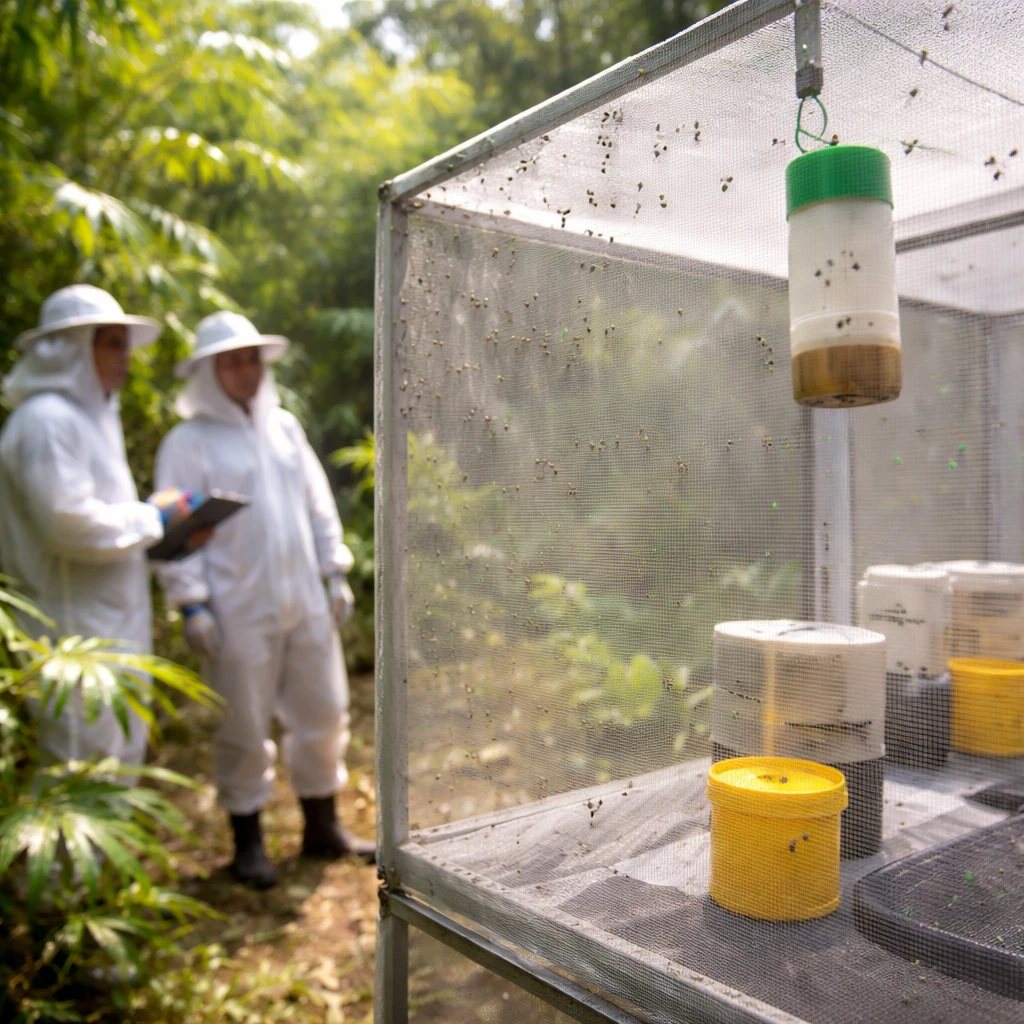
At a U.S.-funded insect production complex in Panama, researchers are preparing the first outdoor evaluations of a genetically modified New World screwworm fly intended to bolster efforts against a parasitic pest that infests warm-blooded animals. The engineered strain, known as NovoFly, will initially be kept in mesh enclosures exposed to Panama's heat and humidity so scientists can measure how long the flies survive and behave outside laboratory conditions before advancing to more extensive field trials.
The tests are part of a larger push to develop a more effective tool against screwworms, a species whose females deposit eggs in open wounds and mucous membranes of livestock and other warm-blooded animals. After eggs hatch, larvae feed on living tissue, a process that can ultimately kill untreated hosts. The economic stakes are significant: widespread infestations in Texas could cause losses estimated at more than $1 billion to the state's livestock sector and potentially spread to other U.S. states.
Existing sterile-fly program and capacity limits
For decades, the principal method to control the pest has been the release of sterilized screwworm flies. A joint Panama-U.S. facility, managed and financed by the U.S. Department of Agriculture and Panama's Ministry of Agricultural Development, now produces roughly 100 million sterile flies per week. The plant, opened in 2006 on the Panama isthmus to maintain a barrier against northward spread, was designed to prevent wild screwworm populations from advancing into Central and North America.
However, wild screwworm flies have now become widespread across Mexico and, in June, were detected on Texas farms for the first time in decades. Given the geographic spread of current outbreaks, the weekly output of the Panama plant is insufficient for eradication efforts. Experts cited in the program indicate that about 500 million sterile flies weekly would be required to push wild populations back to the region near the Darien Gap, the rainforest divide between Panama and Colombia. The existing plant is operating at capacity but cannot meet that larger need.
How NovoFly is intended to work
NovoFly has been genetically engineered to produce only male offspring. Because female screwworms typically mate only once, releasing large numbers of sterile males that successfully mate with wild females would result in unfertilized eggs and a decline in the pest population over successive generations. The USDA previously relied on sterilization techniques beginning in 1957 and eradicated screwworm from the United States by 1966; the sterile-male approach has also been used to halt later outbreaks.
The new project aims to increase the effective production of sterile males. Currently, the Panama facility produces both sexes and has no straightforward method to separate males from females. The presence of females in shipments reduces the number of sterile males available for release. USDA officials say a male-only strain would effectively double the pool of sterilized males in the fight against wild screwworms without immediately increasing production volume.
Scott Hutchins, the USDA's chief scientist and an undersecretary, stated that NovoFly could "almost instantaneously double the number of sterile flies that we put in the fight" and provide a significant operational advantage.
Research sites and upcoming field phases
Some of the USDA's research on screwworms occurs at the Knipling-Bushland U.S. Livestock Insects Research Laboratory in Kerrville, Texas, a facility named for entomologists who developed sterilization techniques. At that lab, flies are irradiated before release - the same process planned for NovoFly insects.
Researchers leading the Panama work said they expected approval from Panama's biosecurity agency to begin the initial outdoor cage trials at the Panama lab. Following these confined tests, larger field trials are slated to begin on a nearby ranch within approximately nine to 12 weeks, according to Alex Arp, a USDA research geneticist working in Panama. Those ranch trials will involve periodic releases of roughly 50,000 insects every few days, with individual flies marked using fluorescent dyes visible under black light. Traps placed around the ranch will allow teams to track survival time and dispersal for each release.
Field test durations are typically six to eight weeks, Maxwell Scott, an entomologist at North Carolina State University involved in NovoFly's development, said while cautioning that field performance is not guaranteed. He noted: "We may get out in the field, and it may not fly very well." The primary question is whether the engineered males will possess sufficient flight ability and mating competitiveness to locate and successfully mate with wild females.
Scale-up considerations and production risk
If NovoFly proves effective in trials, scaling up production will not be immediate. USDA officials and outside experts discussed production strategy, noting that it may be less risky to begin mass rearing at a new sterile-fly production facility expected to open in Texas late next year rather than immediately adding NovoFly strains into the existing Panama plant. Introducing the new strain into Panama's facility could risk upsetting the production process and lead to a collapse of output if the correct rearing conditions - including diets and temperature regimes - are not established for the new strain.
Rear Admiral Michael Schmoyer, who is heading USDA's screwworm response, warned at a legislative hearing in Texas that rushing the process could risk a "total brood collapse," which would set production back to zero and require rebuilding capacity. That risk has led experts to consider staged approaches to integrating NovoFly into the production pipeline.
In June, the U.S. Environmental Protection Agency published a proposed decision to register NovoFly. If finalized, the strain would be the first genetically modified insect to receive full EPA clearance, according to Maxwell Scott.
Expert assessments and regional production plans
Scientists not involved in the project say that even modest increases in sterilized males could speed eradication. Edwin Burgess, an assistant professor of veterinary entomology at the University of Florida, said that researchers must ensure NovoFly is competitive with wild males and can be reared at scale. He stressed that significant work remains to bring the technology to operational readiness but described it as "very, very promising."
Mexico has indicated support for the male-only fly approach and could be producing NovoFly by the end of the year at a recently reopened production plant, Gabriel Ayala, head of animal health for Mexico's National Service for Agri-Food Health, Safety and Quality, said. In the longer term, production could occur in Panama, Mexico, and at the planned U.S. plant in Texas.
Kim Lohmeyer, director of the Kerrville research lab, said she hopes the United States can accelerate eradication compared with the decades-long effort that concluded in the 1960s. Nevertheless, she cautioned that even with successful trials and production integration, it will likely take more than a year to regain control of the pest. "It will take some time and effort," she said. "We need more flies."
Operational unknowns and evaluation metrics
Initial outdoor mesh-cage tests are intended to answer critical operational questions: can NovoFly males fly far enough in natural heat and humidity to find wild females, do they survive long enough outside lab conditions to mate, and are they able to compete with wild males? The marked-release and trapping protocol on the ranch will provide data on survival, dispersal, and recapture rates. Those metrics will guide decisions on whether to scale production and where to place mass-rearing operations.
Officials emphasized cautious progression through testing phases to avoid inadvertently compromising current sterile-fly supplies. The potential benefits of a male-only strain - effectively increasing the number of sterile males available for release without raising immediate production counts - must be weighed against the logistical and biological risks of deploying a new strain at scale.
Note: Some operational approvals and production decisions remain pending with Panamanian and U.S. regulatory authorities.