
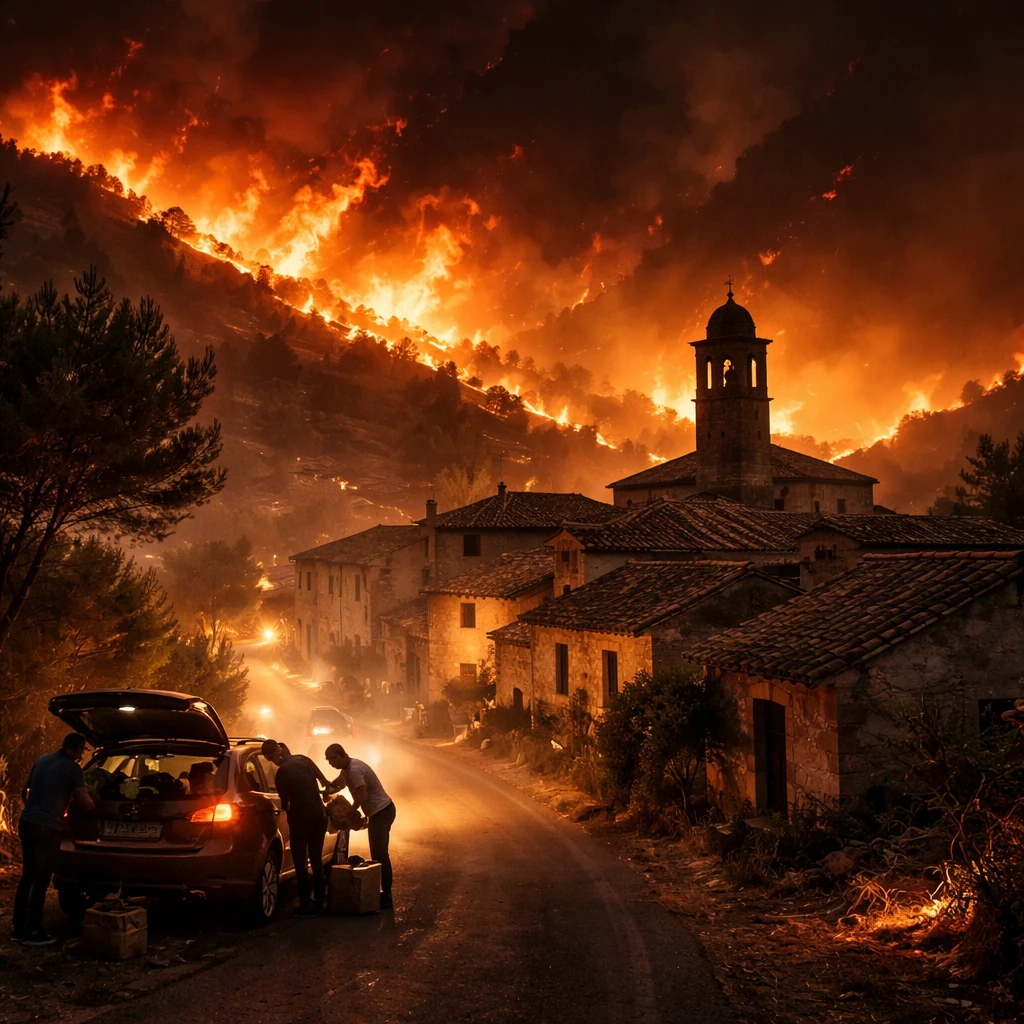
When a wildfire raced through terrain near the mountain village of Bedar in southern Spain on July 9, residents of the small nearby hamlet of Paraje el Curato found themselves facing life-or-death choices with inconsistent information about what to do.
Regional officials said some victims had been advised to remain in place, but interviews with survivors and relatives indicate that many people received no centralised guidance before the flames arrived. Five residents and survivors who spoke about the night to reporters said they had not been given any official direction. Two others who did receive warnings described them as informal or piecemeal - delivered by church bells, messages in WhatsApp groups and visits from local officials.
Bob Layton, a retired technical manager from Britain who lived in Paraje el Curato, said he was never warned by authorities about the approaching fire. He fled on his own, leaving by car roughly one minute before the blaze consumed his home. Paraje el Curato sits about 2.5 km from Bedar and was home to most of those who died trying to escape.
"If I had received any advice to stay in my home we would have been dead - it was burned to the ground," Layton said. He described finding an exit track he knew and using it to drive away, while others who attempted slightly different routes did not survive. "The fire became an inferno," he added.
Authorities say 12 people died while attempting to escape the fire; a 13th fatality was a 93-year-old British woman who later died in hospital from burns. In Paraje el Curato, some houses were destroyed while others survived, and the main village of Bedar itself was not directly damaged.
On the night of the blaze, eight residents from Layton's neighbourhood tried to leave Paraje el Curato by the same track he used, but found it cut off by the advancing flames. Those neighbours abandoned their cars and attempted to flee on foot, and they died in the fire. Four additional victims perished in a separate convoy of cars.
Local timings reported by officials indicate the fire did not reach the hamlet until about 8 p.m., which was approximately 3.5 hours after the blaze was first reported. By that time, the principal road out of the area was blocked.
Antonio Sanz, head of emergencies for Andalusia, said the regional government chose not to activate its emergency alert system that sends messages to mobile phones because it could not be configured narrowly enough for communities with differing needs - some of which needed to evacuate while others were instructed to remain at home. Officials in other Spanish regions, including Madrid, Aragon and Castile La Mancha, had used the same system in response to wildfires the previous week.
In a July 11 statement, the Andalusian government said Bedar's mayor and other local officials had gone door to door to offer guidance and had told victims in Paraje el Curato to shelter in place. Relatives of victims and survivors, however, contested that account.
Sophie Vandebroek, whose brother Stanislas Verdonckt died in the fire, said he did not receive a warning that would have allowed him to evacuate in time. "If only there had been communication through the emergency alert system when the fire broke out, hours before my brother saw the fire, then Stanislas and his seven neighbors would still be alive today," she said. Vandebroek told reporters she had spoken with the mayor and with families of the victims and that conversations among relatives and residents had included whether to flee or stay put.
She added: "It appears that none of the people who died received any official communication before it was too late." Requests for comment to Bedar's mayor, Angel Collado, were declined, and the town hall did not reply to email and phone requests seeking further comment.
A spokesperson for the local military police said that all relevant facts about the fire were the subject of an investigation but would not elaborate because the case is sealed. A spokesman for Andalusia's Supreme Court said the judge overseeing the inquiry was examining the cause of the fire.
Communication was inconsistent
Not everyone in the vicinity was left uninformed. Some people nearer to Bedar did receive alerts in various forms. Waheed Mumtaz, identified as a goatherd, said police visited him at 10:30 p.m. to order an evacuation. Juan Pedro, a waiter at Bedar's Miramar restaurant, said church bells rang after the fire began and that a message circulated on a WhatsApp group run by the town hall advising people to evacuate.
"Here in the village, as soon as we saw the smoke, heard the bells and word got round, everyone knew they had to get out," Pedro said. But not all residents belonged to that WhatsApp group. Pedro Tierney, 31, who observed the fire from a distance, rushed home and escaped by car with his grandmother and aunt. He said he received no formal alert and that a "gut feeling" that they should leave had saved their lives.
Experts note that wildfires can shift direction rapidly with wind changes, complicating the task of telling people what to do. David Alexander, emeritus professor of emergency planning and management at University College London, said that while sudden changes in a fire's behaviour pose challenges, the ad hoc nature of the messages in this case pointed to inadequate planning. He argued that authorities should at minimum have used an alert to warn of a fire even if it was not possible to provide narrowly targeted instructions to different neighbourhoods.
Layton, who lost his home, urged officials to work with residents to develop clearer warning arrangements for the future. "I don’t blame anybody - it all happened so quickly - but I found it despicable that they should try to assign blame," he said.
Preparedness gaps and the speed of fires
As wildfire seasons in Europe become more frequent and blazes propagate more quickly, experts quoted in the aftermath have emphasised the need for pre-established evacuation plans and public familiarity with safety measures. Fernando Medina, a geography professor at the University of Las Palmas of Gran Canaria, said the public must be informed in advance about local risks, evacuation routes and basic self-protection measures. He recommended mapping scattered dwellings, planning evacuation routes and carrying out drills.
In the province of Almeria, which includes Bedar, municipal preparedness appears uneven. Of 103 municipalities, 42 had emergency plans covering wildfires and other contingencies, and only nine had fulfilled the requirement to update their fire plan at least once every four years for risk areas, according to data from the Andalusian government.
Bedar's emergency plan had last been approved in 2019 and was in the process of being updated, a spokesperson for the Andalusian regional government said. The municipality is officially classified as at risk from wildfires. When asked about the shortfall in municipal plans, the regional spokesperson said Andalusia's government provides guidance and assistance, but that the responsibility for updating emergency plans lies with the municipalities themselves.
Bedar's town hall did not respond to multiple requests for information on whether it had held wildfire drills or on the status of local evacuation planning. Almeria province's government said it convened a meeting in February in Los Gallardos - a town near Bedar - with 49 municipalities to discuss how to streamline updating emergency plans. Bedar's town hall did not respond to an email asking whether it had taken part in that meeting.
Legal and investigatory steps
Authorities have indicated that investigations into the cause of the blaze are ongoing. The local military police spokesperson and a representative for the Andalusian Supreme Court both said probes were under way, with the court focused on establishing the origin of the fire. No further details were provided publicly as the matter remains sealed in the judicial process.
The combination of fatalities, contested accounts about warnings, and gaps in municipal planning has left survivors, relatives and officials confronting both immediate recovery needs and questions about emergency communication and preparedness going forward.
Survivors who did receive warnings described them as a mixture of official and informal channels: in person visits by police, church bells sounding the alarm and community messaging apps. For others, no warning reached them in time. That unevenness in communication, alongside the speed with which the fire advanced and the partial obstruction of evacuation routes, contributed to a tragedy in which dozens of families, neighbours and a small mountain community are now grieving.