
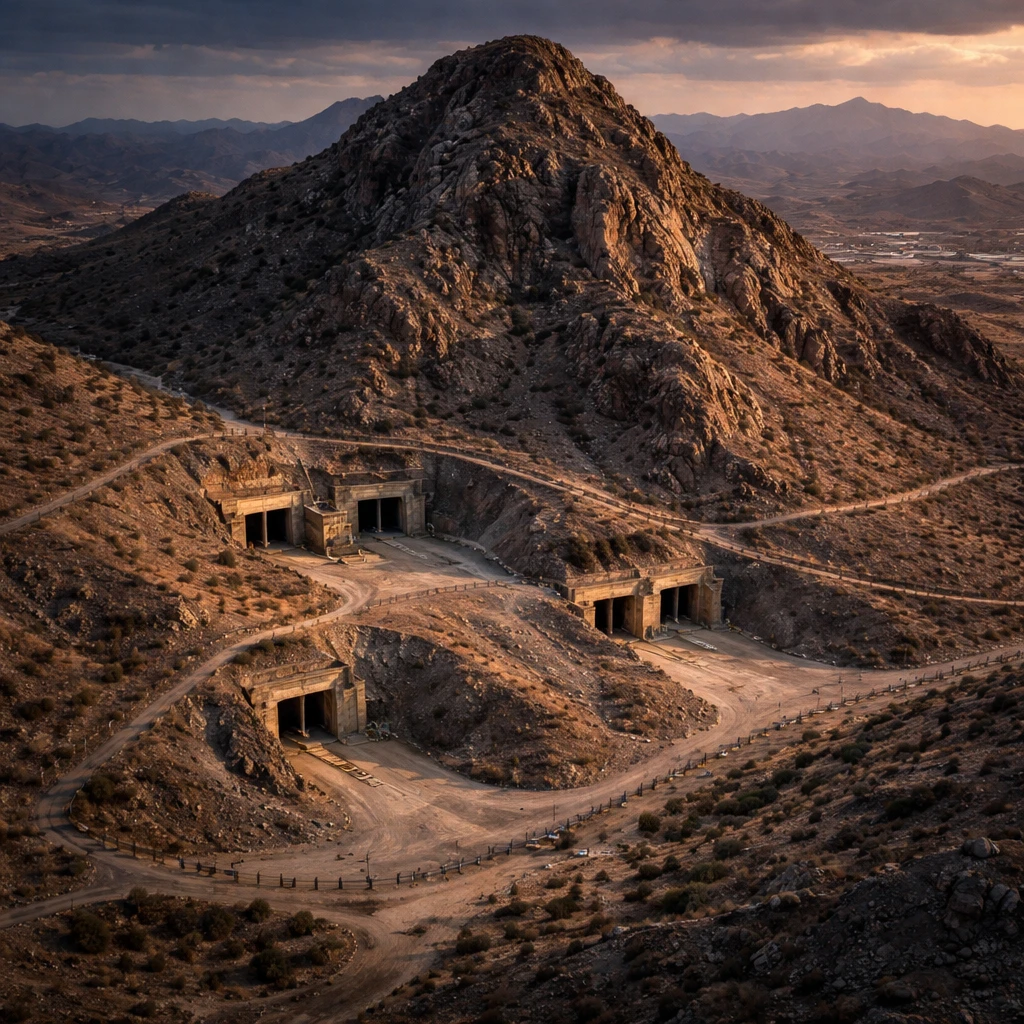
U.S. President Donald Trump recently threatened to strike a site tied to Iran's nuclear programme known as Pickaxe Mountain, drawing fresh attention to a fortified, underground complex located near one of Tehran's principal nuclear installations. The exchange comes amid heightened exchanges of fire between Iran and the United States in the Gulf and has complicated diplomatic efforts to halt the wider conflict.
Location and physical characteristics
Pickaxe Mountain stands roughly 220 km south of Tehran and sits about 2 km from the Natanz nuclear complex. The mountain itself reaches roughly 1,600 metres above sea level. Satellite-analysis and public reporting indicate the site includes a tunnel system carved into the mountain, with entrances that appear to lead to facilities estimated to lie at least 100 metres below the surface.
At Natanz, officials say two uranium enrichment plants existed: one above ground and one underground. The United Nations nuclear watchdog concluded the above-ground plant had been destroyed; the underground facility was likely at least badly damaged in prior strikes. According to a statement on July 22 from an Iranian Foreign Ministry spokesperson, there was no nuclear activity at Pickaxe Mountain.
Origins and construction
Analysis by the Institute for Science and International Security, a U.S.-based non-proliferation think tank known as ISIS, places the start of construction at Pickaxe Mountain in 2020. That timeline followed an explosion at the Natanz complex that Iranian authorities described at the time as sabotage and said had inflicted substantial damage, slowing the development of advanced centrifuges.
In September 2020, Iran's then-nuclear chief, Ali Akbar Salehi, said Iran had begun work on "a more modern, larger and more comprehensive hall in all dimensions in the heart of the mountain near Natanz" to manufacture advanced centrifuges. Rafael Grossi, head of the U.N. nuclear watchdog, has noted that Iran had publicized plans to place sensitive nuclear activity underground as part of a systematic effort to protect its most critical facilities.
What has been built and its defensive measures
ISIS' satellite-image assessments indicate Pickaxe Mountain includes two pairs of tunnel portals, thought to converge into a single underground facility. The group reports extensive hardening around tunnel openings and a broad security perimeter. Since the wars earlier this year and last year, the eastern pair of tunnel portals has been partially backfilled in an apparent attempt to block ground vehicle access, although those portals have not been fully sealed.
Observers who reviewed recent imagery say the reinforced entrances increase the difficulty of destroying the facility with penetrating munitions. Sam Lair, a fellow at the Foreign Policy Research Institute, told reporters that strengthening the tunnel portals would complicate targeting them with bunker-buster weapons.
Operational status and possible uses
U.S. officials, according to public remarks, have said they are monitoring the site and have not observed activity there. ISIS concluded from imagery that the complex appears not yet operational, though construction work has continued and satellite data alone cannot determine when, or if, the site could begin functioning.
ISIS analysts warned that if Iran were to reconstitute its centrifuge manufacturing capability, Pickaxe Mountain could host a smaller centrifuge assembly operation capable of supporting a nuclear weapons programme. The assessment is contingent on future activity and cannot be confirmed from imagery alone.
How the site might be struck
Experts assessing the facility say its depth and reinforcement place it beyond the effective reach of the most powerful bunker-buster bombs publicly known in the U.S. arsenal. ISIS has suggested that the complex would be more vulnerable to an attack by ground forces seeking to penetrate the facility or to sabotage operations. The organisation also noted that some vulnerabilities might still exist that could be targeted by deep earth-penetrating munitions delivered from the air.
Those differing assessments underline an operational dilemma: aerial munitions face physical limits against very deep or heavily hardened structures, while a ground assault would carry different risks and logistical challenges.
Context and conclusion
The attention on Pickaxe Mountain reflects how the contest between Tehran and Washington has expanded beyond open naval and aerial exchanges in the Gulf to include potential strikes on hardened, subterranean infrastructure. What the site will ultimately be used for, and whether it will ever be operational, remains uncertain based on available imagery and public statements.
Reporting for this analysis drew on publicly available satellite assessments and statements from relevant officials and organisations. The structural details, timeline and assessments cited reflect those sources and remain subject to confirmation by on-the-ground verification.