
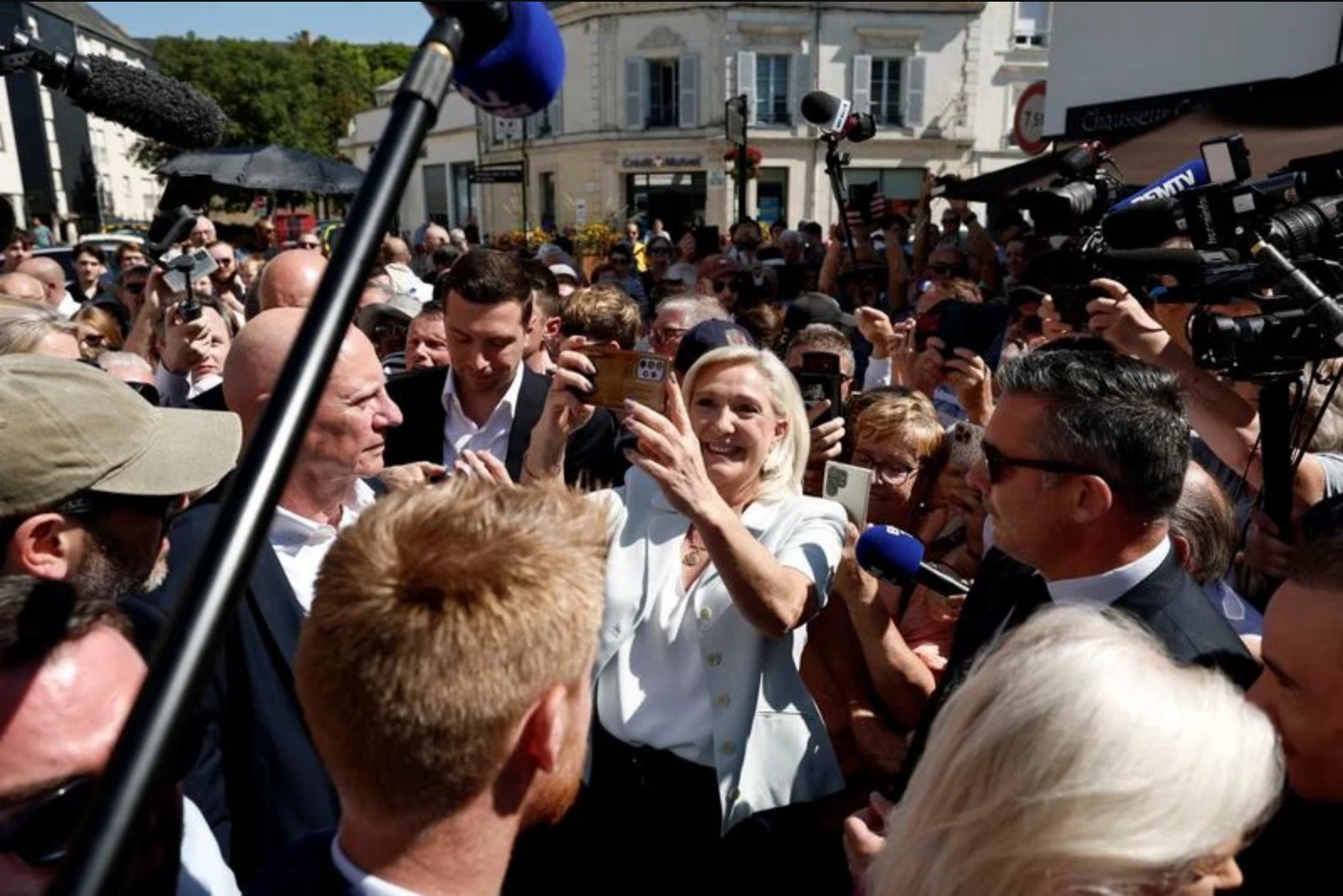
Marine Le Pen staged the opening of her presidential campaign on Wednesday in the market square of La Flèche, a small town in the Loire Valley, where supporters and opponents confronted one another in a display of divided public sentiment. The event came a day after a Paris appeals court allowed her to stand for office while upholding her conviction for embezzling European Parliament funds.
At the market, some people shouted insults such as "Give the money back!" and "Go to jail!" while others shouted "Marine, President!" as Le Pen moved through the crowd, stopping for photographs and handshakes. The mixed reception underscored the contentious environment surrounding her bid.
The appeals court on Tuesday shortened a ban that would have prevented Le Pen from running for public office, but it confirmed her March 2025 conviction for using European Parliament funds to pay staffers associated with her party. The ruling also included a requirement that she wear an electronic ankle tag for one year, a measure that would have forced her to return home from the campaign trail each night.
Le Pen filed a final appeal to France’s highest court, the Cour de Cassation, and that appeal had the immediate legal effect of suspending the ankle tag order. The suspension means the monitoring requirement will not be enforced while the higher court considers the case.
Her party, the National Rally, had been preparing for the possibility that 30-year-old Jordan Bardella would step in as its candidate. Bardella accompanied Le Pen to La Flèche on Wednesday. Le Pen told supporters that, should she reach the Elysee Palace, Bardella would serve as her prime minister.
La Flèche, a town with a history of left-wing politics, elected Romain Lemoigne, a 25-year-old National Rally mayor, in March. That contrast — a long-time left-leaning town with recent RN local success — framed the day's events and reflected the uneven regional political shifts that the campaign faces.
Le Pen, 57, who has now been a presidential contender three times, is campaigning as the leader of an anti-immigrant National Rally that recent opinion polls place ahead of its rivals. Her campaign message emphasized a focus on national sovereignty with a website launched hours earlier featuring an image of her on stage with open arms and the slogan "For France, Revival."
In La Flèche she described what she meant by revival: "the revival of education, the revival of the justice system, the revival of security for our fellow citizens, the revival of control over our borders, and the revival of our sovereignty."
Adélaïde Zulfikapasic of pollster BVA said she expected Le Pen to reach the second-round runoff of the presidential election on May 2 despite the guilty verdict, citing a loyal voter base. Zulfikapasic noted voter ambivalence: while many indicate that honesty and probity are the qualities they most want in a president, they do not always apply those preferences strictly when voting.
She added that the more critical issue for Le Pen is whether she can broaden her electoral appeal beyond her core supporters, and that the conviction could complicate efforts to expand her backing.
Officials at the Cour de Cassation have previously indicated a target of delivering their ruling in early 2027, ahead of the presidential vote. If the highest court upholds the appeals court’s judgment, the original requirement to wear an electronic ankle tag could be imposed during the final weeks or months of Le Pen’s campaign.
Contextual note: The campaign launch demonstrated both the persistence of Le Pen’s base and the legal uncertainty that will shadow her run, with immediate consequences for campaign logistics and broader questions about her ability to attract new voters.