
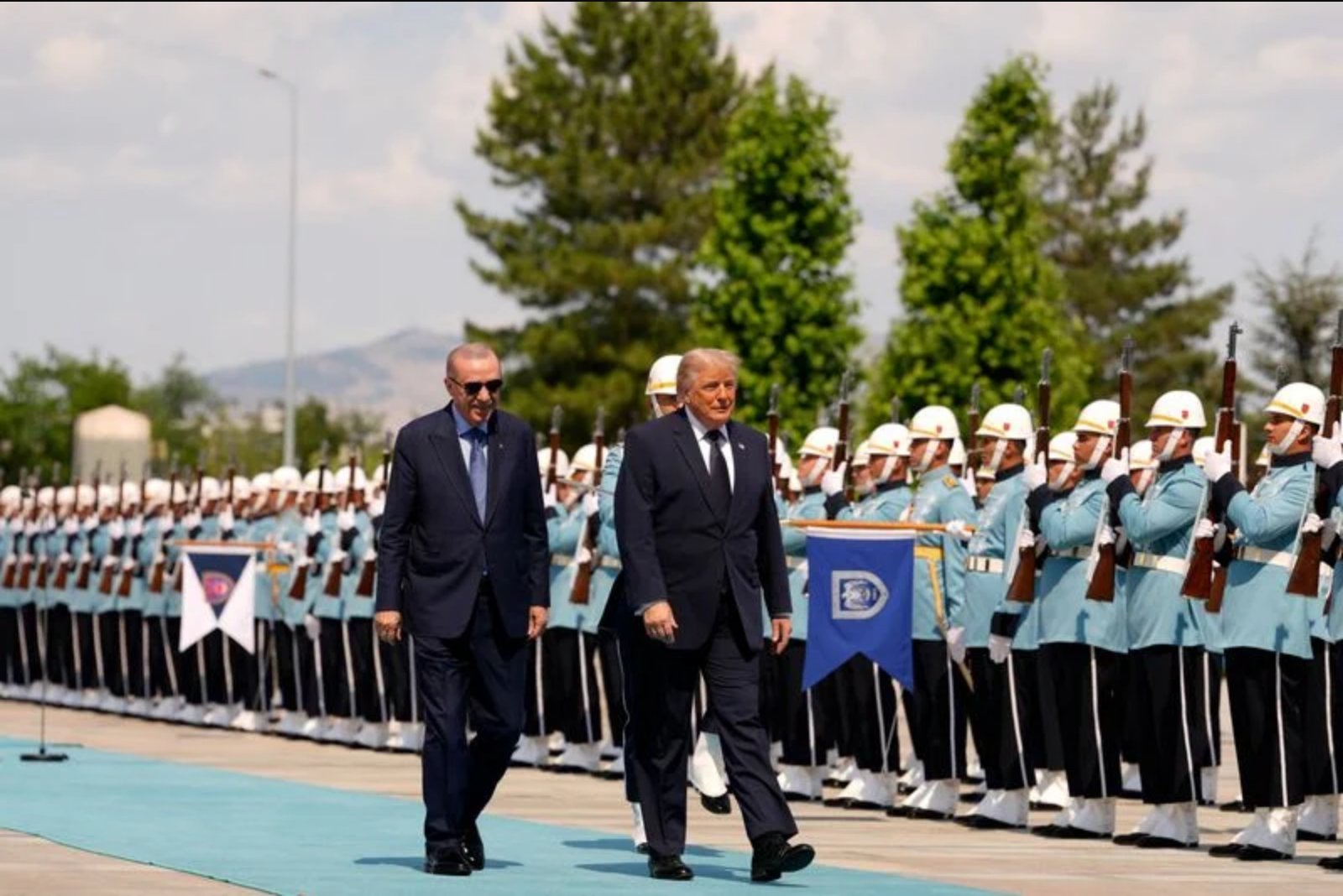
European members of NATO opened a high-stakes summit in Ankara determined to persuade U.S. President Donald Trump to reaffirm his commitment to the alliance after he revived public disputes with allies over the war in Iran and over Greenland.
Arriving in the Turkish capital on Tuesday, the president signalled continuing strains in transatlantic relations. He said he might have skipped the Ankara meeting had it not been for his personal friendship with Turkey’s President Tayyip Erdogan, and he did not rule out additional withdrawals of U.S. troops from Europe.
To demonstrate that European allies are answering calls to spend more on their own defence and to rely less on the United States, NATO unveiled a series of arms agreements on Tuesday totalling at least $50 billion. The moves were presented as evidence of European efforts to shoulder a greater share of defence burdens.
In public remarks alongside President Erdogan, Mr. Trump criticised the alliance’s recent conduct during the U.S.-Israeli war on Iran. He said he was “very disappointed” with NATO and that the U.S. was not “treated well” during the conflict. He questioned why the United States would continue to spend “hundreds of billions of dollars” while allies were not reciprocating in ways he expected.
Mr. Trump also accused some European governments of restricting access to their airspace and bases for U.S. forces during the Iran war. European officials countered that allies had largely honoured commitments to U.S. forces even if they had not been consulted about the conflict, which the officials said roiled European economies and was deeply unpopular among European publics.
The 32 NATO leaders gathered for a dinner on Tuesday evening, with the summit’s main session scheduled for Wednesday. Ambassadors from all NATO members have approved a summit declaration that affirms an “ironclad commitment” to collective defence, but the declaration will be formally issued only after leaders endorse it at the summit.
The Trump administration has pressed European governments to raise defence spending and to assume primary responsibility for the conventional defence of Europe, as the United States shifts focus toward the Indo-Pacific. In line with that strategic reorientation, the U.S. has announced troop withdrawals from Europe, reduced the forces it assigns to NATO defence plans - including cuts to an aircraft carrier, refuelling aircraft, fighter jets and drones - and launched a six-month review of its military presence on the continent.
European leaders say they are working to take on more responsibility for the continent’s security but emphasise the need for a predictable and orderly transition. They have cautioned that any abrupt gaps in defence capabilities could be exploited by Russia.
Diplomatic tensions have also surfaced between Mr. Trump and individual European leaders. In recent weeks the president has publicly criticised Italian Prime Minister Giorgia Meloni, a former close ally, saying their relationship "became a little bad because she refused to help us" with Iran while also describing her as a "nice person". Italian officials have sought to move past the exchange in recent days.
Mr. Trump additionally reiterated a claim that Greenland, a semi-autonomous territory of NATO member Denmark, should be controlled by the United States. Speaking in Ankara, Danish Prime Minister Mette Frederiksen responded hours later that she expected allies to respect the sovereignty of the Danish kingdom and to accept that Greenland was not for sale.
European officials hope that Mr. Trump’s personal regard for President Erdogan, and his reportedly good relationship with NATO Secretary General Mark Rutte, would help reduce tensions and facilitate constructive outcomes at the summit.
Summary
NATO’s European leaders are pushing to secure a recommitment from President Trump at the Ankara summit after he publicly criticised the alliance’s conduct during the U.S.-Israeli war on Iran and raised territorial claims over Greenland. NATO unveiled at least $50 billion in arms deals to show European defence spending increases while the U.S. continues to adjust its troop posture in Europe and reduce forces assigned to NATO defence plans.
Key points
- At least $50 billion in arms deals were unveiled to signal European members are increasing defence spending and reducing reliance on the U.S.
- The United States has announced troop withdrawals, cuts to assets assigned to NATO defence plans - including an aircraft carrier, refuelling aircraft, fighter jets and drones - and begun a six-month review of its military presence in Europe.
- Ambassadors have approved a summit declaration affirming an "ironclad commitment" to collective defence, which must still be endorsed and issued by leaders at the summit.
Risks and uncertainties
- Potential for additional U.S. troop withdrawals from Europe could create operational gaps - a risk to defence and security sectors and to countries’ military readiness.
- Disputes over access to airspace and bases during the Iran war highlight uncertainty in military logistics and cooperation, affecting defence planning and forward basing arrangements.
- Political frictions among leaders - including public spats between the U.S. president and European heads of government and disagreements over territorial claims such as Greenland - may impede consensus on collective security and complicate defence procurement and market confidence.