
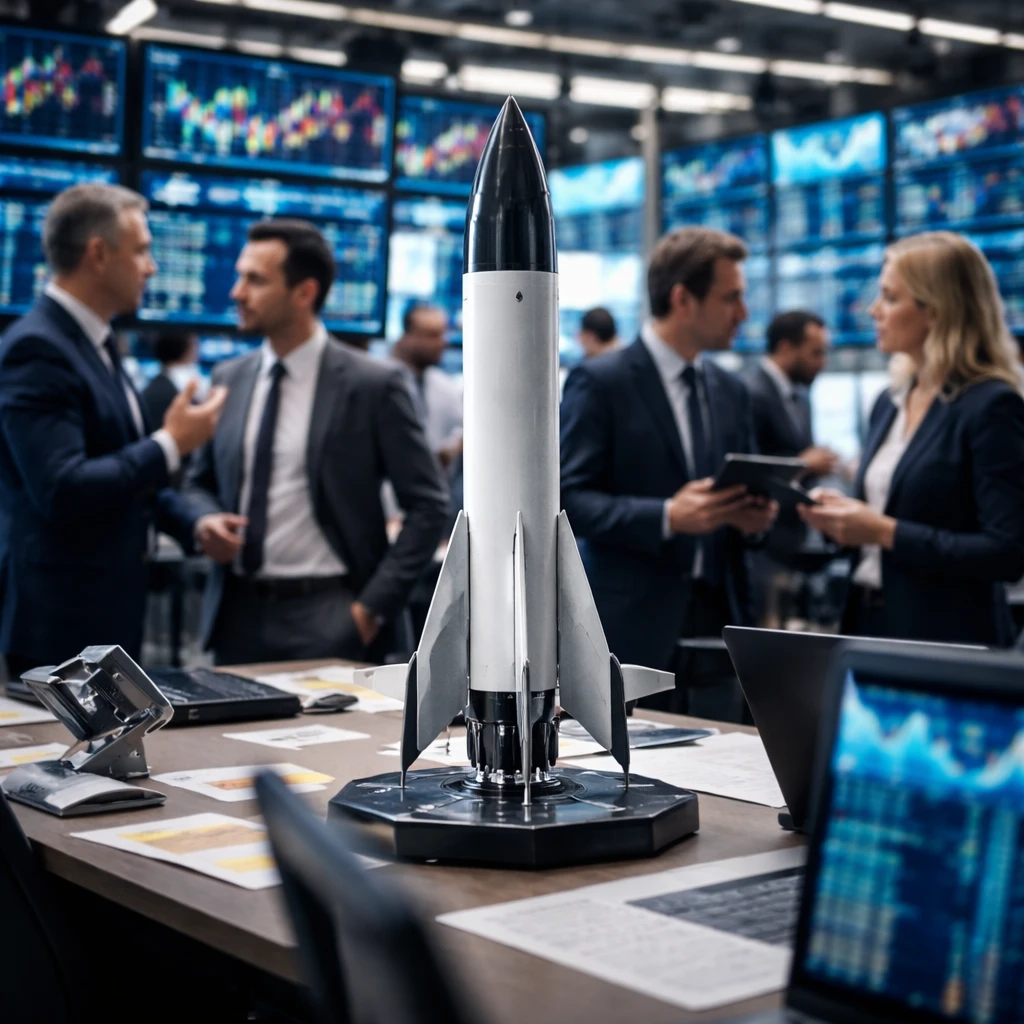
SpaceX's recent initial public offering has stirred a fresh debate on Wall Street about the shorthand used to describe the market's largest technology leaders. The IPO - the largest in U.S. history - pushed SpaceX's valuation beyond $2 trillion, placing it ahead of two companies traditionally counted among the market's top seven: Tesla and Meta Platforms.
The arrival of a new, multitrillion-dollar contender has led market participants and strategists to question whether the "Magnificent Seven" label still fits. That group has become a common way to refer to a set of heavyweight technology-related stocks, but the addition of SpaceX to the universe of the very largest companies complicates the label's usefulness as a tidy shorthand.
"It becomes very hard to keep using Mag 7 as the clean shorthand for market leadership because one of the most important companies in the world would immediately be outside the label," said Shay Boloor, chief market strategist at Futurum Equities.
Market nicknames like this are informal categories invented by strategists, investors and the media to capture which big stocks are leading at a given moment. Their lineage stretches back decades through other popular groupings, and they evolve as the composition of market leadership shifts.
Nearly immediately after SpaceX's IPO, investors and social media users began proposing new acronyms. One that has gained attention on X is "MANGOS," which expands the set to Meta, Anthropic, Nvidia, Alphabet, OpenAI and SpaceX. Interpretations of the letters vary - for instance, some read the "A" as Apple rather than Anthropic - showing there is no standardized replacement yet.
Asset managers and ETF strategists have been among those experimenting with new labels. "We are already referring to it internally and the industry is picking up on it as well," said Aga Kuplinska, senior vice president of product development at Tidal Financial Group, which assists asset managers with ETF launches. Other practitioners prefer different formulations: Dan Boardman-Weston, CEO at BRI Wealth Management, has suggested the name "Magna Atoms" to encompass the Magnificent Seven together with SpaceX, OpenAI and Anthropic.
The "Magnificent Seven" phrase itself was coined late in 2023 by Michael Hartnett, then chief investment strategist at BofA Global Research, to describe a group that included Nvidia, Apple, Amazon, Alphabet, Meta, Tesla and Microsoft. As markets have been buoyed by interest in artificial intelligence, the roster of leading stocks has shown signs of change, and new trillion-dollar companies have started to reshape the leaderboard.
Reflecting that recent shift, a BofA note published on May 22 used the phrase "AI Big 10," expanding the original seven to add Broadcom, Micron Technology and Advanced Micro Devices. According to LSEG data cited in market discussions, that expanded group now represents more than 40% of the S&P 500's weight.
The evolution of labels is not new - earlier waves saw the progression from FANG to FAANG and then to the Magnificent Seven, each iteration tracking which firms were at the center of market attention. The shifts have followed changes in sector leadership and market capitalization rather than any firm rule about which names qualify.
Some market professionals believe the longstanding label will endure even as new terminology emerges. "The Magnificent Seven label is not going away," said Dave Mazza, CEO of Roundhill Investments. "It is too embedded in how investors and the media view large-cap tech leadership. What you will likely see is additive terminology rather than replacement." Others welcome a fresh handle. "It’s been Mag 7 for several years now. Maybe the markets are excited for something new," said Dustin Thackeray, chief investment officer at Crewe Advisors.
What names eventually stick will likely depend on how many of the newly public or soon-to-be-public companies sustain multitrillion-dollar valuations and how the market narrative around AI and cloud-enabled platforms continues to evolve. For now, market participants are using a mix of inventive acronyms and expanded sets when discussing leadership among the largest tech and AI-related firms.
Contextual note - The discussion around these labels reflects shifting market capitalizations and investor attention among large-cap technology and AI-focused firms. With higher valuations entering the group, the shorthand used by investors and the media is actively being reconsidered.