
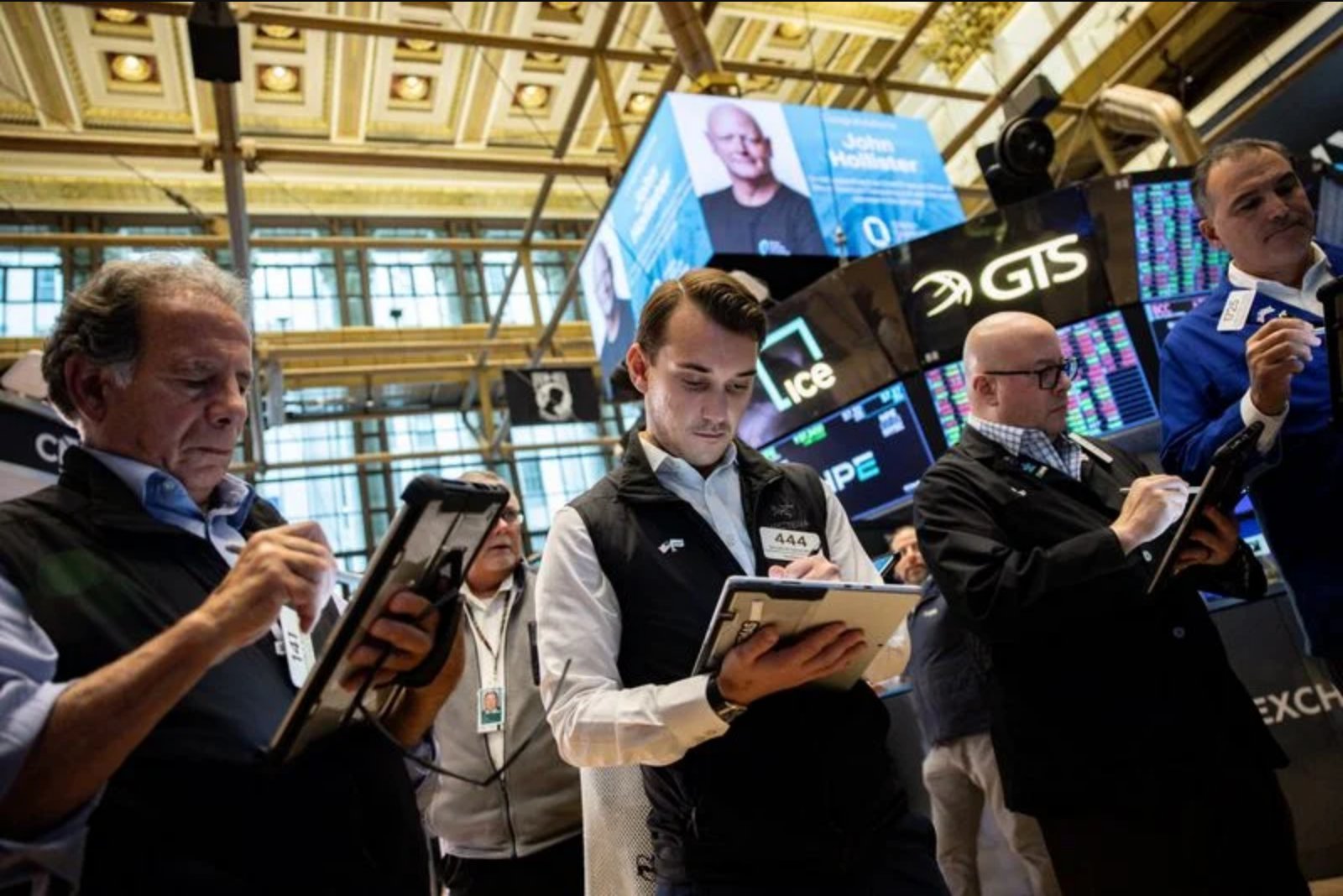
Warnings that machine-driven technology poses an existential threat to humanity opened market conversations at the start of the week, but investor attention rapidly moved to immediate macroeconomic and energy concerns. Leaders of major U.S. AI companies publicly urged restraint in accelerating model capabilities, while monetary policy actions and Middle East supply disruptions tested risk appetite across global markets.
In an extended essay published last weekend, Anthropic chief executive Dario Amodei argued that developers should slow the rate at which they improve AI model capabilities. The message - that progress will still appear rapid even if development is deliberately tempered - found public endorsements from other high-profile AI executives. Elon Musk, who runs xAI, and Sam Altman, CEO of OpenAI, said they agreed with Amodei's call for greater caution.
Political leaders reacted differently. The U.S. president wrote on Truth Social on Monday that the only guardrails AI needs are provided by a "STRONG AND SMART (High IQ!) PRESIDENT," and warned that China would benefit from any U.S. slowdown in AI progress. A state-backed Chinese newspaper editorial framed the move by U.S. AI executives as part of a "Cold War playbook" aimed at curbing China's technological rise. That divergence in public positions is likely to feature in an upcoming meeting between the U.S. president and China's leader in Washington next week.
How credible the apocalyptic predictions are remains unresolved, and it is unclear whether caution from AI companies will translate into any meaningful slowing of development or reduced spending on the technology. If the risks are as severe as some industry leaders suggest, there appears to be an obvious tension: governments and corporations face strong incentives to continue competing for technological primacy despite safety concerns. For markets, the immediate effect of the debate was nervousness in equity trading early in the week, as investors weighed the possibility that a deceleration in AI investment could dent growth expectations.
By midweek, the market's focal point had shifted to monetary policy. The Federal Reserve raised its policy rate by 25 basis points to a 3.75%-4.00% target range on Wednesday and indicated that additional hikes may still be on the table. While the increase itself had been broadly anticipated, the decision was unanimous and the forward guidance was marginally more hawkish than many had expected, particularly given prior uncertainties about the resolve of Fed leadership to tighten policy amid political objections from the White House.
The U.S. president criticized the move on social media, arguing that interest rates should be "1%, or less," on the basis of the United States being the world's best credit. He did not single out the Fed chair by name in public remarks, instead attributing the action to the board and calling it "very hostile" and "very political." Investors appeared to interpret the Fed's message positively: yields on the short end of the curve rose while longer-term yields edged down, which market participants interpreted as a sign of increased confidence in the Fed's ability to tame inflation.
Energy markets provided a tangible reminder of inflationary pressure that policy alone cannot quickly fix. Crude oil spiked early in the week after Saudi Arabia temporarily suspended crude loadings at its Red Sea port of Yanbu. That development, combined with a recent temporary shutdown of the Kingdom's East-West pipeline following a drone strike from Baghdad - an area where Iranian-backed militias operate - pushed Brent crude prices near $109 per barrel on Monday and Tuesday. The East-West pipeline has been an important route allowing Saudi exports to be redirected through the Red Sea and the Bab el-Mandeb Strait as a workaround to the Strait of Hormuz during the current conflict.
Meanwhile, Yemen's Iran-aligned Houthi movement has tightened control over Bab el-Mandeb and stepped up strikes on Saudi facilities, widening the geographic footprint of risk to global shipping and refining operations. By midweek, Brent had eased, trading as low as $102 per barrel by early Friday after reports that Saudi Arabia was seeking to maintain flows by boosting loadings off Oman. U.S. Energy Department commentary also suggested the East-West pipeline might be restored sooner than initially thought. Those developments provided some relief to markets, but did not change the underlying reality: the conflict has grown beyond a brief disruption and has become an ongoing and unpredictable strain on global energy supply.
The refined products market underscored the persistent supply stress. Diesel prices in the United States remained above $6 per gallon after crossing that threshold for the first time the prior week. In an effort to blunt pressure on diesel markets, the U.S. president publicly asserted that he had negotiated an agreement for Russia and Ukraine to stop attacking each other's energy infrastructure, but neither side appeared to be complying. Even if such a truce were to take effect, the extent of damage to refining systems means it could take years before capacity recovers to pre-conflict levels.
Central bank reaction outside the United States reflected parallel concerns. The Bank of England maintained its bank rate at 3.75% and signalled that further hikes would be more likely if energy price volatility persisted. The Bank of Japan raised its interest rate on Friday to 1.25%, the highest in 31 years. The BOJ move was widely expected, but two members dissented and guidance on future tightening was described as vague, contributing to investor unease. The yen slipped to levels above 157 per dollar following the meeting, reflecting market nervousness about the clarity of the BOJ's path.
Looking ahead, geopolitics will remain a focal point for markets, with the United Nations General Assembly meeting in New York and the U.S.-China state visit by China's leader on the calendar next week. Those gatherings are likely to keep traders and policymakers attuned to developments that could influence supply chains, trade flows, and broader economic cooperation or competition.
Questions under active discussion among market analysts this week reflect the breadth of concerns weighing on investors and policymakers. Observers are probing a wide range of topics that tie together fiscal sustainability, monetary policy history, shipping costs, critical minerals supply, yield curve signals, strategic energy reserves, the potential implications of proposed fiscal measures, Europe-U.S. energy relations, the AI investment debate, shifts in household finance, and discounting patterns in crude markets. Specific queries being raised include:
- Can U.S. democracy survive the country's debt tipping point?
- How has the 10-year Treasury yield behaved during earlier tightening cycles?
- Are we witnessing the start of a historic spike in global shipping prices?
- What is constraining Europe's progress in securing critical minerals?
- What warning is the U.S. yield curve currently sending?
- Is China drawing down its strategic oil reserves?
- What will Fed leadership do if proposed $5,000 payments are implemented?
- In what ways is China assisting Europe with liquefied natural gas needs?
- Do AI optimists still hold the stronger argument in debates over an AI bubble?
- What has replaced real estate as the primary source of household liquidity in the U.S.?
- Which barrels of crude are being sold at steep discounts?
- What essential reforms must the EU adopt to remain competitive in AI?
- How could a prospective "Super El Nino" affect European gas demand?
Markets that are particularly sensitive to the confluence of these developments include energy, where crude and refined product pricing remains directly exposed to supply interruptions; financials and fixed income, where central bank decisions and forward guidance shape yield curve dynamics; and technology sectors linked to AI, where investment momentum could be influenced by both corporate caution and government policy. Logistics and shipping sectors are also implicated, given the potential for rising maritime and freight costs as regional conflicts impinge on major trade routes.
For now, the anticipated existential risk from AI has been relegated to a longer-term debate in the minds of most investors, while immediate pressures from energy market dislocations and central bank tightening dominate trading floors. The trajectory of each of these elements - AI development pace, conflict-related energy disruptions, and monetary policy paths - will continue to interact and contribute to market volatility in the near term.
Feedback and correspondence are welcome.