
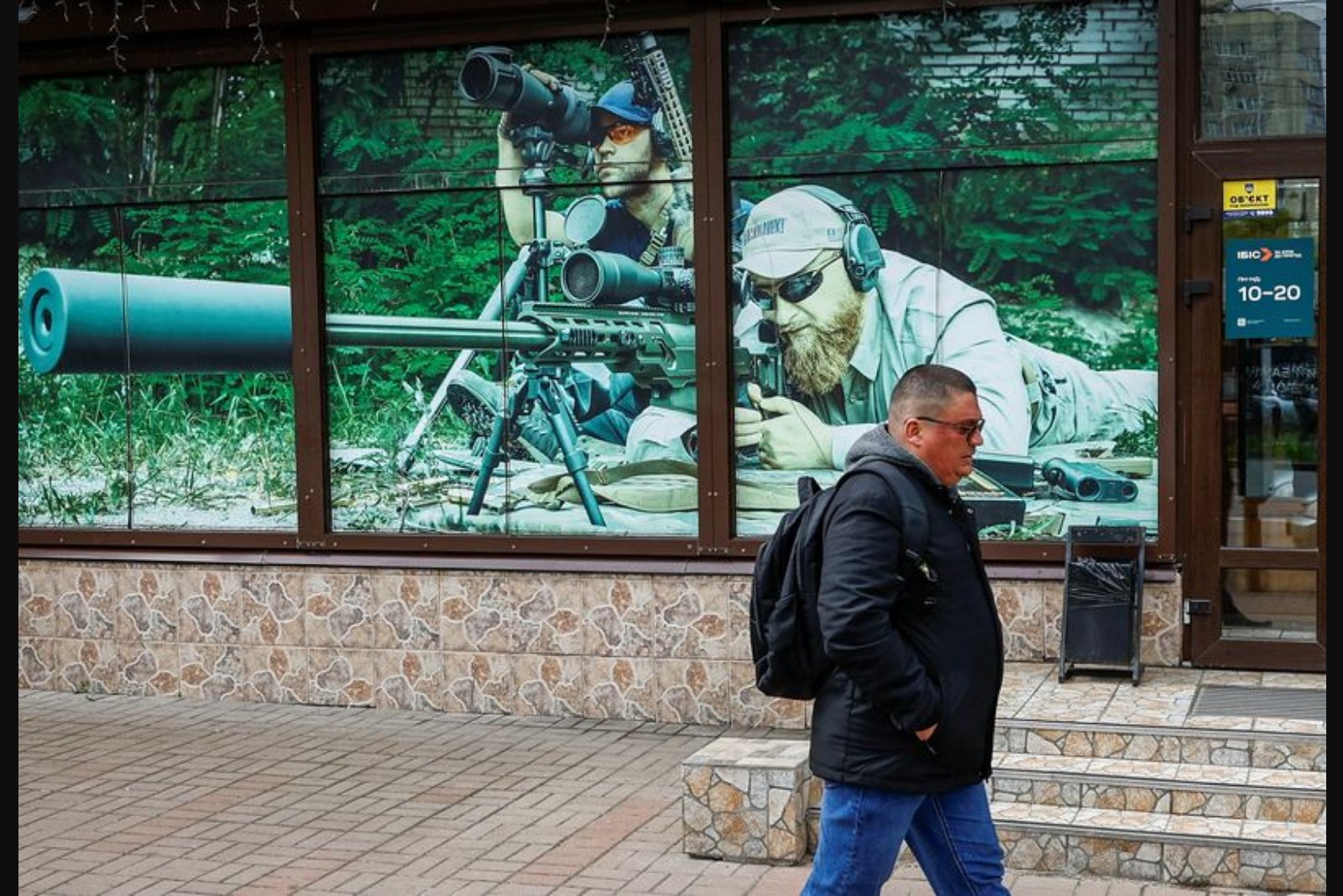
KYIV, April 21 - A deadly attack at a Kyiv supermarket over the weekend, in which a gunman took hostages and killed seven people, has sharpened an already heated national debate about whether civilians should be allowed to own and carry handguns for self-defence. The violence prompted intense reaction on social media, with many Ukrainians demanding the right to bear arms as a means of protection and others urging caution and alarm.
Hours after the attack, Maksym Zhorin, Deputy Commander of the 3rd Army Corps, posted on the Telegram app that "If the people who encountered the terrorist today had been armed, there wouldn’t have been so many victims." He added, "Legalising handguns is the only correct conclusion to draw from this tragic event."
Under current Ukrainian law, civilians are not permitted to carry firearms, and the country lacks a comprehensive legal framework for armed self-defence. That prohibition sits awkwardly alongside wartime realities: after Russia launched its full-scale invasion in 2022, authorities distributed weapons to civilians to help repel the invasion on the condition that those weapons would be returned when the conflict ends. Those distributions, and millions of weapons used in the fighting, have left significant numbers of firearms in circulation.
Legislative movement on the issue predates the supermarket shooting. A draft law on civilian firearm circulation, which passed its first reading in 2022, is being revived in parliamentary discussions. Ihor Fris, a co-author of that draft from the ruling Servant of the People party, told Reuters that lawmakers, the interior ministry, and subject-matter experts will meet to prepare the bill for a second reading in the near future. Fris argued that while criminals will find ways to obtain weapons regardless of the law, ordinary civilians currently lack legal means to defend themselves.
"In my view, today we could allow Ukrainians to own short-barrelled firearms - weapons for self-defence at home," Fris said, qualifying that any approved law should come into force a year after being passed to allow for implementation. He has proposed a tightly controlled system of checks for gun permit applicants and the creation of gun schools modeled on licensed driving academies to reduce risks. Fris also said it is critical to amend the criminal code to clearly define the rights and limits of self-defence as part of the transition.
Interior Minister Ihor Klymenko, under pressure over how police handled the supermarket attack, has publicly expressed support for the measure. "I believe that people should have the right to armed self-defence," Klymenko said, signaling alignment between elements of the executive branch and lawmakers pushing for reform.
Public attitudes toward liberalisation of gun rights have shifted since the onset of the war. The largest survey to date, conducted by the state in mid-2022, found that 59% of respondents supported the right to carry a handgun in public, while 22% were categorically opposed. The state poll included responses from more than 1.7 million people, with an additional 19% saying they support gun rights but not carrying them in public.
Yet not all citizens agree with easing restrictions. "I’m actually very much against the call for firearms for people," said Daryna, a 31-year-old resident of Holosiivskyi district, the area where the shooting occurred. "Because we see what’s happening in the U.S. Firearms are allowed there and there are many more such situations there." Her view underscores wider anxieties about potential consequences if guns become more commonplace.
Those concerns are echoed by several lawmakers and commentators who highlight both recent trends in weapons-related incidents and gaps in the legal and institutional environment. According to interior ministry statistics cited in recent reporting, Ukraine recorded 273 cases of weapons-related violence in 2021, including incidents and accidents with explosives. By 2023, that figure had risen to over 11,000. Opponents of liberalisation argue that these increases raise questions about whether expanding access to firearms will reduce or increase harm during violent incidents.
Roman Kostenko, a member of the parliamentary defence and security committee from the Holos party with battlefield experience, said many advocates for broader access to guns do not understand the legal and practical complexities of armed self-defence. "I see many arguments in favour from people who have never been in a situation where they had to decide whether to use one, let alone actually use one and understand the consequences," Kostenko said. He added that Ukraine’s legal system is ill-suited to adjudicate cases of armed self-defence under present arrangements.
Other opponents point to the risk that wider legal access to firearms would make weapons more available to those intent on causing harm. Inna Sovsun, another lawmaker from Holos, noted that the Kyiv shooter had a registered weapon, saying: "The system has given a weapon to this man. Why do we assume that, in the future, only good people will be given arms to protect us from the bad ones?"
Proponents counter that a tightly regulated rollout, including rigorous vetting and mandatory training, could mitigate such risks. Fris has recommended a transition period of at least one year to establish permit procedures, training infrastructure, and checks on applicants before any law would take effect.
The scale of firearms already in the population complicates the debate. Heorhiy Uchaykin, chair of the Ukrainian Gun Owners’ Association, told Reuters that Ukrainians may hold up to 7 million undeclared small arms. Uchaykin, who has long lobbied for the right to carry handguns, framed the issue as a constitutional matter: "If the constitution guarantees me the right to defend my own life, I must have the means to do so." He also criticised local police performance during the supermarket shooting, pointing to video of officers fleeing the scene, which prompted the resignation of a police chief and the opening of criminal investigations.
Despite vocal support from some quarters, many lawmakers remain cautious about moving quickly. "We must not legalise guns based on emotions after tragedies," warned Olha Vasylevska-Smahliuk, a lawmaker from the ruling party, reflecting a broader hesitation in the legislature to adopt rapid policy changes in response to a single event.
As discussions move forward, lawmakers, the interior ministry, and legal experts face a policy choice between formalising a right to armed self-defence under strict regulations or maintaining a restrictive approach while attempting to address public safety through other means. The supermarket attack has intensified pressure on policymakers to find solutions that reconcile public demand for protection with concerns about public safety and institutional capacity.
Any pathway to legalisation envisioned by supporters would require not only new statutes governing firearm circulation and carrying but also an overhaul of criminal code provisions related to self-defence, the establishment of licensing and training infrastructure, and robust enforcement mechanisms. Opponents stress that even with such measures, the presence of millions of undeclared weapons and the psychological toll of prolonged warfare, including post-traumatic stress, create heightened risks if access to handguns is expanded widely.
The debate now centres on whether Ukraine can design and implement a tightly controlled, evidence-based regime for civilian handguns that addresses vetting, training, and legal clarity - and whether such a system can be built in a country still coping with large-scale conflict and institutional strain. Lawmakers and ministries say they will engage in further discussions in the near term, but there is no final decision and multiple unresolved questions remain about timing, scope, and safeguards.