
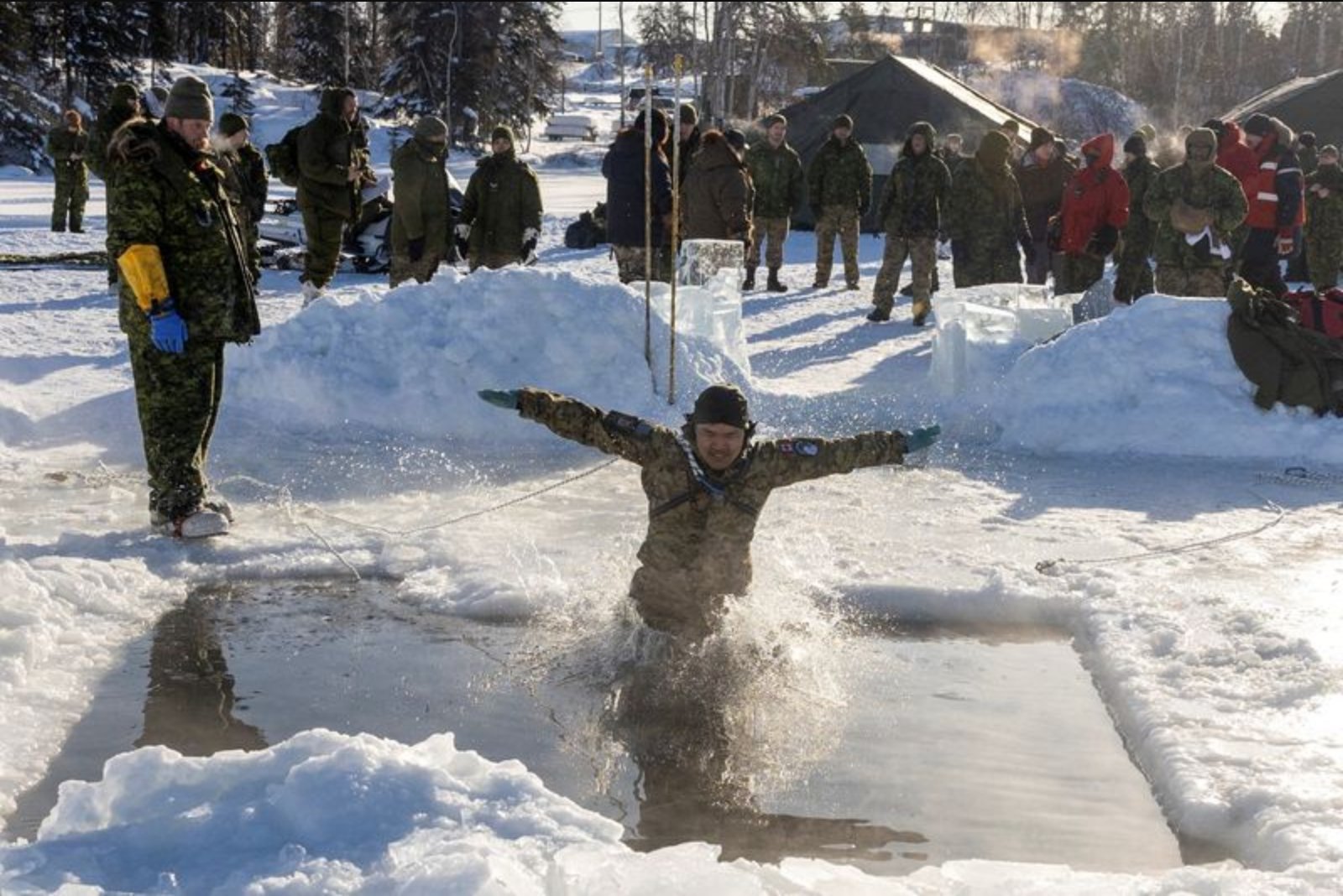
Over a period of three months this winter, members of the Canadian Armed Forces undertook an arduous snowmobile patrol that covered more than 5,000 kilometres, moving from Inuvik in the Northwest Territories to Churchill in Manitoba. The campaign took place under extreme Arctic conditions, with participants confronting blinding blizzards and thermometer readings reported as low as minus 60 degrees Celsius. The operation formed part of a suite of military exercises meant both to rehearse responses to a potential foreign threat and to demonstrate that Canada intends to be able to defend its Arctic region largely on its own.
Commanders and participants described the patrol and concurrent activities as tests of endurance, logistics and the armed forces' capacity to move men and materiel through some of the most inhospitable terrain on Earth. "There are Canadians up here defending (the country) at all times of the day," said Travis Hanes, a commanding officer with the 1st Canadian Ranger Patrol Group, a reserve unit of the Canadian Armed Forces. Hanes, speaking while recuperating from frostbite to his nose after weeks on the snowmobile route, said Rangers are pushing the limits of what is possible in a landscape defined by ice, cold and whiteout conditions.
For Hanes and many who serve in the region, the notion that a foreign power could take control of Canadian territory in the north is difficult to comprehend. "We are the landowners and it’s hard to see how someone thinks it could be taken away," he said. That sentiment reflects a belief among many on the ground that sovereignty over the vast region is secure by virtue of the presence and persistence of Canadian forces and communities.
Exercises and scale
The recent operations involved roughly 1,300 personnel from the Canadian Armed Forces. Participants conducted patrols on skis, practised landing aircraft on frozen expanses of the Arctic Ocean and moved artillery to Cambridge Bay, Nunavut, reaching the most northerly point the exercise has ever visited. Organizers said this was the largest deployment of Canadian forces in the exercise series since it began in 2007. The long-range snowmobile patrol concluded in Churchill, Manitoba, last week.
A small contingent of observers and participants from other countries - including the United States, Greenland, Belgium and France - attended or monitored aspects of the training, though officials described the operation as overwhelmingly Canadian in composition and leadership.
Political backdrop and a pledge of responsibility
The exercises occurred in a political atmosphere that participants and officials say has shifted in recent years. The article referenced statements by U.S. President Donald Trump - including repeated comments about making Canada an American state, proposals to take control of Greenland and publicly voiced threats to withdraw from NATO - as factors that have prompted Canadians to reassess the extent of their reliance on the United States for northern defence.
Against that backdrop, the prime minister, named in official communications as Mark Carney, presented a plan last month that detailed how Ottawa would allocate C$35 billion to strengthen military capabilities in the far north. In announcing the plan, he said Canada was taking "full responsibility" for its Arctic sovereignty and declared that "We will no longer depend on any one nation." The government has framed increased spending and the recent exercises as steps toward ensuring the country can protect its territory without external aid, while officials have not provided a specific timeline for achieving complete self-reliance.
Officials’ perspectives and continued partnerships
In interviews with military leaders, government ministers, diplomats, analysts and serving personnel during a multi-day visit to the Arctic, officials emphasized that while Ottawa has committed to greater autonomy, the deep institutional ties between Canada and the United States remain intact. Canada’s foreign affairs minister, Anita Anand, told officials that the government is moving as quickly as feasible to enable Ottawa to assume full responsibility for defending its Arctic, but she declined to give a firm timeline. She said the most serious threat to Canada comes from the expansion of Russian infrastructure further north toward the Arctic Circle, and described the wider geopolitical environment as "much more volatile." At the same time, she said cooperation with the United States through NORAD remains "fundamental."
A senior White House official, responding by email, said the United States and its allies will continue to work to ensure the Arctic remains "free and open for peaceful purposes" and that Washington "welcomes Canada’s efforts to take responsibility for securing its own territory." The Russian foreign ministry has repeatedly said Moscow seeks to preserve peace and stability in the Arctic and has criticized Western states for turning the region into an arena of geopolitical competition, a critique voiced publicly by a ministry spokeswoman in March.
Capabilities and gaps
Observers and military leaders interviewed in the Arctic stressed that geography, vast distances and limited infrastructure present enormous challenges to monitoring and defending the territory. Whitney Lackenbauer, an Arctic specialist at Trent University, said neither Canada nor the United States possesses on its own the capability to keep comprehensive watch over the roughly 4 million square kilometres that make up the Canadian Arctic, a region that also includes more than 36,000 islands.
Brigadier-General Daniel Riviere, commander of Canada’s Joint Task Force North, said this year’s exercises demonstrated the armed forces’ capacity to transport specialized weapons and equipment to remote northern locations in the unlikely event of a land-based attack. "We need to be prepared for the worst," he told officials from his base in Yellowknife, where Canada’s Arctic defence command is headquartered. That said, Riviere underlined the importance of the Canadian-American military relationship, saying Canadian troops stand "shoulder to shoulder" with U.S. forces.
On the maritime front, the Canadian Coast Guard reports a stronger Canadian presence in Arctic waters compared with the United States. Neil O’Rourke, Director General for Fleet and Maritime Services at the Coast Guard, noted that Canadian icebreakers regularly escort U.S. ships traveling into the Arctic and that Canada maintains the world’s second-largest icebreaker fleet, after Russia. Yet in other domains Canada still lags behind needs.
Across northern Canada there are 47 radar sites that make up the North Warning System, a chain of detection installations stretching from the western Yukon to Labrador. Former northern commander Pierre Leblanc called the network increasingly obsolete and raised doubts about whether Canada could mount an independent response should those sites detect a significant threat. The system is remotely monitored by NORAD and the Canadian military but is managed by a private Canadian firm, Nasittuq, which received a C$592 million government contract in 2022 to operate and sustain the network. In communications, Nasittuq described the radar network as "a legacy system" that is "aging and limited against modern threats."
At Cambridge Bay, which also functions as a logistics hub, there was no permanent military staff on site at the radar location, but visitors could find a gift shop selling branded merchandise connected to the radar system.
Interdependence and strategic reliance
Several analysts and former officials stressed that Canada and the United States remain mutually dependent in the Arctic. Troy Bouffard, a former Arctic adviser to a U.S. senator from Alaska, said Washington relies on Canadian sources for intelligence about potential threats in the far north and that Canada's geography provides a buffer between the United States and other global powers such as Russia, China and Iran. Much of the Arctic’s airfield and radar infrastructure was originally conceived, financed and built by the United States during the Cold War, a legacy that contributes to the enduring interdependence between the two countries.
Following years of underinvestment in northern defences and public complaints from former President Trump, Canada reached the NATO guideline of spending 2 percent of GDP on defence last year, a development Ottawa links to its broader effort to upgrade capabilities in the Arctic.
Encounters and operational realities
Officials described recent operational incidents that illustrate the security environment in the high north. Kevin Knight, head of intelligence for Canada’s Joint Task Force North, said that last month NORAD scrambled about six Canadian and U.S. fighters to intercept two Russian aircraft that came very close to entering Canadian airspace. Knight noted the incident for how near the aircraft approached Canadian territory, underscoring the sensitivity of monitoring and responding to incursions in remote parts of the Arctic.
Major Matt Wookey, a Royal Canadian Air Force pilot who practised landing a Twin Otter aircraft on frozen sea ice as part of the exercises, described flying in the Arctic as a demanding and unique challenge. "Everything is just snow and drifts, and it all looks the same, even the shoreline," he said. "Nothing is built to properly function when the thermometer goes below minus 40, including humans." His remarks emphasized the physical difficulties of operating aircraft, maintaining situational awareness and supporting personnel in such extreme conditions.
Scope and implications
The scale of the recent exercises, the allocation of C$35 billion for Arctic defence upgrades and the public statements by political leaders highlight Ottawa's intent to take on more responsibility for its northern security. At the same time, defence officials and experts who spoke with government representatives in the Arctic stressed that significant capability gaps persist and that close Canadian-American cooperation remains a central pillar of continental defence.
Even as Ottawa seeks to demonstrate greater self-sufficiency, the record of shared infrastructure, ongoing operational cooperation and the practical need for allied intelligence and logistics suggest that Canada and the United States will continue to work together closely in the Arctic. Officials say the challenge is not only to deploy forces in short-term exercises but to sustain presence, monitoring and logistics across an area that is vast, remote and seasonally hostile to people, platforms and equipment.
For the Rangers and others who took part in the patrol, the training was both a test of capability and a reaffirmation of commitment. They return with experience gained under extreme conditions and with a clearer sense of the limits and possibilities of Canada operating independently in the north. How quickly Ottawa can translate training, spending and political resolve into a fully autonomous defence posture remains an open question acknowledged by officials and experts alike.