
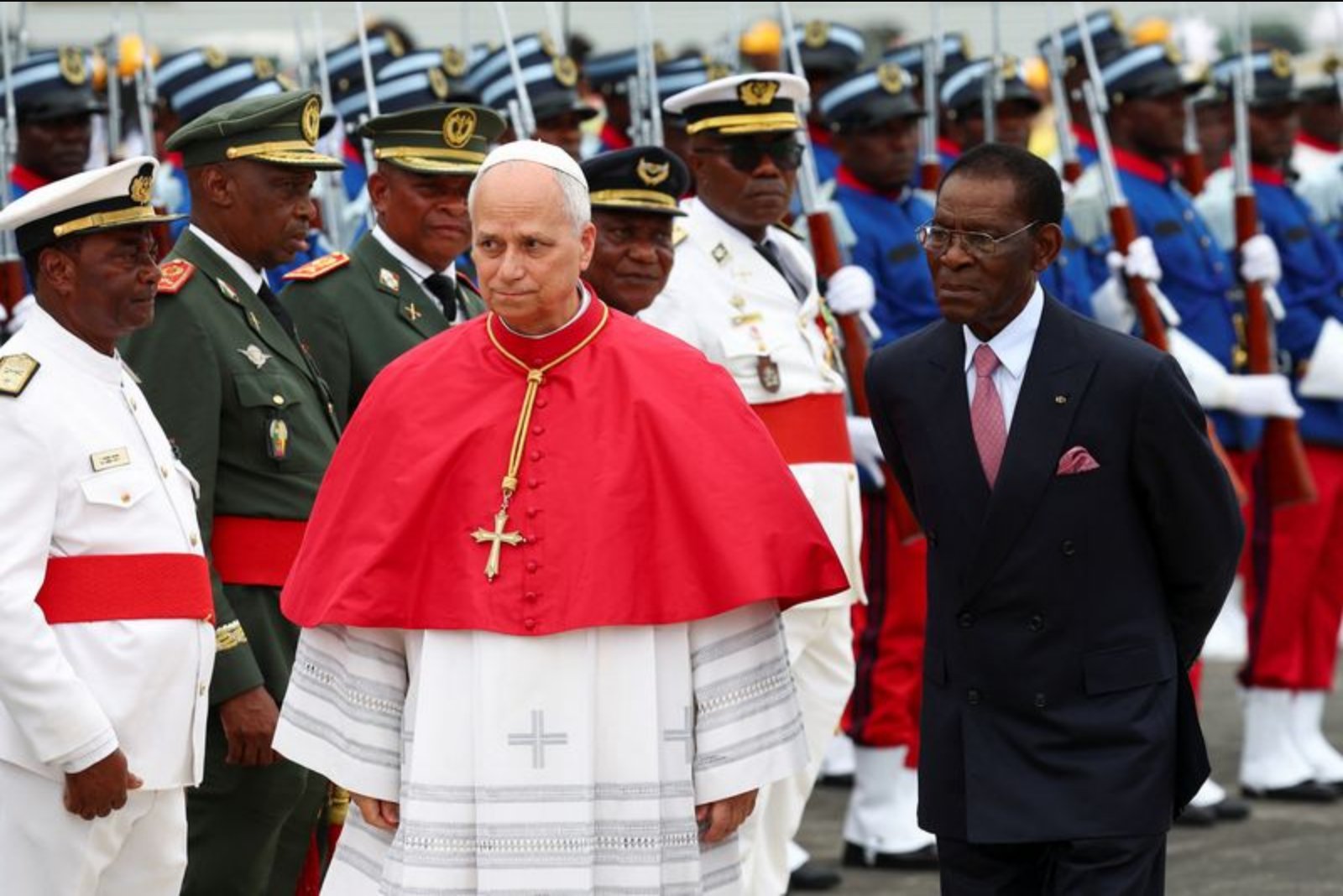
Pope Leo arrived in Malabo on Tuesday to begin a two-day visit to Equatorial Guinea, the final country on a four-nation African itinerary during which he has issued pointed criticisms of despotism and widening inequality. He flew in from Angola, where on Monday he said many people worldwide were being "exploited by authoritarians and defrauded by the rich."
On the flight between Angola and the island of Bioko, where Malabo is located, the pope paid tribute to his predecessor, Pope Francis, who died one year ago today. Leo is scheduled to meet President Teodoro Obiang Nguema Mbasogo and afterward address political leaders.
Obiang has governed Equatorial Guinea since 1979, a tenure that predates by three years the country's only other papal visit, by Pope John Paul II in 1982. The nation of about 1.8 million people counts more than 70% of its population as Catholic, underscoring the significance of the pontiff's visit.
Human rights lawyer and activist Tutu Alicante, who is U.S.-based and from Equatorial Guinea, said the pope's arrival "presents a profound opportunity to affirm, clearly and convincingly, that human dignity, justice, and accountability are not optional, but essential responsibilities of governance."
The pope's schedule in Equatorial Guinea will include several high-profile stops. In Bata, Leo will visit a high-security detention centre identified by Amnesty International as one of three facilities where detainees, including political prisoners, are often held for years without access to lawyers or family. The government has rejected external criticism of its justice system and asserts it operates an open democracy.
Authorities have prepared some sites for his arrival. Alicante noted improvements at certain facilities ahead of the visit but emphasized that cosmetic changes are insufficient. "The real test will be whether humane conditions, access to medical care, and basic rights are sustained long after the papal visit concludes," he said.
Also in Bata, the pope will pray at the location where a series of explosions at a military barracks in 2021 led to the deaths of more than 100 people. The government attributed the catastrophe to poor ordnance storage, while human rights activists have repeatedly called for an independent investigation into the incident, a demand that has not been met.
Equatorial Guinea's recent economic history is tied to an oil boom that began in the 1990s and has since waned. Observers and critics have frequently labeled President Obiang one of the region's most repressive leaders, allegations he rejects, including claims of human rights abuses and corruption.
Pope Leo's background as a missionary in Peru and his expected use of Spanish during the visit reflect personal and linguistic ties that will shape his engagements in the former Portuguese and Spanish colony. His remarks in Angola and his broader rhetorical approach on this Africa tour have been notably more forceful than in some previous papal trips, prompting reactions abroad, including drawing the ire of President Donald Trump.
The visit to Equatorial Guinea is part of an expansive 10-day Africa tour that spans nearly 18,000 km (11,185 miles) and encompasses 11 cities and towns across four countries. The itinerary requires 18 flights. Organizers expect Wednesday to be the most demanding day of the tour, when the pope will take three flights to reach three different cities in Equatorial Guinea.
The trip's concentrated schedule and the selection of stops - including a notorious detention facility and the site of a deadly military explosion - signal priorities that include drawing attention to human dignity and the need for accountability. Yet the government's dismissal of outside critiques and its insistence on democratic openness underscore the tensions that accompany high-profile international visits.
Contextual notes - The pope's statements in Angola and his itinerary in Equatorial Guinea highlight persistent questions about governance, accountability and the long-term durability of reforms where international attention is brief. Local activists have framed the papal visit as a moment to press for lasting changes in detention conditions, medical access for detainees, and independent inquiry into fatal incidents.