
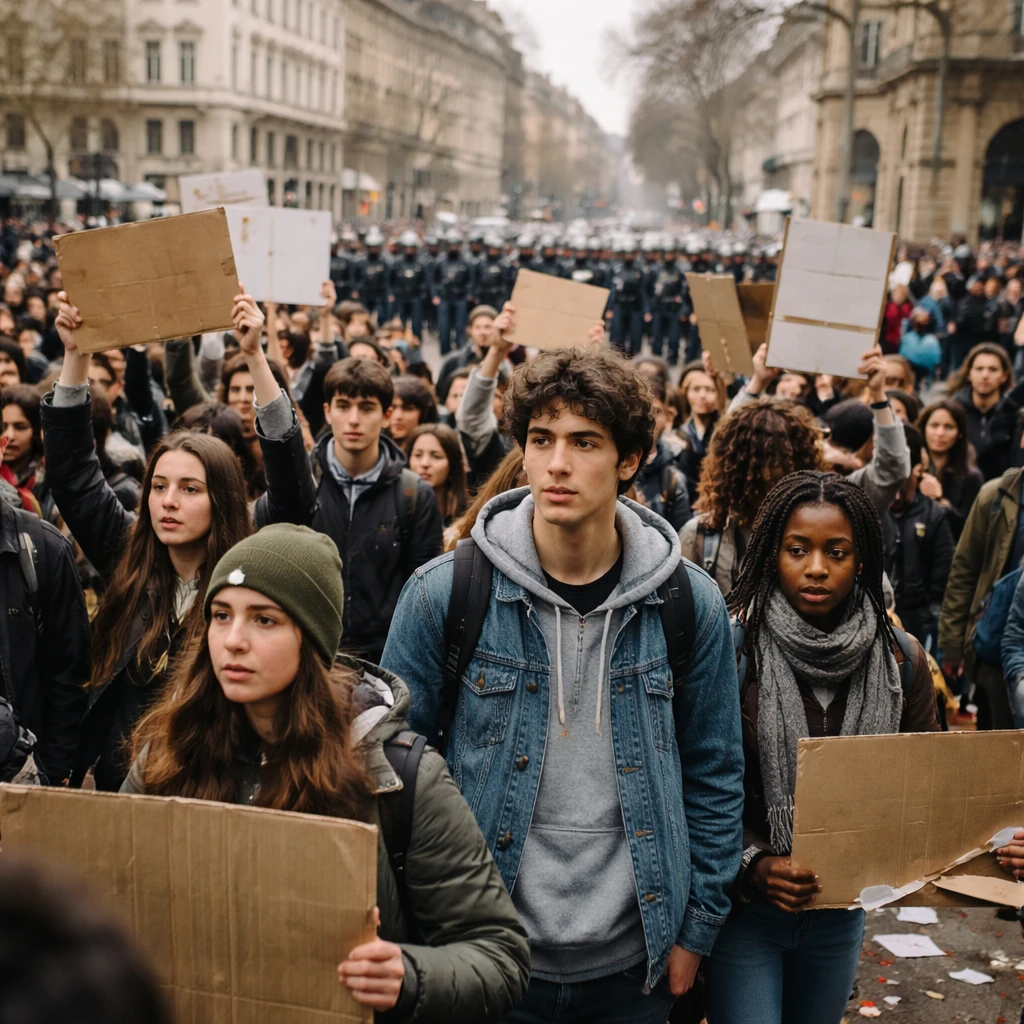
Maya Gourdel, a 19-year-old student in Brussels, has been hand-writing protest slogans at her desk, including the line "If we burn, you burn with us!" - a phrase borrowed from the 2012 film The Hunger Games that has been adopted by youth movements internationally. For Gourdel and many of her peers across Europe, the slogan captures a mix of anger and a demand for change as Generation Z increasingly leads protests from Paris suburbs to Belgrade squares.
The flashpoints vary by city, but recurring themes run through the demonstrations: run-down school facilities, staff shortages, a sense of shrinking economic opportunity, the rising cost of living, corruption and a feeling among young people that they are not being heard by political elites. In some cases the protests have turned confrontational. French cities have seen thousands of shops damaged or looted in recent weeks, and police responses have included stun grenades and water cannon.
In contrast to scenes of unrest elsewhere, the sustained student movement in Serbia produced a decisive political outcome - the electoral defeat of Aleksandar Vucic, a long-time leader, following almost two years of demonstrations over concerns about corruption and creeping authoritarianism. "Waking up, the first thing we felt was certainly a sense of relief and freedom," said student protester Stasa Piletic. "Personally, I feel a sense of victory. I feel that we finally moved from protests to responsibility."
Young protesters describe a feeling that their futures have been constrained. Chiara, a 21-year-old student in Milan, framed participation in demonstrations as a necessary response to what she called "an explosion of rage" that enabled collective action. She accused the ruling class of having deprived her generation of the ability to imagine a secure future. In Italy she pointed to schools with crumbling buildings and insufficient teachers, and to a labour market where underpaid jobs await graduates - often in positions for which they are overqualified - and to housing that is small and expensive, frequently forcing young people to live away from the cities they prefer.
Observers and participants note that Generation Z has been increasingly visible in protests beyond Europe in recent years - examples cited by demonstrators include movements in Bangladesh in 2024, Nepal in 2025 and India this year - and that Europe has now become a key theatre for this generational mobilisation.
Economic strain is a central driver for many young people. A European Union survey published in 2025 found that rising prices and the cost of living were a concern for 40% of those aged 16-30. The same set of EU data for 2025 showed that among the 92.7 million people in the EU at risk of poverty or social exclusion, the highest risk was recorded for young adults aged 18-24 years, at 26.3%, while the lowest risk was recorded for adults aged 65 years or over, at 18.8%.
Generational disparities in wealth and voting behaviour add to tensions. According to the OFCE think tank, people over 60 in France make up a quarter of the population but own 60% of the country's wealth. Public pension spending figures are part of the policy debate: French pensions are on track to reach 14% of economic output. That level of spending remains below Greece and Italy, which the OECD recorded in 2025 as spending around 16% of GDP on public pensions, but is well above countries such as Australia, Chile, Iceland, Ireland and South Korea, which the OECD reported were spending less than 4% of GDP on pensions.
These spending patterns influence where governments direct resources. A French government report in October highlighted that pension spending had risen by 2.5 percentage points of GDP between 2000 and 2023 while education spending had declined by 0.5 percentage points. The same report found that 32% of the education ministry's budget was absorbed by pensions, a dynamic that demonstrators say crowds out funding for teachers, school maintenance and other educational needs.
On the streets, students express a sense of shared grievance across national borders. Bilal Narjissi, 17, from a northern suburb of Paris, described deplorable school conditions and staff shortages. He said that in the past there had even been rats and recalled an evacuation after a roof collapsed on a courtyard last year, although no one was hurt. Narjissi argued the protests show that "young people in Europe are united," adding that they want to be treated as stakeholders and not dismissed as children.
Gourdel echoed that sentiment in Brussels, saying previous attempts to protest "passively" failed to attract attention. "Nobody heard us. It's only when people started to burn trash or that kind of stuff that the media and cameras started showing us," she said, linking a rise in more visible tactics to increased media focus.
Protests are not confined to Western Europe. Demonstrations have reached Germany, where a demonstration has been planned over cost of living, inequality, war and the state of schools. In Albania, student-led actions have engulfed Tirana and spread to other cities as young people rallied against Prime Minister Edi Rama's government, citing perceived corruption, a lack of jobs and low education standards. "Our Prime Minister spent 130 days not listening to us," said Xyke Kurti, a 19-year-old architecture student. She said many Albanian students see their future outside the country, arguing that connections rather than talent determine success at home.
Serbia's student movement stands out for translating protest into political change, but the article notes that governance presents a new challenge. Neither the student activists nor their candidates have prior governing experience - a fact acknowledged by participants. Luka Stojakovic, another protester, dismissed concerns over that inexperience, saying, "We have seen where people with political experience have brought us." The text underlines that the transition from street movement to government responsibility will be a testing period for those involved.
The protests have economic and social implications across several sectors. Damage to retail outlets in France illustrates an immediate cost to commerce. Education systems are a focal point for many demonstrators seeking better facilities and staffing. Public finances and pension commitments are central to debates over resource allocation, with demonstrators contending that pension obligations are crowding out education spending. Housing affordability and labour market conditions for young people are recurring complaints that shape the movement's demands.
For now, student activists across Europe continue to press their grievances into public view, seeking tangible policy responses and greater influence over decisions that will affect their futures.