
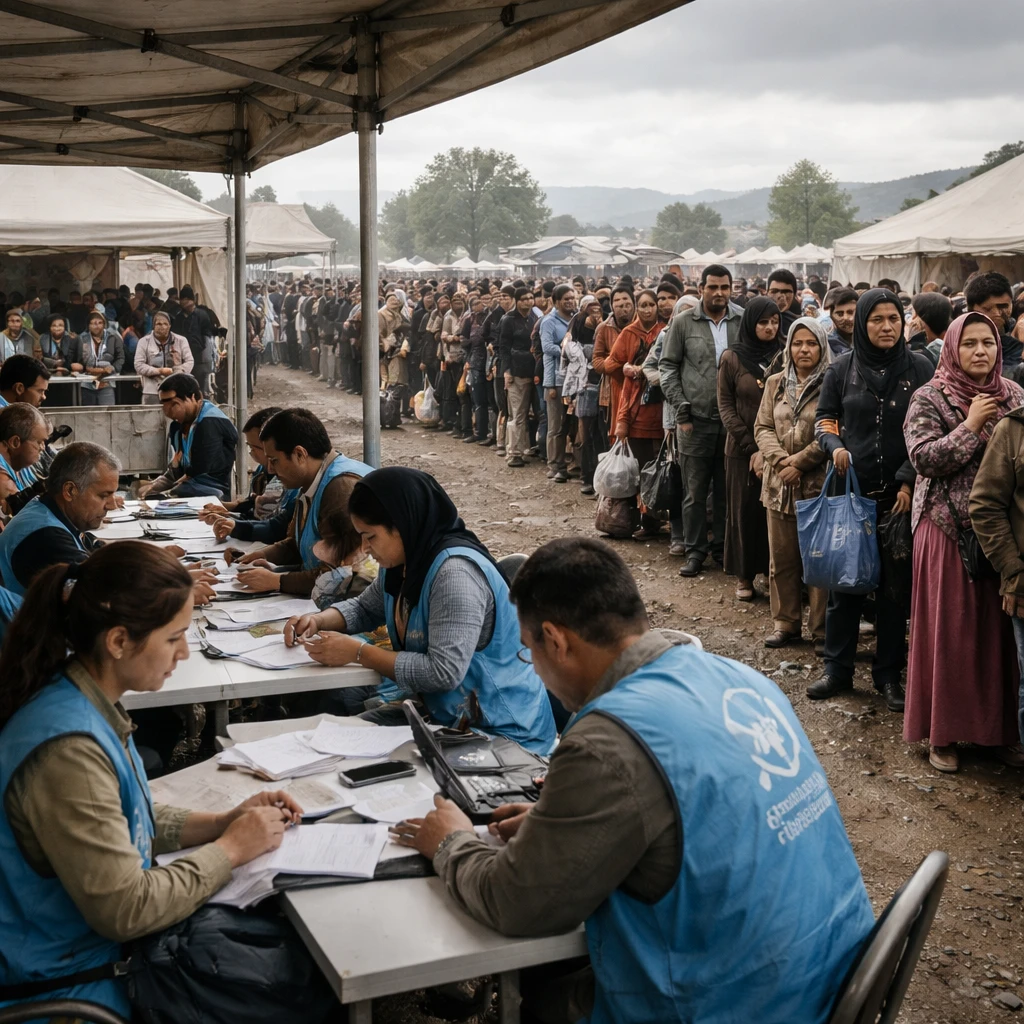
GENEVA - The UN refugee agency is confronting severe funding shortfalls that are forcing substantial cuts across its global humanitarian operations, the agency's head told policymakers on Monday. Barham Salih, the High Commissioner, reported to the agency's executive committee in Geneva that UNHCR has obtained just $3 billion - equivalent to 35% of the $8.5 billion it says it needs for 2026.
Salih said the funding gap follows reductions in aid from a number of countries and is occurring at a time of record displacement around the world. He warned that internal restructuring can only stretch resources so far and cannot permanently make up for falling donor support.
"Protection has a floor. Below it, the system does not simply become smaller. The protection we can provide begins to fail," Salih told the meeting, underscoring the limits of efficiency measures when confronted with dramatic budget cuts.
The agency has embarked on what Salih described as one of its largest restructurings because of the fiscal squeeze. Since 2024, UNHCR's workforce has been reduced from 20,000 employees to just under 12,000, he said. Despite the reductions, the agency is trying to preserve frontline services by concentrating cuts at its Geneva headquarters and in regional offices, keeping 88% of staff deployed outside headquarters.
Salih emphasised efforts to retain personnel carrying out protection activities in the field. He reported that about 95% of staff involved in protection work - including registering refugees, providing legal assistance and supporting solutions such as safe returns - remain in field locations.
Nonetheless, the funding crisis is already having tangible impacts on specific programmes, Salih said. In Chad, limited resources threaten specialised medical care and legal assistance for more than 50,000 survivors of conflict-related sexual violence who fled neighbouring Sudan. In Ethiopia, he said refugee registration has been suspended for tens of thousands of refugees from South Sudan and Eritrea.
Salih also flagged a regional imbalance that is drawing concern from Latin American states. He said Colombia has raised concerns on behalf of countries in the region that the Americas may be disproportionately affected. The Americas region - comprising the United States, Canada, Latin America and the Caribbean - faces a budget reduction of 32% in 2027 compared to this year, a decline of about $485 million, according to Salih. He added that this would be the largest regional budget reduction, even as the number of forcibly displaced and stateless people in the Americas is projected to rise by 4% to about 24.5 million people in 2027.
On the broader funding outlook, Salih said that funding for next year remains uncertain. He noted an expected figure of around $2.68 billion that could be improved following a UNHCR donor pledging conference scheduled in December.
"There is a difference between doing more with less and being asked to do the impossible," Salih said, cautioning executives that continued restructuring will not indefinitely compensate for falling contributions.
The High Commissioner framed the situation as a series of difficult trade-offs: safeguarding essential protection services versus trimming administrative and support functions. He outlined a model in which headquarters and regional office cuts are prioritised to maintain field presence, but warned that further reductions risk degrading core protection capacities.
As UNHCR moves through this restructuring and seeks additional pledges at the end-of-year conference, it faces the dual challenge of operating with reduced staff and resources while demand for protection and humanitarian assistance rises in several regions.