
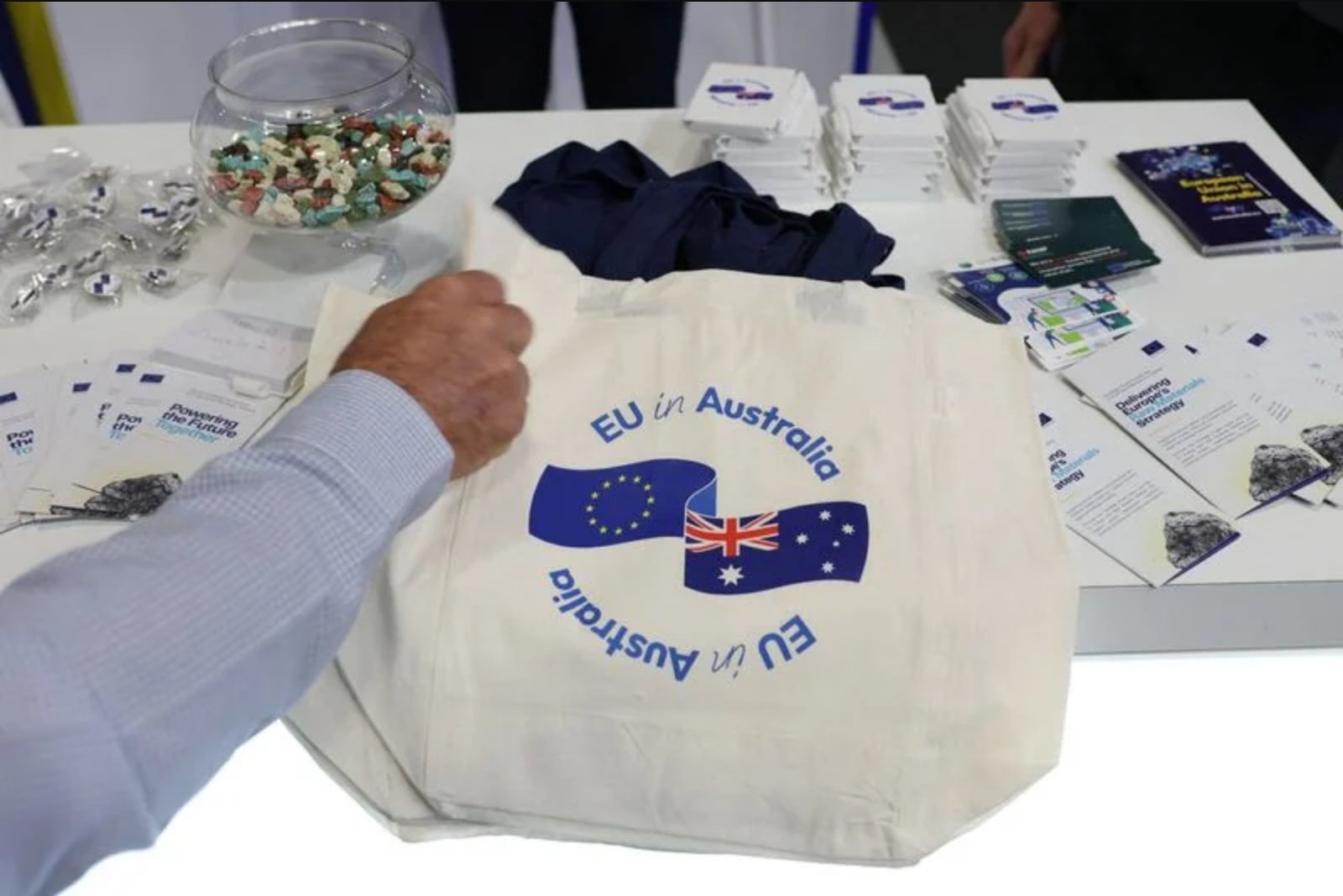
The European Union is lining up significant financial backing for Australia’s critical minerals sector as it moves to reduce dependence on China, the EU ambassador to Australia said on Tuesday. The announcement follows a free trade agreement struck in March between Australia and the EU, which removed tariffs on almost all goods and relaxed EU access to Australian critical minerals after eight years of negotiations.
Under the terms of the trade deal, once both sides sign and ratify the agreement - a step expected early next year - a current 5.5% EU tariff on critical minerals will be eliminated. "It is going to be a game changer," the ambassador said, describing a shift that he said should accelerate investment flows.
In parallel with the trade agreement, talks are described as "very close" for Australia to sign a memorandum of understanding with the European Investment Bank, which would serve as the EU’s funding vehicle for projects. "The European Union will be massively investing in critical minerals. Since we wish to diversify away from China, then one of the most likely partners has to be Australia," he added.
Policy proposals from the EU have earmarked up to €10 billion for critical raw materials within a larger €409 billion competitiveness fund that is being debated for the 2028 to 2034 budget period. The ambassador said the bloc intends to invest not only in raw extraction but also along the processing chain, aiming to bolster refining and downstream capabilities.
Australia itself indicated on Tuesday that it would refresh its critical minerals strategy to put greater emphasis on refining and processing as competition for investment intensifies and supply-chain concerns continue. The EU is initially following Australia’s lead in focusing on the minerals Canberra plans to include in its strategic reserve: gallium, antimony and rare earths.
According to the ambassador, accelerated project advancement by Australian companies through early development phases would speed the deployment of European investment. He noted the trade agreement signals that Europe wants a deeper relationship with Australia, which includes a security and defence partnership. Much of that cooperation, he said, entails dual-use technologies that depend on these critical minerals.
The EU has also announced plans to mobilise €800 billion into defence under the ReArm Europe initiative by 2030. Separately, Australia is on track to join the EU’s flagship research and innovation programme, Horizon Europe, next year.
The ambassador described 2026 as a "transformational" year for EU-Australia relations and expressed confidence that the partnership would advance further in 2027. The financial context included in the original reporting noted that €1 equals approximately $1.116 when converted from the euro figure provided as ($1 = 0.8961 euros).
As the clock moves toward formal signatures and ratifications, the combination of tariff removal, proposed EU funding and prospective EIB involvement frames a substantial potential inflow of capital into Australia’s critical minerals ecosystem, with particular attention on processing, refining and the supply chains that support defence and high-tech manufacturing.
Key implications and next steps
The near-term steps include the anticipated signing and ratification of the free trade agreement early next year and the finalisation of a memorandum of understanding with the European Investment Bank. The pace at which Australian projects move through development stages will influence how quickly investments are deployed.