
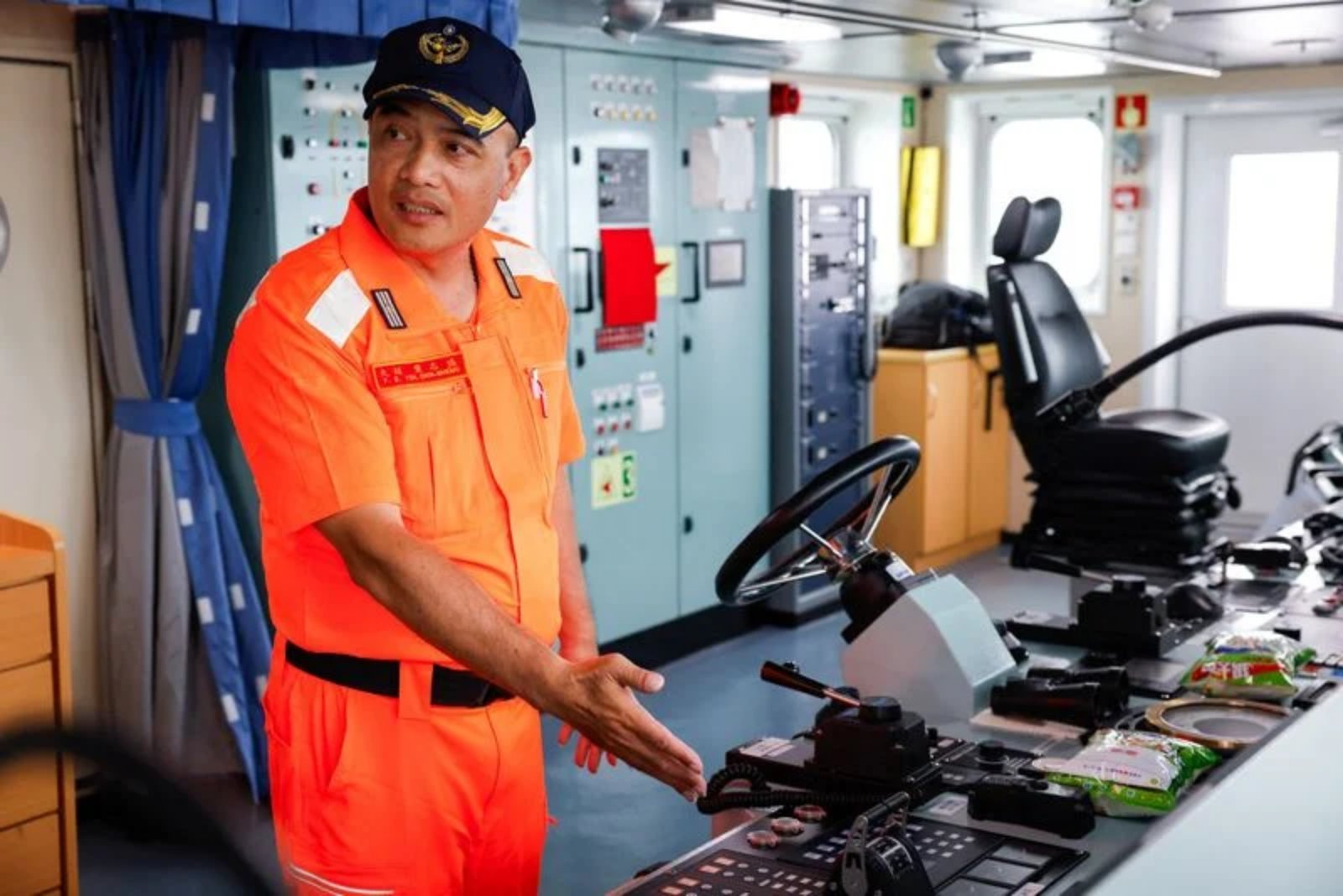
When first mate Yeh Chih-sheng puts to sea aboard the Taiwan Coast Guard ship CG1005, he brings more than uniform and radio gear. He also carries temple charms blessed at a Penghu shrine that coastal residents have long turned to for protection while fishing.
The 2,400-ton vessel is based in Taiwan’s Penghu islands, a strategic archipelago through which billions of dollars of trade transit each year. Yeh serves on the frontline of Taipei’s maritime presence as China presses its claim over the democratically governed island. Off duty, Yeh functions as an assistant priest - known in Taiwanese as a sio-huat - at a local temple dedicated to the Five Lords, guardian deities worshipped in coastal communities for safe passage at sea and protection from plague.
Yeh’s connection to the temple goes back to childhood. He said he has helped spirit mediums during rituals since primary school, in ceremonies where the deities are believed to descend and convey instructions. He described the relationship between his two roles as complementary. "The Coast Guard is a tangible backing people can see," he said. "The Five Lords are a spiritual anchor in people’s hearts. Both help bring fishermen and ordinary people a sense of reassurance."
That fusion of practical duty and ancestral faith has taken on fresh significance as Taiwan faces growing military pressure from China. Beijing has not ruled out the use of force to bring the island under its control, a claim Taipei rejects, including China’s assertion of a right to conduct "law enforcement" patrols in waters Taiwan regards as its own.
Recent Chinese activity has drawn concern from the U.S. and some allied governments, which last week said operations off Taiwan’s east coast threatened regional stability. China’s defence ministry has characterized its coast guard patrols as "lawful, legitimate and necessary." Reporters were granted rare access to Yeh’s ship in Penghu to observe operations and the daily routines of crew members.
Yeh said encounters at sea have evolved. Chinese warships and coast guard vessels now commonly cross the median line that once served as an unofficial buffer and have approached Taiwan’s 24-nautical mile contiguous zone. "They have already erased the median line," Yeh said.
On patrol, Yeh said his objective is to monitor and to warn rather than to escalate. The crew deploys non-lethal measures - water cannon, loudspeakers, LED boards and radio messages - to deter and communicate with other vessels. Yeh said he adheres to the Coast Guard principle of "not provoking and not yielding." He also brings talismans and command tablets from the temple when leaving port.
At the Penghu temple, standing beside the Chienchiu Paochien - a ceremonial divine boat used in rituals - Yeh drew a parallel between the shrine’s vessel and his own coast guard ship. "What we protect is people’s sense of safety and peace of mind," he said. "With the coast guard and navy there, people can live normally."
Contextual notes
- The CG1005 operates from Penghu, an archipelago positioned in the Taiwan Strait that handles a large volume of maritime trade.
- Yeh combines formal maritime duties with customary religious practices associated with the Five Lords temple, reflecting local coastal traditions.
- Encounters at sea have shifted toward closer approaches by Chinese vessels to areas Taiwan considers within its jurisdiction.