
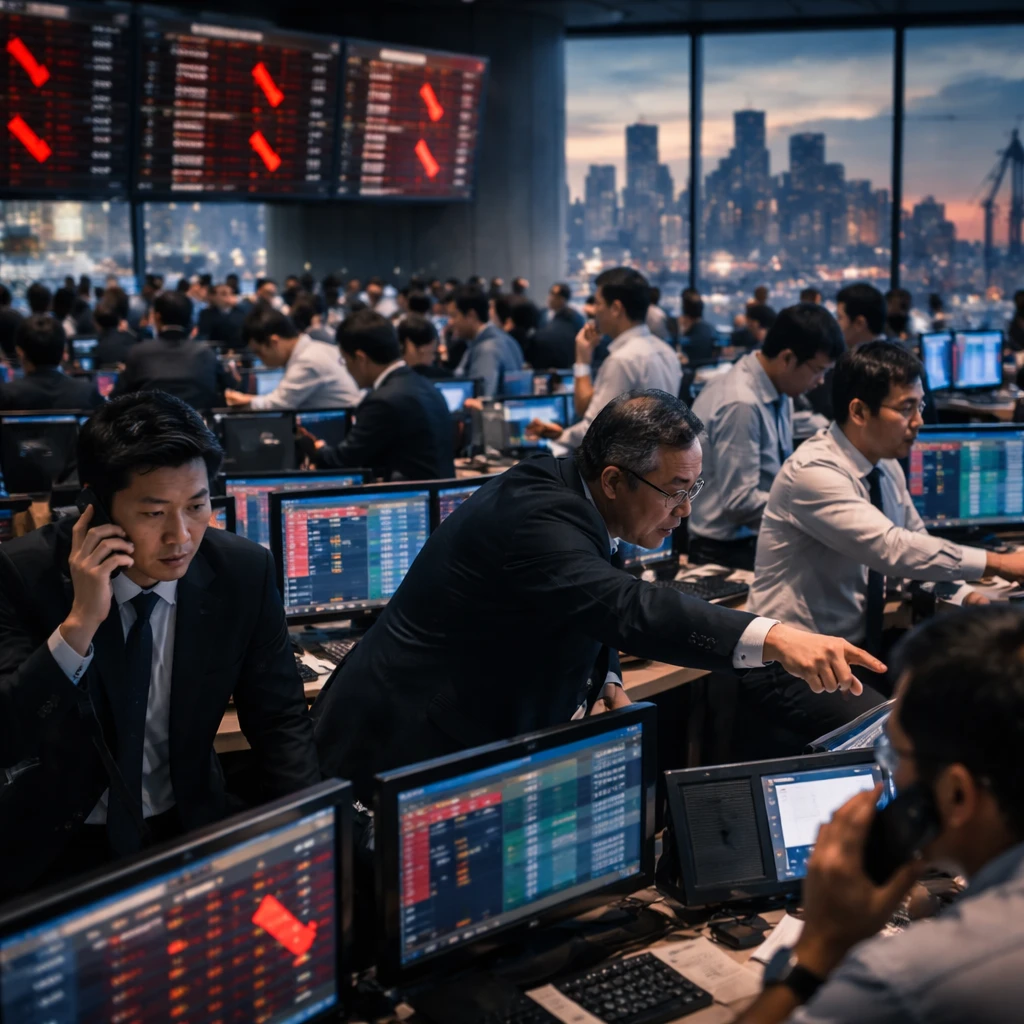
Asian stock markets opened the week under pressure as technology and artificial intelligence-related shares led declines across the region. Investors pulled profits from a sector that had contributed materially to recent gains, while a fresh exchange of airstrikes between Iran and Israel and a strong U.S. jobs report added to risk aversion.
South Korea's KOSPI was the hardest hit in the region, plunging as much as 8.8% amid sharp falls in its large-cap chipmakers. The index had been boosted earlier this year by gains in the tech sector, a dynamic that now left it exposed to concentrated profit-taking once sentiment shifted.
Samsung Electronics Co Ltd (KS:005930) fell 4.7% and SK Hynix Inc (KS:000660) dropped 1.1%. SK Hynix's decline was mitigated somewhat by news of an advanced chip partnership with AI specialist NVIDIA Corporation (NASDAQ:NVDA), but overall losses in memory-related names weighed heavily on the KOSPI.
In Japan, the Nikkei 225 slid 3.6% as investors re-assessed lofty expectations for technology shares. Major Japanese tech and industrial firms weighed on the benchmark, with SoftBank Group Corp. (TYO:9984) down 7.5% and chip-related companies SUMCO Corp. (TYO:3436) and Renesas Electronics Corp (TYO:6723) each falling by more than 10%.
Japan's broader TOPIX index also fell, dropping 2.7% as markets digested a downward revision to first-quarter gross domestic product. The economy grew 1.8% in the first quarter, revised from a prior estimate of 2.1%, with weaker business spending cited as the main drag. The revised print prompted questions about the potential impact of the Iran-Israel hostilities on growth and whether the Bank of Japan will retain scope to raise interest rates in its upcoming meeting.
Regional markets began the session on a weak footing after a negative close on Wall Street Friday, where major U.S. benchmarks fell between 1% and 4.5%. Technology was the most heavily hit sector on Friday, and a hotter-than-expected U.S. nonfarm payrolls reading lifted expectations that the Federal Reserve could keep rates higher for longer or even raise them further, a prospect that is typically unfavorable for risk-sensitive assets.
Despite the Friday sell-off, S&P 500 futures and Nasdaq 100 futures were trading higher in Asian hours, rising 0.2% and 0.7% respectively, as some investors looked for signs of a rebound in U.S. technology stocks following the slump.
Geopolitical developments added an additional layer of concern. Iran and Israel exchanged airstrikes on Sunday in what was reported as their first overt military exchange since an early-April ceasefire. The flare-up dampened hopes for a lasting diplomatic settlement and coincided with reports that oil prices rose sharply over the weekend. Higher oil came as another factor spooking risk assets across the region.
Regional bourses reflected those pressures: China's Shanghai Shenzhen CSI 300 fell 1.6% and the Shanghai Composite dropped 1.2%, while Hong Kong's Hang Seng declined 1%. Singapore's Straits Times index was down 1.2%. Futures for India's Nifty 50 rose 0.3% after the index had suffered deep losses the prior week.
Beyond geopolitics and profit-taking in technology, investor concern about the implications of a stronger U.S. labor market also contributed to the sell-off. A robust nonfarm payrolls figure strengthens the case for the Fed to sustain or raise interest rates, a trend that typically pressures equity markets reliant on cheap financing and elevated growth expectations.
For now, markets are balancing several simultaneous forces: concentrated gains in AI and semiconductors that leave those sectors vulnerable to sharp corrections; renewed Middle East hostilities lifting energy prices and geopolitical risk premia; and U.S. economic data that could keep monetary policy tighter than hoped by risk asset investors. Until these elements clarify, volatility in technology-heavy indices and broader Asian markets is likely to remain elevated.