
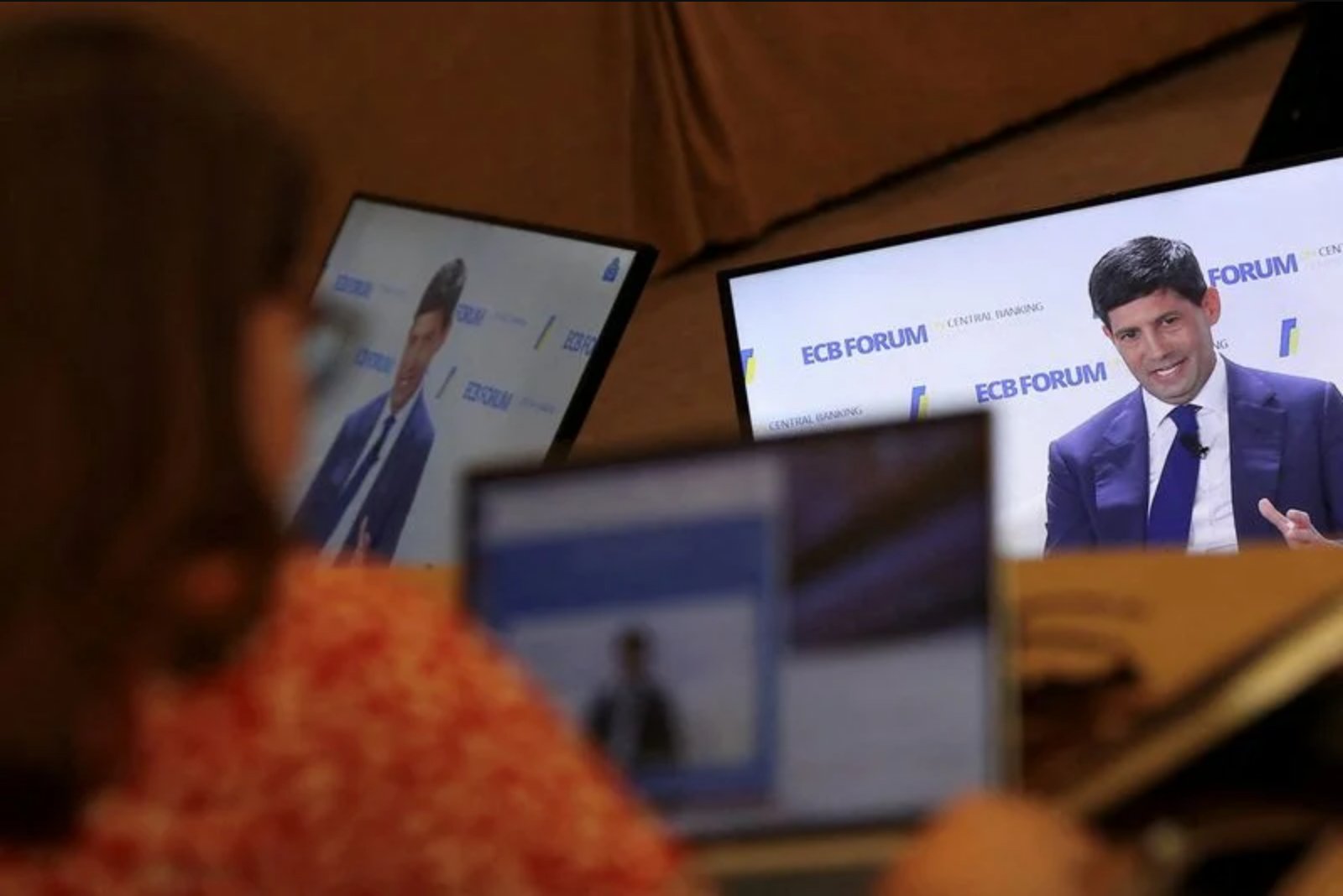
Federal Reserve Chairman Kevin Warsh used a prominent international forum to establish a clear boundary regarding the central bank's policy trajectory, asserting a steadfast commitment to a 2% inflation target and signaling resistance to external pressures for monetary easing. Speaking during a panel discussion at the European Central Bank's annual policy conference in Sintra, Portugal, on Wednesday, Warsh addressed the intersection of political expectations and central bank independence. He firmly dismissed any assumptions that the Federal Reserve would tolerate inflation rates exceeding its stated goal, regardless of political calls for lower borrowing costs.
"If there were people in households or the business sector, in the financial markets, who thought that this central bank was going to be comfortable with an inflation objective above 2% -- well, I guess they’d be disappointed," Warsh stated. His remarks were a direct response to President Donald Trump's public advocacy for interest rate reductions. When pressed on whether this stance of disappointment extended to the President, who appointed him to lead the Fed, Warsh reiterated the institution's long-standing autonomy. "We have been an independent central bank for a long time. We are going to be an independent bank at this moment and you will see no changes on that," he emphasized.
The appearance followed a significant legal development just two days prior, when the U.S. Supreme Court ruled that the President could not remove Federal Reserve Governor Lisa Cook. While the justices expanded the President's authority to dismiss members of other ostensibly independent agencies, Warsh indicated that the Court's decision would not alter the Federal Reserve's operational conduct or its commitment to independence.
The Sintra forum, Warsh's second public address since assuming the role of Fed chief in May, highlighted a growing consensus among top global central bankers regarding the limitations of "forward guidance." Alongside counterparts from the ECB, the Bank of England, and the Bank of Canada, Warsh demonstrated a reluctance to provide detailed forecasts or policy direction ahead of decision-making meetings. He explicitly stated that discussions regarding potential interest rate adjustments would remain confined within the Federal Reserve's closed-door sessions. "We get into that room and shut the door, we’re going to have a good debate, but I don’t have much more for you than that," he told CNBC anchor Sara Eisen, who attempted to elicit further commentary. "I am not going to give forward guidance," Warsh added, playfully noting that he would "fail" to break his rule against pre-decision commentary.
This strict approach extended beyond rate decisions to the broader economic outlook. When Eisen inquired about his views on upcoming economic growth, Warsh dismissed the line of questioning as a form of forced prediction. "We are playing Mad Libs now?" he remarked, referring to a word game that involves filling in blanks. "You’re back to forward guidance. I’m going to disabuse you of trying to extract that. ... My view is financial markets and the real economy work best when you look at what’s happening in the real economy. You make your own judgments." This stance shifts the burden of economic analysis back to market participants, discouraging reliance on central bank signals to anticipate future conditions.
Warsh also addressed the potential inflationary impacts of artificial intelligence, a subject of intense scrutiny for the Federal Reserve. Rather than dissecting the specific dynamics of how AI might strain resources or enhance productivity, he maintained a generic position: it is the central bank's responsibility to ensure that technological advancements do not fuel inflation. This response avoided committing to a specific view on whether AI would initially be price-increasing or deflationary in the long run.
The broader context of the Sintra meeting involved a diverse set of monetary challenges. Warsh shared the stage with ECB President Christine Lagarde, Bank of England Governor Andrew Bailey, and Bank of Canada Governor Tiff Macklem. While all face elevated inflation, their policy responses are diverging due to differing national economic conditions and the varying degrees of impact from geopolitical conflicts, including the U.S.-Israeli war with Iran. Warsh's comments following the Fed's June 16-17 policy meeting had already prompted investors to increase the probability of a rate hike as soon as September. In contrast, the ECB has already implemented rate increases, while policymakers in the UK and Canada have exercised caution due to domestic economic weakness.
A key theme in Warsh's remarks was a return to "first principles" in central banking. He described a collective willingness among global peers to move away from the unconventional policies developed during and after the 2007-2009 global financial crisis. Warsh, who served as a Fed governor during that period and later campaigned against some of the resulting programs, cited issues such as oversized balance sheets and the overuse of forward guidance to steer financial markets as burdens that the industry needs to shed. "I feel incredible comfort that I’m not sure I had internalized that there is a willingness by my colleagues in the central banking community around the world to go back to first principles," he observed.
To facilitate this transition, Warsh announced the formation of several internal task forces, which will be named in the coming week. These groups are expected to include former foreign central bankers, mirroring review processes previously conducted at institutions like the Bank of England. Warsh anticipates rapid results from these reviews, with a primary objective of modernizing the Fed's data infrastructure. He expressed a strong aspiration for the Federal Reserve to shift from relying on backward-looking government surveys to utilizing real-time data for monetary policy decisions. "Because of AI and what he described as an 'exponential' pace of change, Warsh said it was important to recognize new trends as they are unfolding, not after the fact," he noted.
This modernization effort extends to the labor market, a critical component of the Fed's dual mandate. Warsh characterized the current technological revolution as being in its early stages, stating, "We are in the first or second inning of this revolution. ... Jobs will be greater, prosperity will be greater ... the question is timing." He reiterated the Fed's commitment to achieving both stable prices and maximum employment, acknowledging the challenge of balancing these goals amidst rapid economic shifts. The potential disruption to job creation and the timing of prosperity gains present complex variables for monetary policy, requiring agile and data-driven responses from the central bank.