
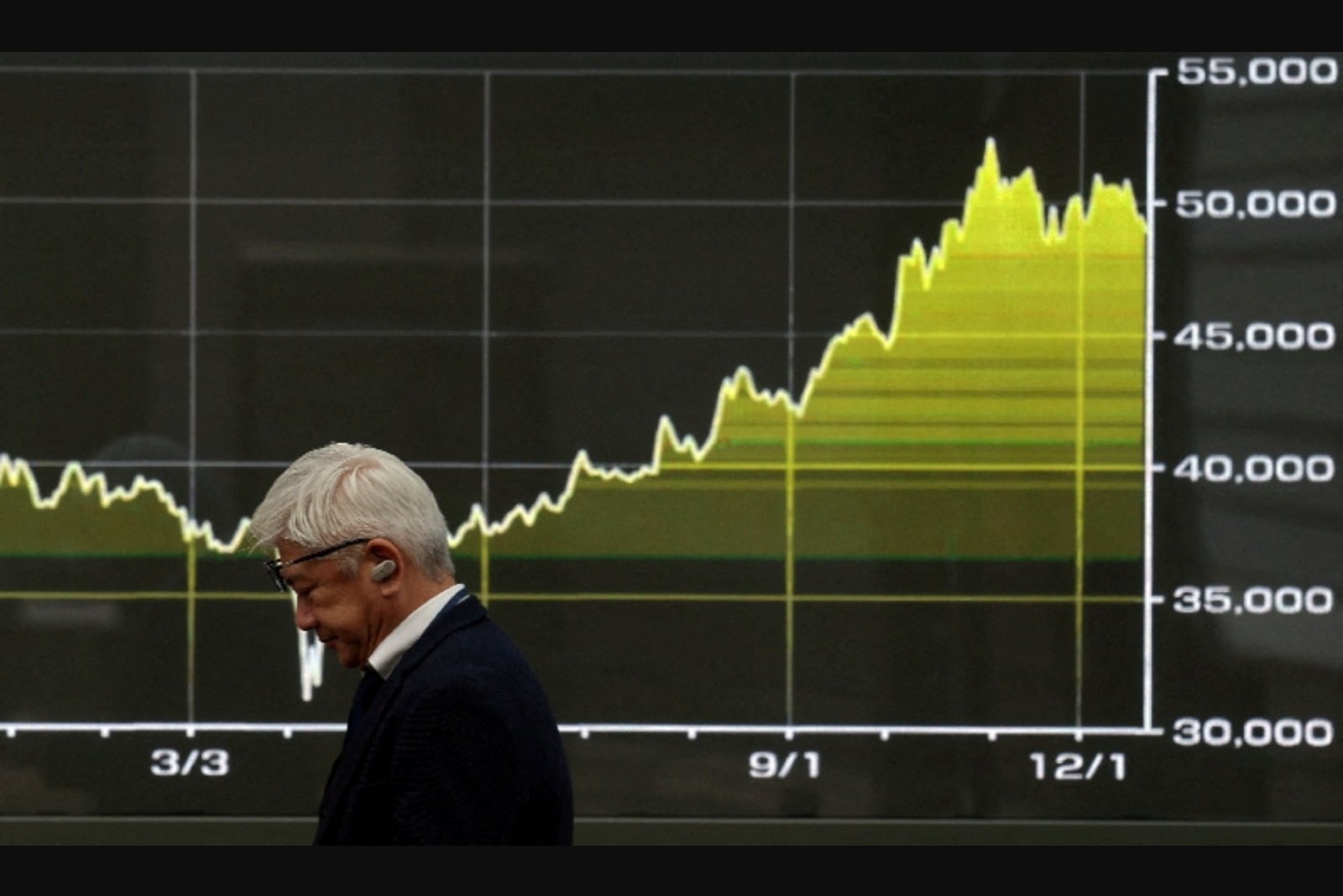
Asian equity markets continued their downward trajectory on Wednesday, marking the fourth consecutive session of losses. The decline is being driven by a confluence of factors, most notably rising bond yields fueled by inflation fears linked to ongoing conflicts, alongside significant anticipation regarding Nvidia's upcoming quarterly earnings report.
The sell-off in global bond markets has maintained its momentum overnight. Investors have increased their bets that the Federal Reserve may implement interest rate hikes later this year. This shift in sentiment pushed the benchmark 10-year U.S. Treasury yield to a 16-month peak of 4.687% overnight. Simultaneously, the 30-year yield ascended to 5.198%, reaching levels not observed since 2007.
Market Performance and Regional Indices
The impact of these macroeconomic pressures was visible across various Asian markets. MSCI’s broadest index for Asia-Pacific equities, excluding Japan, recorded a decline of 0.7%. In Japan, the Nikkei saw a sharper drop of 1.6%, while South Korea's KOSPI fell by 2%. Chinese blue-chip stocks experienced a 0.4% slip, and Hong Kong's Hang Seng index eased by 0.7%.
In Europe, pan-region stock futures declined by 0.5%. Across the Atlantic, Nasdaq futures remained flat, whereas S&P 500 futures saw a slight dip of 0.1%.
The Nvidia Factor
A focal point for global investors remains the first-quarter earnings announcement from Nvidia, scheduled for after the market close on Wednesday. The semiconductor giant is under intense scrutiny as it attempts to navigate an environment of rising borrowing costs. Expectations for the company remain exceptionally high; according to a median forecast from an LSEG survey of analysts, revenue is projected to climb by nearly 80%, reaching approximately $79 billion.
Despite these lofty expectations, some market analysts express caution. Tony Sycamore, an analyst at IG, suggested that current market movements might represent a corrective pullback following a major rally. While noting that U.S. yields are creating significant market ripples, Sycamore also expressed skepticism regarding Nvidia's ability to continue its trend of massive surprises, suggesting that the company's ability to shock the market as it has in the past may be diminishing.
Geopolitical Tensions and Commodity Volatility
Energy markets have been influenced by geopolitical instability. Brent crude futures saw a minor decrease of 0.2%, yet prices remained above the $110 threshold, trading at $111.07. This volatility is linked to the effective closure of the Strait of Hormuz and comments from U.S. President Donald Trump. While Trump indicated he was postponing an imminent strike to allow for further negotiations with Tehran, he also noted the possibility of needing to strike Iran again.
In a separate diplomatic development in Beijing, Chinese leader Xi Jinping is set to host Russian President Vladimir Putin, occurring less than one week after a high-profile visit by Trump.
Currency and Precious Metals
The U.S. dollar has strengthened, trading near a six-week high against major currencies. The yen stood steady at 159.05, following seven straight sessions of gains that largely offset the intervention-driven movements seen on April 30 when Japanese authorities acted to protect the currency at the 160 mark. The euro was last valued at $1.1594, hitting its lowest point since April 8 overnight, while the British pound sat at $1.3380, approaching a six-week low.
Gold prices also faced downward pressure, slipping 0.4% to $4,463 per ounce, marking its lowest level since late March as the strength of the U.S. dollar persisted.