
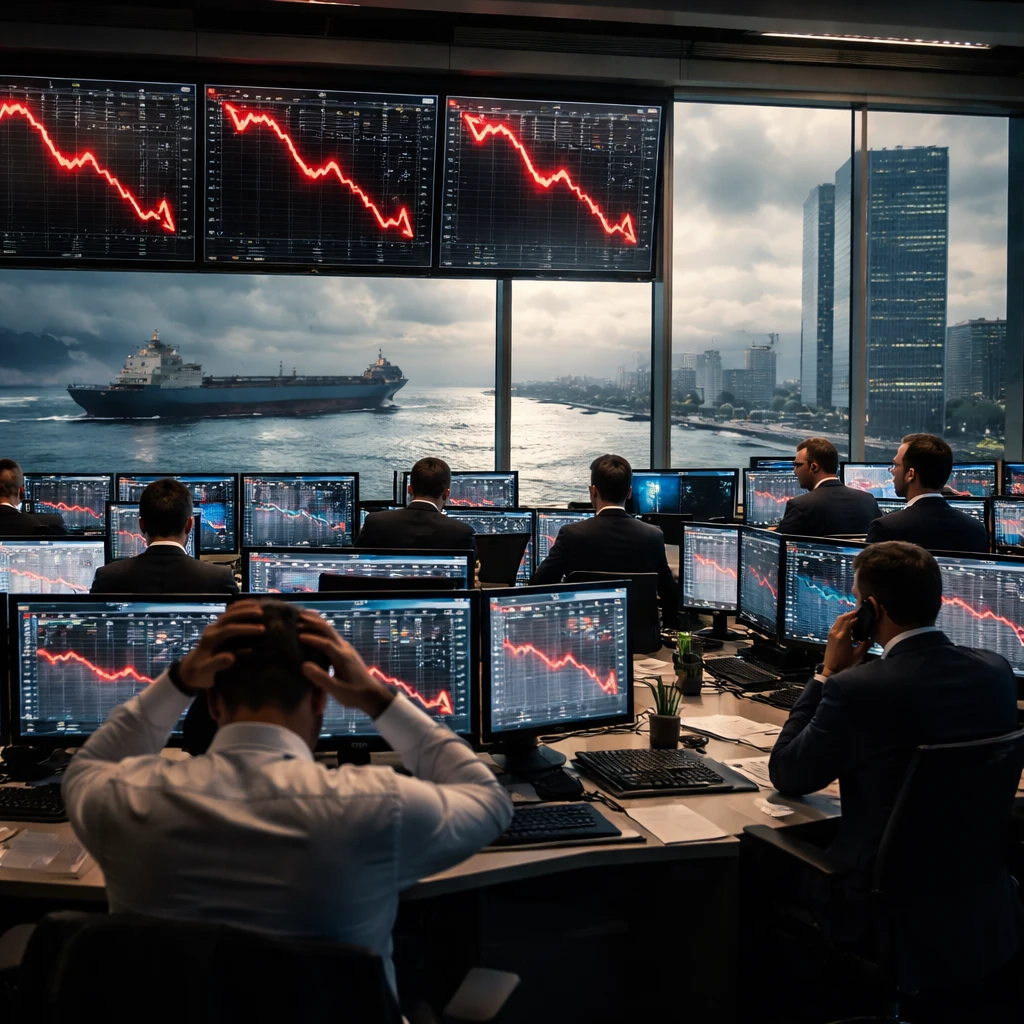
U.S. stock futures opened under pressure Thursday as markets absorbed earnings from several large technology companies and monitored a potentially expanding conflict in the Middle East that has pushed oil prices higher and revived inflation worries.
By 03:03 ET (07:03 GMT), futures on the Dow had slipped about 187 points, or 0.4%. S&P 500 futures were down roughly 26 points, or 0.4%, and Nasdaq 100 futures had declined about 123 points, or 0.4%. Shares on Wall Street had closed lower the previous day, and investors were awaiting major after-hours earnings that could offer clues about the commercial path for artificial intelligence-related services.
Energy markets tightened as the United States and Iran traded strikes that threatened shipping lanes through the Strait of Hormuz. Simultaneously, Tehran-backed Houthi fighters said they hit Saudi-related targets in and near the Red Sea. Crude oil, trading well above levels seen before the wider conflict, climbed on the headlines. Analysts and market participants said the combination of higher oil and potential supply disruptions has refocused attention on inflation risks and the possibility of further central bank rate action.
Technology earnings and corporate spending
Alphabet, Tesla and IBM each delivered results and guidance that illustrated a pattern among large technology companies: significant investment in AI and related infrastructure, with an accompanying hit to free cash flow.
Alphabet, the owner of Google, raised its full-year capital expenditure guidance to as much as $205 billion, up from a prior estimate of $190 billion. The company cited spending needed to build the infrastructure supporting its AI initiatives. Media reports that reviewed company financials noted Alphabet's free cash balance after operations and investments fell to negative $5.9 billion, the first time in roughly a decade that the figure was below zero.
CFO Anat Ashkanazi attributed the negative free cash flow to rising capex, which reached roughly $45 billion in the second quarter. That compared with about $36 billion in the prior quarter. In extended-hours trading, Alphabet's shares slipped by more than 2%, though the stock had gained over 8% year to date before the release.
Investors and analysts flagged that Alphabet's move underscored shifting market expectations - from an era dominated by AI hype to one in which hyperscalers must show that their heavy capital outlays translate into measurable enterprise adoption and monetization. "For the broader tech sector, Alphabet's quarter sets a clear precedent: the market is transitioning from AI hype to monetization discipline," said Chris Ballard, Managing Partner at Check Capital.
Tesla likewise reported elevated investment as it advances initiatives related to AI and robotics. The automaker's capital spending rose to $5.8 billion in the second quarter, a level CEO Elon Musk described to investors as part of "a massive capex year" intended to deliver substantial returns over time. Despite a revenue uptick — helped in part by resilience in its core automotive business even amid intense competition — the higher spending drove free cash flow to negative $1.1 billion in the quarter, the first negative reading in two years. Tesla's shares fell more than 4% in after-hours trading.
IBM's results painted a different picture. The company confirmed second-quarter figures that included a 7% year-on-year drop in infrastructure revenue to $3.8 billion, and a sharper 42% slump in sales of data-center mainframes. Following those results, IBM warned that full-year revenue growth would be lower than previously expected, revising its outlook to a range of 4% to 5% growth instead of the 5% that had been forecast earlier this year.
IBM's stock had already experienced a dramatic decline the prior week, shedding roughly $67 billion in market value on pre-release results. CEO Arvind Krishna described the company as navigating a "structural shift" while asserting IBM remains positioned to help clients capture benefits from AI technologies.
Macro backdrop and central bank focus
Elevated oil and the prospect of lasting supply disruptions have stoked concern about renewed inflation pressures. Deutsche Bank analysts noted that "inflation has remained top of the agenda for markets this morning," pointing to the ongoing US-Iran exchanges and Houthi attacks as evidence the conflict shows "no sign of easing." The analysts emphasized that the recent targeting of oil tankers and related incidents have raised fears the situation could broaden.
The European Central Bank is scheduled to announce its monetary policy decision later in the day. Markets broadly expect the ECB to hold interest rates steady at the meeting, but investors will scrutinize commentary from policymakers for clues on future borrowing-cost decisions.
At its previous meeting the central bank raised its deposit rate by 25 basis points to 2.25%, a move aimed at demonstrating readiness to counter inflationary pressures linked to the Middle East developments. In its statement last month, the ECB said the conflict had already contributed to inflation pressures and described a rate increase as a "robust" step across several potential scenarios mapping how the shock could evolve and feed into the medium-term outlook.
Inflation in the 21-member Eurozone is running at nearly 3% on an annualized basis, above the ECB's 2% target. Officials have voiced concern that sustained price growth could prompt higher wage demands, creating the risk of a persistent inflationary spiral. The central bank now sees headline inflation averaging 3% for this year, 2.3% in 2027 and 2% in 2028, revised from earlier projections of 2.6% for this year, 2% in 2027 and 2.1% in 2028.
Market implications and investor focus
Investors face a mix of corporate-level and macro-level signals. On the corporate side, large technology companies are increasing capital intensity to develop AI infrastructure and products. Those investments are weighing on free cash flow in the near term and leaving shareholders to evaluate whether the spending will translate into enterprise-grade revenue and pricing power over time.
On the macro front, a renewed spike in oil and concerns about broader disruption in shipping lanes are lifting the possibility of inflation surprises that central banks might address with additional rate increases. That dynamic keeps monetary policy front and center for both equity and fixed-income markets as traders parse statements and forecasts from the ECB and other policymakers.
For market participants, the coming hours and days will be about triangulating corporate reporting on AI spending, near-term profit dynamics and central-bank language on inflation risks arising from geopolitical tension.
Key takeaways
- Major tech firms reported elevated capital expenditure tied to AI initiatives, which has pushed free cash flow into negative territory for Alphabet and Tesla.
- Oil prices rose on heightened Middle East tensions - including U.S.-Iran exchanges and Houthi attacks - renewing inflation concerns and putting central banks back in focus.
- The ECB meets with markets expecting a pause in rate moves but watching for signals on how officials plan to respond to inflation pressures linked to the conflict.