
Overview
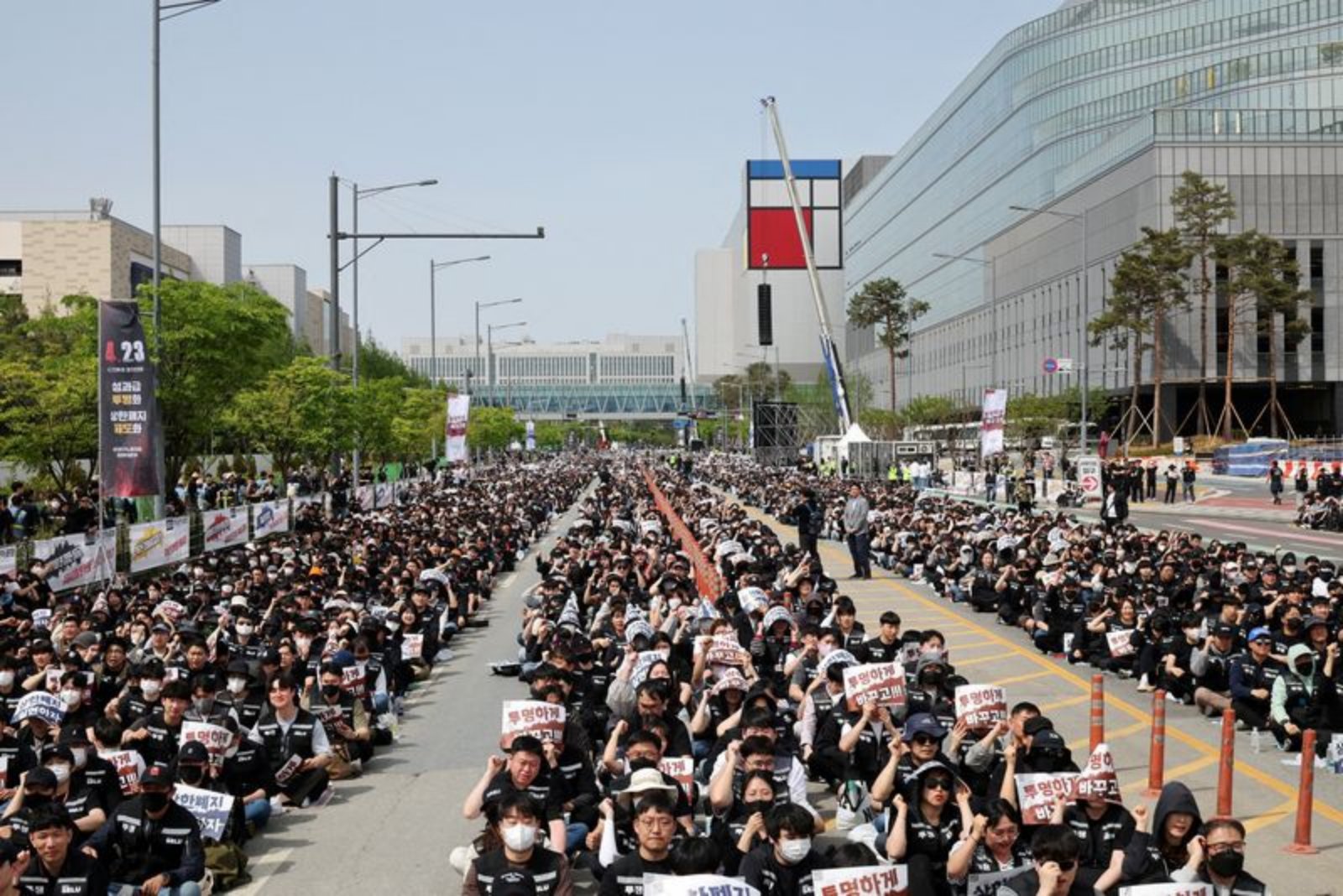
Samsung Electronics is confronting what union leaders describe as the largest strike in the company’s history, set to begin on Thursday and run for 18 days. The industrial action stems from a bitter dispute over bonus payments for workers in Samsung’s memory chip operations. Nearly 48,000 employees have registered to take part, with the majority coming from chip manufacturing sites.
Union demands
The union is asking Samsung to remove a policy that caps bonuses at 50% of an employee’s annual salary, and to create a bonus pool equivalent to 15% of annual operating profit that would be distributed to workers. Crucially, the union wants these changes to remain binding beyond the current year, turning the new arrangements into a multi-year commitment rather than a one-time concession.
Samsung’s response
Company proposals during negotiations have differed markedly from the union’s request. Transcripts from talks in March show Samsung proposing substantially larger payments for some staff this year but stopping short of eliminating the 50% cap in principle. Samsung cited estimates suggesting that workers at a smaller rival, SK Hynix, might receive bonuses equivalent to 607% of annual salary, and indicated it could offer memory chip workers bonuses that would exceed levels at SK Hynix.
For employees in Samsung’s logic chip businesses, the company proposed one-off bonuses ranging from 50% to 100% of annual pay. Those payments would apply to the current year only; Samsung has not agreed to permanently abolish the 50% bonus cap.
Context behind the dispute
Both Samsung and SK Hynix have seen profits rise sharply as global demand for memory chips surged, driven in part by a shortage of supply and growing investment in artificial intelligence. The two firms together produce most of the world’s memory chips. Media reports cited by union representatives say SK Hynix removed its bonus cap for a 10-year period last year, a move that led to bonuses for some employees exceeding those paid at Samsung by more than three times. That gap is reported to have encouraged some workers to move to SK Hynix and has been linked to increased union membership at Samsung.
Scale and legal limits on the strike
This action is poised to be far more extensive than an earlier walkout in 2024, which involved about 6,000 workers. The current tally of nearly 48,000 participants represents about 38% of Samsung Electronics’ domestic workforce. Samsung sought a court injunction and on Monday the court partially granted the request. The ruling requires that essential staffing levels at certain production facilities be maintained during any industrial action.
Samsung has informed the union that 7,087 workers will be required to report for duty even if the strike proceeds. The company’s chip plants in South Korea operate around the clock across three shifts at sites including Pyeongtaek and Hwaseong, meaning that mandated minimum staffing will touch multiple production schedules.
Potential impact on supply and the economy
The strike is raising concerns because Samsung is the world’s largest manufacturer of DRAM chips, holding an estimated 36% market share at the end of last year, according to TrendForce. Memory chips are integral components for laptops, smartphones and increasingly for AI data centers. Analysts have produced estimates of the potential supply impact: one analyst, Jeff Kim at KB Securities, has said that an 18-day stoppage could reduce global DRAM supplies by roughly 3% to 4% and NAND supplies by 2% to 3%, which could prompt further price rises.
South Korean government officials have flagged the wider economic risks, noting Samsung accounts for nearly a quarter of the country’s exports. A central bank official warned that, in a worst-case scenario, the strike could cut 0.5 percentage points from an expected 2.0% expansion in the South Korean economy this year. That scenario rests on an assumed loss of about 30 trillion won in chip production, with an additional unspecified "few weeks" of production disruption possible. At the exchange rate noted in reporting, 1 U.S. dollar equals 1,505.9000 won.
Near-term outlook
The outcome hinges on whether negotiations yield a new agreement before the planned walkout or whether the partial injunction and required reporting levels materially limit disruption at critical facilities. The company and the union remain far apart on whether the 50% bonus cap will be removed and whether any profit-linked bonus arrangement will be binding beyond this year.
Facts preserved in this report
- The union demands abolition of a 50% cap on bonuses and a bonus pool equal to 15% of annual operating profit, binding beyond this year.
- Samsung proposed larger, one-off bonuses for memory and logic chip staff this year but did not agree to abolish the 50% cap.
- Nearly 48,000 workers have signed up to strike for 18 days, representing 38% of Samsung’s domestic workforce; a court ruling requires 7,087 workers to work if the strike proceeds.
- Samsung held a 36% share of the DRAM market at the end of last year per TrendForce; analysts estimate an 18-day strike could cut global DRAM supply by 3% to 4% and NAND by 2% to 3%.
- Officials warned the disruption could reduce South Korea’s GDP growth by up to 0.5 percentage points under one worst-case estimate tied to a potential 30 trillion won production loss.