
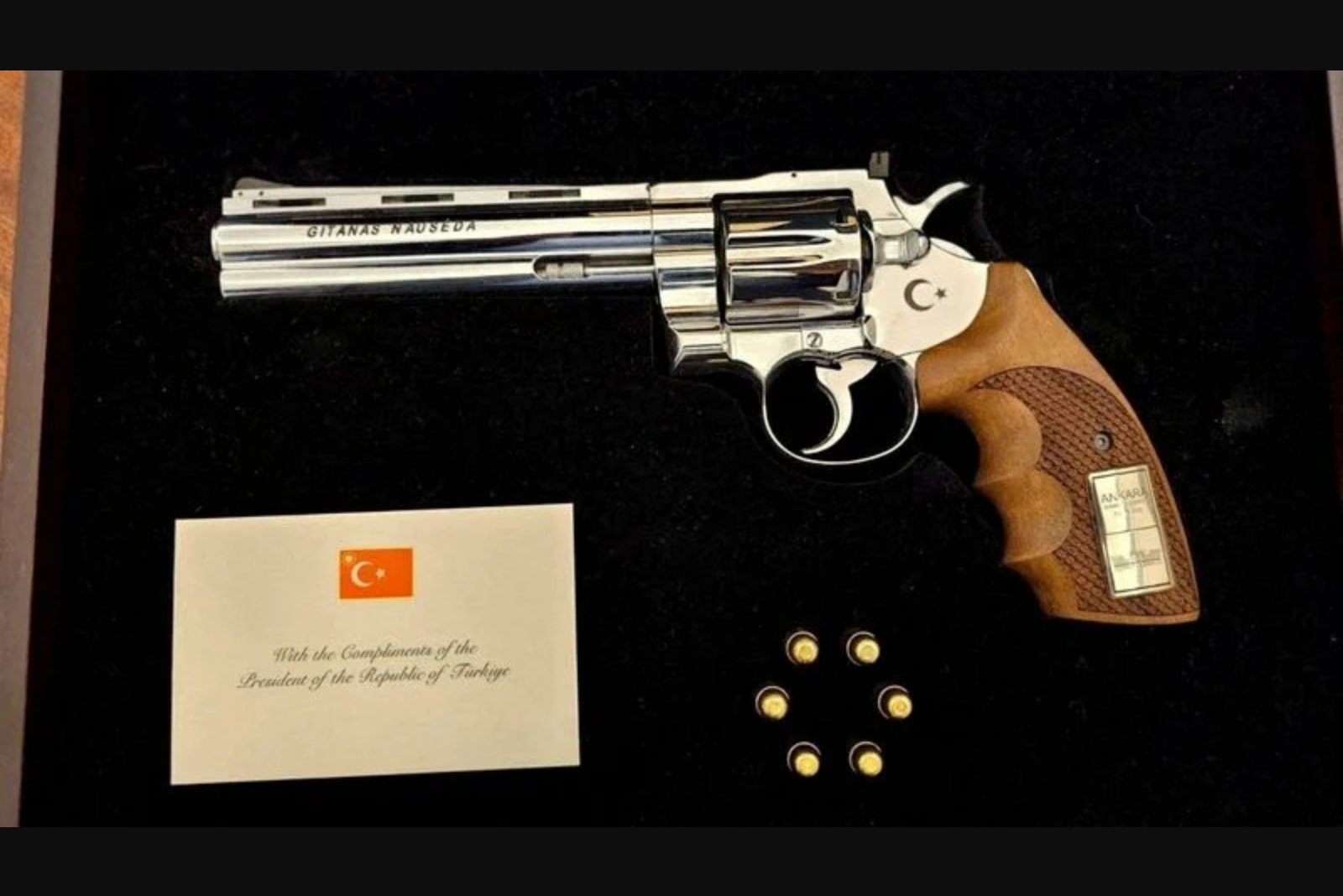
MADRID, July 9 - Leaders attending Wednesday’s NATO summit in Ankara received an unexpected parting gift from host President Recep Tayyip Erdogan: a vintage revolver accompanied by live ammunition.
Images circulated by the office of Lithuanian President Gitanas Nauseda showed a six-shot revolver identified as the Gumusay .357 Magnum, a model manufactured in the 1990s by Turkish state-owned gunmaker Makina ve Kimya Endustrisi (MKE). The firearm was presented in a wooden display case decorated with Turkey’s national flag and the NATO emblem, and included a bilingual placard stating: "Gumusay, the first revolver-type handgun produced in our country" in Turkish and English.
Turkish officials framed the gesture as a showcase of the country’s defence industry, which Ankara has been promoting as both an export sector and an instrument of foreign policy.
Responses from recipient countries varied. Spain’s prime minister’s office said each attendee received the same model, with revolvers engraved with the individual leaders’ names. In Belgium, Prime Minister Bart De Wever reported being surprised to discover a handgun and ammunition in his luggage upon returning home. He handed the weapon to Brussels airport police so it could be placed in a secure storage safe.
In Poland, an aide to President Karol Nawrocki said the revolver was held at Warsaw Airport pending customs clearance and would be stored in an appropriate location "so that it is firstly safe and secondly respected as a gift." The aide added: "Certainly no one will be shooting it."
The offices of the Dutch and Swedish prime ministers said their respective gifts had been transferred to their nations' embassies in Ankara. The Dutch government said its revolver was due to be disabled, while the Swedish office reported that the weapon was awaiting import paperwork.
Downing Street confirmed that the revolver presented to Britain’s Prime Minister Keir Starmer arrived with a cleaning kit and 500 rounds of ammunition, according to a government source. In Italy, Prime Minister Giorgia Meloni’s revolver was placed in secure storage at the Palazzo Chigi along with other state gifts. European Commission President Ursula von der Leyen planned to donate her revolver to a military museum.
Industry context included in the gifts’ presentation noted that Turkey’s contemporary handgun production centres largely on semi-automatic pistols, making the Gumusay a notable collector’s item rather than a current-production model. Turkish manufacturers have increasingly entered the European civilian firearms market with competitively priced pistols and shotguns, presenting competition to traditional Italian and Belgian producers previously associated with higher-priced sporting and service weapons.
According to the Geneva-based Small Arms Survey, Turkey ranked as the world’s third-largest exporter of small arms between 2019 and 2024, with total exports of about $3 billion over that period, trailing only the United States and Italy.
Key points
- Turkish President Erdogan gave NATO leaders vintage Gumusay .357 Magnum revolvers in wooden display cases with live ammunition after the Ankara summit.
- Recipient nations have pursued different handling paths - secure storage, embassy transfer, disabling, customs processing, or donation to museums.
- The gesture highlights Turkey’s growing role in the global small-arms market and its use of defence exports as a foreign policy tool, with implications for firearms manufacturers and defence trade flows.
Risks and uncertainties
- Logistical and regulatory hurdles - several revolvers face customs clearance or import paperwork, affecting transport and legal compliance for governments and embassies - impacts customs, aviation, and diplomatic services.
- Safety and security considerations - some recipients have opted for secure storage or disabling of the weapons to mitigate risk, relevant to security services and state protocol offices.
- Political and diplomatic sensitivities - presenting live ammunition alongside state gifts may raise questions in recipient capitals about appropriateness and precedent, which could influence diplomatic gift protocols.