
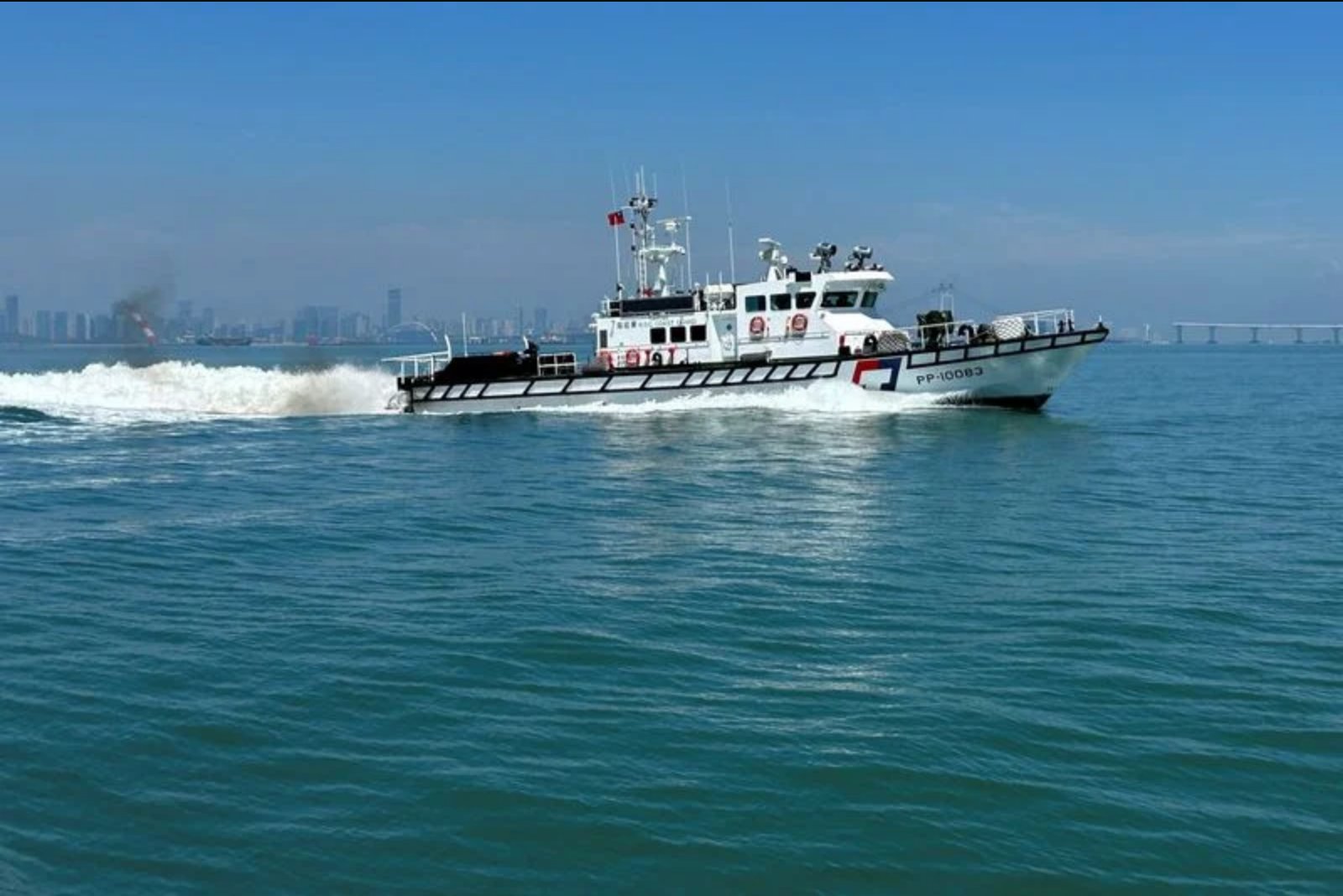
Taiwan's government staged a maritime tour on Thursday, bringing a small group of foreign lawmakers and Taiwanese parliamentarians aboard the coast guard ship PP-10081 to navigate waters around the Kinmen islands - territory administered by Taipei but located a few kilometres from the Chinese mainland.
The 90-minute trip, organized by Taiwan's foreign ministry and the Ocean Affairs Council which oversees the coast guard, is intended to show visiting legislators first-hand the pressures Taiwan says it faces from expanding Chinese maritime operations. Seven foreign lawmakers and two Taiwanese members of parliament joined the tour, which observers believe is the first time such a delegation has been taken on a patrol around Kinmen in this way.
A visible response
The PP-10081 is one of several 100-ton patrol vessels based in Kinmen. On Thursday the vessel carried no visible weapons on deck and crew members were not visibly armed, according to those on board. Encounters between Taiwanese and Chinese coast guard vessels in the Kinmen area typically consist of radio exchanges and verbal warnings; no Chinese coast guard ships appeared during the legislators' tour, though Taiwan's coast guard said Chinese vessels had entered Kinmen waters the day before.
As the ship moved along the northern coast of Kinmen, the delegation had a clear view of the Chinese shoreline, including the new airport at Xiamen. Taiwan officials have said China has not provided safety information for Xiamen's new airport despite its proximity to Kinmen's airport.
Who was on board and why it matters
Among the visitors was Britain’s Tom Tugendhat, a former security minister, who described the trip as an important demonstration of support for Taiwan. He said, "I’m in Taiwan. I’m in Taiwanese waters. This has nothing to do with Beijing. This is to do with simply defending the international rules-based system that the Chinese government in Beijing claims to have signed up to." Also participating were two other British lawmakers and one each from Ukraine, the Czech Republic, India and New Zealand. All are members of the Inter-Parliamentary Alliance on China.
Ukrainian lawmaker Yulia Sirko drew parallels between Taiwan's situation and Ukraine's experience, saying lessons include the need to prepare for conflict to maintain peace. She said that the Ukrainian experience underlines the importance of readiness, noting that delays in preparation had consequences for Ukraine.
Taiwan Coast Guard deputy director Tsai Chung-mou told the visitors that the trip aimed to give the international community a clearer sense of the pressure Kinmen faces. He said, "We hope that all countries around the world that support freedom and democracy can understand that Kinmen stands on the front line of the Taiwan Strait, facing the Chinese Communist Party."
Context of Chinese patrols
Beijing regards democratically governed Taiwan as part of its territory and rejects claims by Taipei to sovereignty or maritime jurisdiction. In 2024, China’s coast guard began regular patrols around the Kinmen islands, which face the Chinese cities of Xiamen and Quanzhou. The move followed the death of two Chinese nationals who were fleeing Taiwan’s coast guard after entering restricted waters.
Since last month, China’s coast guard has also carried out patrols off Taiwan’s east coast in what Beijing described as a law enforcement operation. Those east coast patrols have prompted concern from the United States, Britain, France and Germany, and have provoked strong reactions from Taipei.
When asked about the lawmakers' visit, China’s foreign ministry said Beijing firmly opposes visits by lawmakers from countries that have diplomatic ties with China to Taiwan, describing such trips as "sneaky visits." The ministry also criticized the Inter-Parliamentary Alliance on China, saying the group had "spread lies and rumours concerning China, and has no credibility whatsoever."
Geography, history and local dynamics
Kinmen, along with the Matsu islands further up the coast, has been under Taiwan’s control since 1949 when the Republic of China government relocated to Taipei after its civil war with the Communists. Taiwan’s coast guard operates within waters controlled by Taipei around Kinmen, but Chinese coast guard vessels regularly enter those same waters.
The last major attempt by China to seize Kinmen by force occurred in 1958, during what is commonly referred to as the Second Taiwan Strait Crisis. China’s near-daily artillery fire at Kinmen and Matsu persisted until 1979. Today Kinmen is a frequented tourist destination, with regular ferry services to China, while Taiwan maintains a substantial military presence on the islands.
Political tensions persist at the highest levels. China’s government refuses to engage with President Lai Ching-te, labeling him a "separatist." President Lai has said that only Taiwan’s people can decide their future and that Beijing has no right to claim the island or represent it internationally.
Significance of the visit
By inviting foreign legislators to observe operations and geography at close range, Taipei sought to internationalize what it describes as persistent maritime pressure. The trip provided lawmakers a direct perspective on Kinmen’s proximity to the Chinese mainland and on the patterns of patrols that Taipei says challenge its maritime authority and the safety environment around local infrastructure such as airports.
The event also served as a diplomatic signal amid rising concern in several Western capitals about China’s expanding coast guard activities around Taiwan. For Taiwan, the visit was a calibrated effort to document and communicate the operational realities of those activities to international partners without escalating into a direct confrontation at sea.
Summary
Taiwan hosted a group of seven foreign lawmakers and two Taiwanese MPs on Coast Guard ship PP-10081 for a 90-minute tour around the Kinmen islands. The visit, organized by Taiwan’s foreign ministry and the Ocean Affairs Council, was designed to draw international attention to China’s expanding coast guard patrols near Taiwan-controlled islands, which Taipei and multiple Western governments have flagged as troubling.