
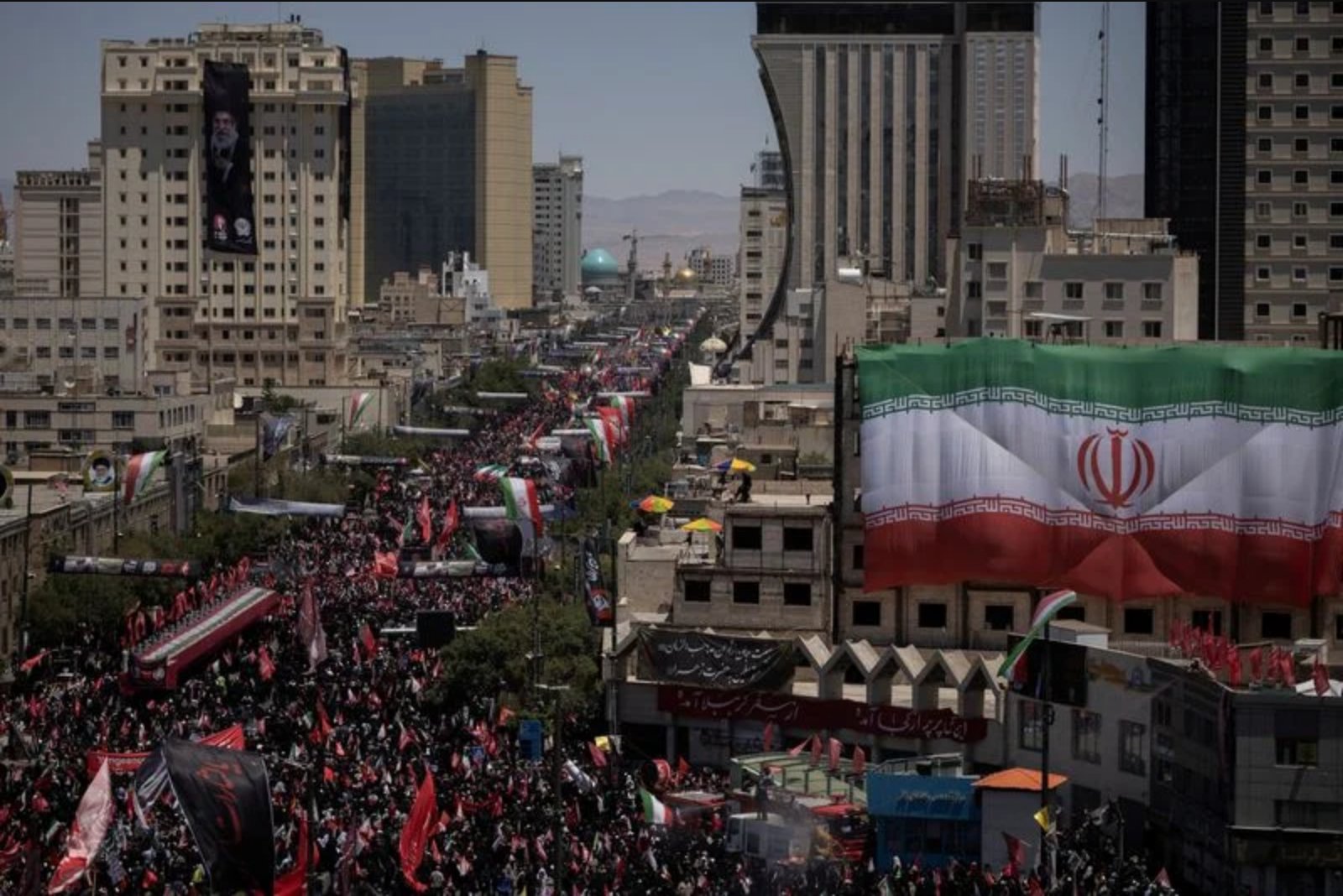
Iran carried out the burial of Supreme Leader Ayatollah Ali Khamenei on Thursday at the Shrine of Imam Reza in Mashhad, the country’s holiest Shi’ite site, concluding a week of mass funerals and public mourning. The ceremony took place as the whereabouts and condition of his son and designated successor, Mojtaba Khamenei, remain largely hidden from public view after he sustained serious injuries in the strike that took his father’s life.
Crowds moved through the streets of Mashhad on Thursday morning, where the Shrine of Imam Reza’s golden dome and minarets reflected the sunlight as mourners carried Iranian flags, images of the late leader, and placards bearing revolutionary slogans. The burial marked the end point of a procession that had passed through major religious and political centers in Iran and Iraq over the preceding week.
During the days of public mourning, Iran’s clerical leadership urged large turnout at funerals and rallies. State religious authorities sought to channel the crowds to project the ideological fervor and resilience of the theocratic system. Khamenei’s remains, together with those of four family members who died with him, were displayed in multiple locations including Tehran and the clerical city of Qom, as well as the Iraqi shrine cities of Najaf and Karbala.
At each stop, mourners packed streets and public squares, accompanied by sung Shi’ite laments and chanting revolutionary slogans. The public rituals drew on the centrality of martyrdom in Shi’ite religious tradition, with the fact that Khamenei was killed by foreign actors emphasized repeatedly during ceremonies.
State messaging and the mass mobilization of mourners occurred against the backdrop of renewed hostilities with the United States following a period of truce. Officials and organisers framed the funerals as demonstrations of the republic’s survival despite what was described as a months-long blitz by its strongest adversaries, the United States and Israel.
Yet despite that portrayal of external resilience, the country faces significant internal strains. The legacy of Khamenei’s 37-year rule remains deeply contested inside Iran. His long tenure as supreme leader saw a consolidation of political, economic and military authority in the office, a process that increasingly sidelined elected institutions including the presidency and parliament, and that evolved together with the growing influence of the Islamic Revolutionary Guard Corps.
The succession process has sharpened focus on the role of the Guards. Mojtaba Khamenei was proclaimed supreme leader by a clerical assembly a week after his father’s death, reportedly with the backing of the Guard establishment that is now widely seen as the dominant actor in Iranian political and strategic affairs.
Despite the proclamation, Mojtaba Khamenei has not appeared publicly since the conflict that began with the strike on February 28 that killed Ali Khamenei. He has issued statements in writing, but no photographs, video, or voice recordings have been released. Senior sources in Tehran have said he sustained debilitating injuries in the same strike, leaving his face disfigured and limbs badly wounded, and that he is in recovery. Those sources added that he has not yet been fit for public appearances and that state security services are acting to limit his exposure because of concern over further U.S. attacks.
As the Mashhad crowds jostled for position to view the cortege, some demonstrators chanted slogans demanding revenge against U.S. President Donald Trump for his role in the killing. Reporters observed shouts including the words: "I swear by the blood of the Supreme Leader, Trump, we will kill you!" Women in the crowds were reported holding placards with the message "Kill Trump."
The funeral proceedings occurred at a sensitive political moment for Iran. The burial effectively turns the page on nearly four decades of rule under Ali Khamenei and follows months in which the Islamic Republic faced mass nationwide protests. Those protests were sparked in part by frustration with an economy strained by sanctions and other pressures. Security forces suppressed the unrest, with authorities responsible for killing thousands of demonstrators in what human rights observers and others described as a wave of repression that echoed past bouts of violence.
Analysts have assessed that Iran has emerged from the recent conflict strategically strengthened in certain respects, including maintaining its control over the Strait of Hormuz. At the same time, the country sustained widespread damage that has added to existing economic difficulties. The combination of external confrontation, internal political shifts, and economic strain sets a complex backdrop for the new leadership and the state’s political institutions as they seek to manage succession and stability.
Context and ceremonial route
Khamenei’s body was moved through Tehran and Qom, the Shi’ite clerical centre, and was displayed in the Iraqi pilgrimage cities of Najaf and Karbala before the final burial in Mashhad. Throughout the processions the state emphasised themes of martyrdom and resistance, with public mourning rituals blending religious lament and political messaging.
Succession and security
Mojtaba Khamenei’s condition and absence from public life have prompted questions about the practicalities of the succession and the role security services and the Guards will play in shielding the new supreme leader while he recovers. Officials have said he is recovering but not yet ready for public duties.
Domestic pressures
Inside Iran, the final ceremony comes amid lingering public grievances tied to the economy and the memory of large-scale protests, and it arrives as the state seeks to project unity and continuity in the face of external confrontation and internal contestation.