
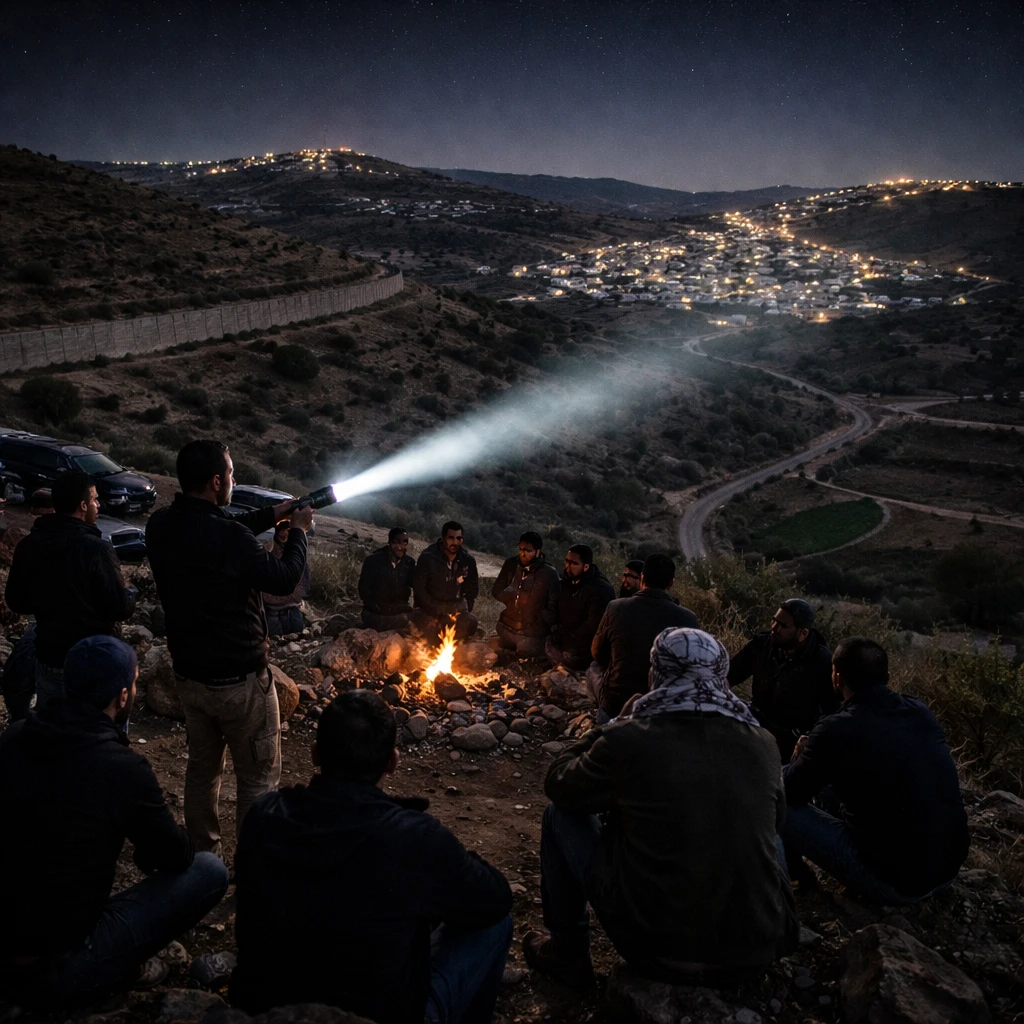
On a cool June night, about 15 residents of Sinjil gathered on a ridge above their town to scan the darkened valleys for signs of movement they fear could herald another Israeli settler assault. The volunteers are part of a grassroots defence effort established by locals who say the existing security apparatus has not been able or willing to stop rising incidents of settler violence.
"We have been left on our own. You are facing settlers supported by their government," said volunteer Fadi Alwan, describing the volunteers' sense of isolation and duty. "We have nobody. So we are forced to stay here and protect this town."
Local and national political developments inform the backdrop to Sinjil's predicament. The current Israeli government has authorised the creation of hundreds of new settlements and outposts across the West Bank. Officials say the placement of those settlements is intended to prevent the emergence of a Palestinian state centered on the West Bank - an objective Palestinians long cited as central to the two-state solution. Most of the international community regards settlement activity in the West Bank as illegal under international law; Israel disputes that characterization.
Residents say that when they contact Israeli police or military forces about attacks they either receive a delayed response or witness security forces acting to assist settlers. The military rejects assertions that it supports settler violence. In response to inquiries about Sinjil and a reported uptick in attacks, the Israeli military said troops deploy to disperse confrontations but noted that responsibility for Israeli civilians in the West Bank rests with the Israeli police. The police did not reply to requests for comment.
How the town organises itself
The volunteer contingent in Sinjil combines stationary watch points with mobile patrols and rapid community alerts. On June 26, as the volunteers warmed themselves around a small fire, one man swept a searchlight over the ridgelines while others made rounds by car. The town uses WhatsApp groups as an alert network so residents can warn each other of suspected threats or approaching settlers.
"If they get close to the houses, we go confront them, we send (messages out) on the WhatsApp groups," Alwan said. The organisation of patrols in and around Sinjil is, residents say, more systematic than similar efforts reported in other West Bank towns.
Alwan described a range of incidents in and near Sinjil. He said a settler beat him with a spiked club as he worked harvesting wheat during daylight hours; he showed a still-fresh wound when speaking with reporters. He also recounted a prior episode in which settlers fired live rounds at a tent used by the volunteers, narrowly missing the men inside. The next day, he said, troops dismantled that watch tent. The military did not immediately comment on allegations that it tore down the volunteers' tent.
Residents believe that most attacks on Sinjil originate from six settler outposts positioned on the hills around the town. Organisations representing settlers did not reply to requests for comment about the outposts or what local regional councils are doing to address violence.
Municipal response and restrictions
Sinjil occupies a position along the main road connecting the Palestinian urban centres of Ramallah and Nablus, with the hills north of the town dotted by settlements and outposts. Municipal officials say that the military has restricted movement into Sinjil by closing four of the town's five entrances and by erecting a metal wall that cuts the community off from approximately 2,000 acres of private land.
"We really feel as if we are living in a collective prison," said Moataz Tawafsha, head of Sinjil's municipality, describing how the town's isolation has intensified since the war in Gaza began in October 2023. Tawafsha said that in the months after that conflict began, settler attacks escalated and the municipality concluded it must take the lead in arranging protection.
According to municipal figures cited by Tawafsha, settler attacks since October 2023 have resulted in two deaths and the displacement of more than 100 people from a Bedouin Palestinian community on town land. He added that a further 20 families were forced to leave their homes in the town's core over the same period.
Personal accounts of survival and assistance
Some residents attribute their immediate safety to community protection efforts. Abed Foqahaa said he installed metal bars on his windows and built a high metal fence around his garden after settlers threw a Molotov cocktail through his family's window roughly two years ago. The resulting fire could not be controlled quickly, he said, and the household suffered from smoke inhalation.
When the incident occurred, Foqahaa broadcast a call for help via the town's WhatsApp group. Young men who initially had been obstructed by the Israeli military managed to reach the house and assisted in carrying out his father, who uses a wheelchair. "God bless them, they really helped us," Foqahaa said.
What residents say they are left with
Residents of Sinjil describe a pattern of repeated confrontations involving settlers based in nearby outposts, constrained access to their agricultural lands, and increasing reliance on municipal and volunteer measures for protection. The community's defensive measures mix improvised watch posts, communication networks and on-the-ground patrols designed to detect and deter attacks and to assist neighbours in distress.
Authorities at the national level frame settlement activity as a strategic policy, while local residents and officials stress the direct impacts on daily life and movement in and out of the town. Military authorities have said they intervene in confrontations, but they placed responsibility for Israeli civilians on the police. The police did not provide comment for this account.
For now, Sinjil's volunteers remain positioned on ridgelines at night and in the streets by day, trying to translate a limited supply of local resources and rapid alerts into a measure of protection residents say they cannot otherwise secure.