
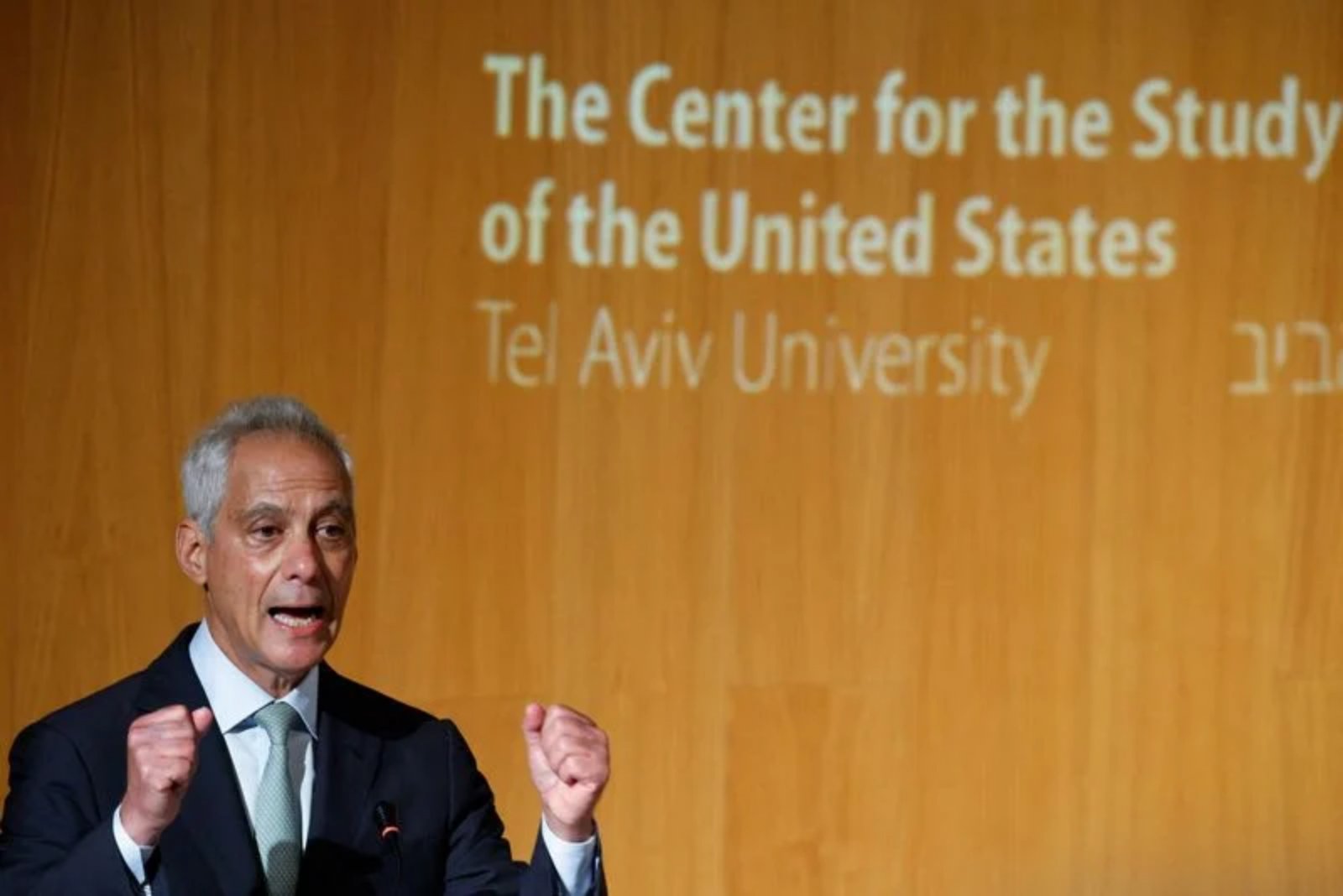
Rahm Emanuel, a prominent Democrat who is considering a run for the 2028 U.S. presidency, delivered a pointed critique of Israel’s current government on Wednesday, saying the trajectory of Israeli policy toward the Palestinians is creating a rift with American public opinion that could jeopardize the bilateral alliance.
Speaking at Tel Aviv University, the former Chicago mayor and one-time White House chief of staff to President Barack Obama argued that deep-seated changes are necessary to preserve the strength of ties between Washington and Jerusalem. "Without question, the alliance is at a crossroads. It cannot stand or survive as it has been. To maintain the strength of our ties, this alliance needs significant changes and a new direction," Emanuel said.
In his remarks, Emanuel identified several Israeli policies he said were driving declining support among Americans, particularly younger voters. He pointed to settlement expansion and settler violence in the occupied West Bank, restrictions on humanitarian aid to Gaza, and other actions that he said have contributed to a broader sense of unease about Israel among U.S. voters.
The speech represented an unusually frank public warning from a high-profile Democrat that long-standing political backing from the United States may no longer be presumed. Emanuel noted the issue has become a major point of division in U.S. politics ahead of the November midterm elections, where progressive Democratic figures have won primary races while opposing U.S. funding for Israel.
Reuters/Ipsos polling figures cited by Emanuel underscore the shift he described: Israeli favorability among Democrats dropped from 59% in 2018 to 22% in May. Emanuel contrasted that decline with persistent support among Republicans, while acknowledging that some factions in former President Donald Trump’s coalition have also advocated cutting aid.
Turning to U.S. policy, Emanuel argued that longstanding unconditional American backing has enabled Prime Minister Benjamin Netanyahu, who has served nearly continuously since 2009, to discount U.S. concerns while pursuing policies that have, in Emanuel’s view, led to violence, destabilization and increased diplomatic isolation for Israel. A spokesperson for Netanyahu did not immediately respond to a request for comment.
One of Emanuel’s concrete policy prescriptions was a change to how the United States subsidizes Israeli defence procurement. He urged that Israel should buy American weapons on the same terms afforded to other allies rather than under a special subsidy arrangement. Currently, military aid to Israel amounts to $3.8 billion a year, and Emanuel said moving away from unconditional defence subsidies would be part of reshaping the bilateral relationship.
Emanuel, who is Jewish and has personal ties to Israel - including volunteer service supporting the Israeli military during the 1991 Gulf War and a father born in Jerusalem - was candid in his assessment of Netanyahu’s strategy. "The prime minister and his government have led Israel into a dead-end," he said, asserting that Netanyahu has favored military action over diplomacy.
Highlighting what he described as strategic failures, Emanuel said Israel "has failed to convert its military gains into strategic advantages." He added that the same pattern applied beyond the issue of Iran: "You had no day-after Hamas plan for Gaza. You had no strategy to make a partner of the Lebanese government against Hezbollah." Those comments echoed concerns about the absence of sustained post-conflict planning and regional partnership-building.
Despite those criticisms, the article notes that Israeli officials have pursued diplomatic efforts in the region: Netanyahu has said he seeks to broaden ties across the Middle East, and Israel launched U.S.-backed peace talks with Lebanon in June. Emanuel proposed a set of trust-building measures aimed at reviving a peace process that stalled in 2014, suggesting Arab states take a central role that would eventually culminate in formal relations between Israel and the Arab League.
Emanuel also leveled criticism at Palestinian and Arab leaders, describing the Palestinian leadership as failed and corrupt and saying Arab governments have largely offered lip service rather than meaningful engagement on Palestinian statehood. There was no immediate comment from the Palestinian Authority.
As discussions about U.S. assistance and regional strategy continue in Washington and Jerusalem, Emanuel’s speech underscores growing domestic political pressure in the United States over Israel policy and highlights tangible policy options - including reassessing defence subsidies and reviving multilateral peace initiatives - as potential responses to the widening gap between American public opinion and current Israeli policies.