
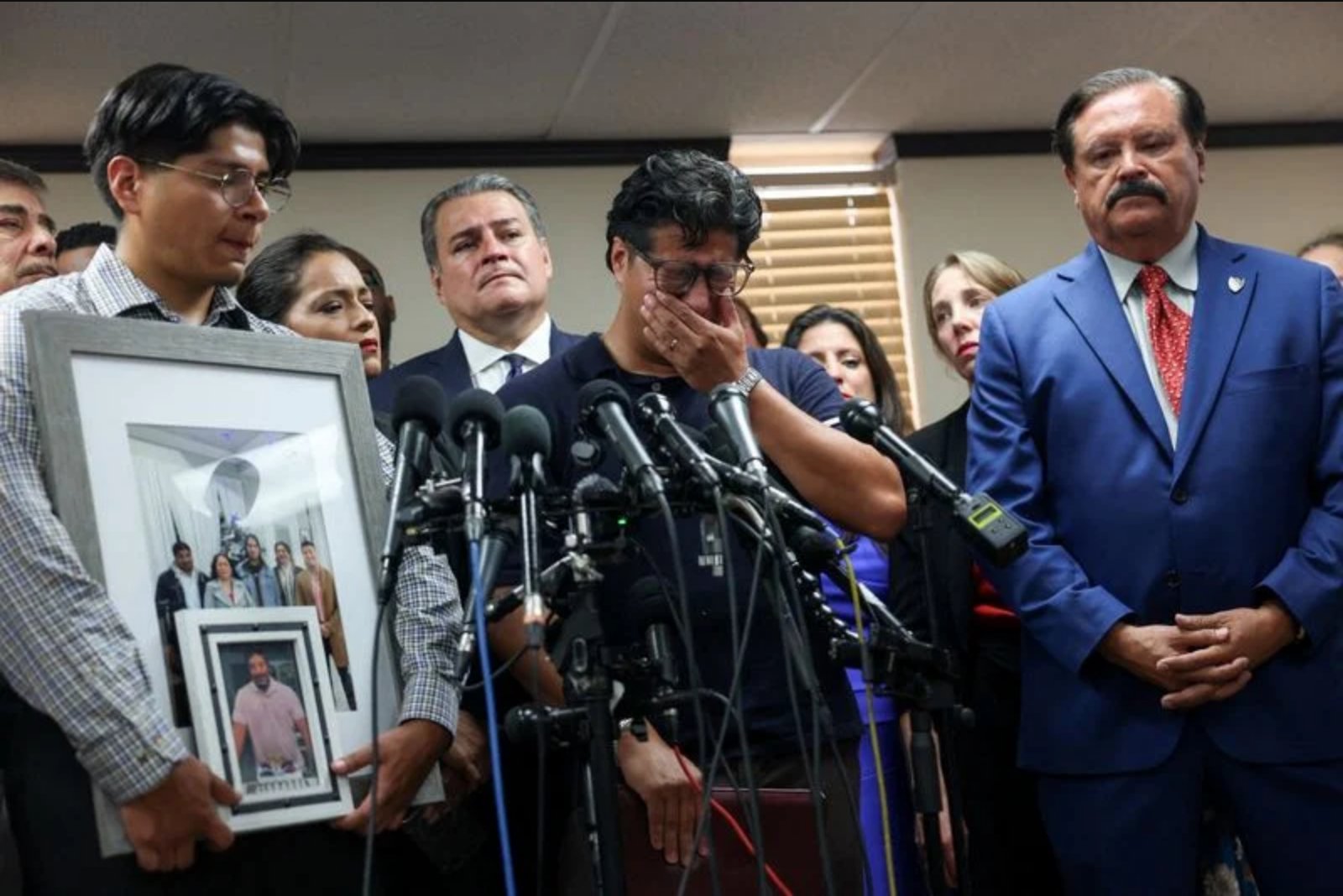
Calls intensified on Wednesday for an independent and transparent inquiry into the killing of Lorenzo Salgado Araujo, a man shot by an Immigration and Customs Enforcement officer in Houston during an operation on Tuesday morning. ICE released a statement saying the driver rammed an ICE vehicle, attempted to run over an officer and was shot by the agent in what the agency described as self-defense. The agency added that Salgado was a Mexican national living in the United States without legal status and had been the subject of a targeted enforcement action.
Independent verification of Salgado’s immigration status and the sequence of events leading to the shooting was not available. Family members, community leaders and elected officials pressed authorities to make evidence public and to allow a truly impartial investigation.
At a press conference on Wednesday, Salgado’s son, Ronaldo, described his father as a peaceful construction worker who had lived in the United States for 35 years. Ronaldo said his father had been working toward legal status and was close to completing that process. He learned of the shooting only after seeing a video shared on social media, which showed his father on the ground beside a white van.
"I recognized him immediately, not from his appearance, but from his voice, crying for help as he lay on the street, bleeding out," Ronaldo said through tears at the news conference. He stood flanked by several members of Congress, leaders from Latino advocacy groups and city officials as he called for "a full investigation" into his father’s death.
Roman Polares, president of the League of United Latin American Citizens, said it was unacceptable to use fatal force and then withhold evidence. "It is un-American to use a fatal force against a human being, then lock away the evidence," he told reporters, and he framed the incident as part of a broader pattern of enforcement that communities of color have long criticized.
ICE said the Department of Homeland Security will lead an investigation of the shooting, while the FBI will take the lead on examining a possible assault on a law enforcement officer. Nonetheless, several local officials and lawmakers said they did not want to rely solely on federal reviews.
Alejandra Salinas, a member of the Houston City Council, wrote in an op-ed that an "immediate and impartial investigation" was needed and that all available video and findings should be released promptly. U.S. Representative Sylvia Garcia, a Democrat representing the neighborhood where the shooting occurred, reiterated those demands at the press event and urged reforms to ICE procedures. Garcia also called for measures including body cameras, clear identification for agents, unmasked officers during operations and an end to paramilitary-style enforcement in neighborhoods.
Houston Mayor John Whitmire, speaking at a City Council meeting, said he was in constant contact with federal officials and asked for a transparent and independent probe but stopped short of initiating a city-led investigation, noting that parallel inquiries could be problematic. The shooting follows tensions between Whitmire and Texas Governor Greg Abbott earlier this year over whether city police should cooperate with ICE. Some observers said Whitmire has since been reluctant to confront federal immigration actions directly.
Brandon Rottinghaus, a University of Houston political science professor, remarked that the mayor might seek to avoid escalation and focus on matters more directly under city control, given the political friction over immigration enforcement.
ICE described the incident by saying Salgado "rammed an ICE law enforcement vehicle, refused to follow multiple verbal commands, and weaponized his vehicle in an attempt to run over an ICE law enforcement officer." According to the agency, the officer fired in self-defense, striking the driver, who later died in a hospital from his injuries.
The Houston shooting occurred as ICE has increased enforcement activity nationwide. Two people familiar with the matter said immigration officers were arresting about 2,000 migrants per day last week. Officials and advocates note that at least six people have been shot and killed by federal immigration officers since January 2025, when the current administration initiated large-scale deportation operations.
As of Wednesday afternoon, no video of the shooting itself had been released, and it was not clear whether the agents involved were equipped with body cameras. The current administration has been criticized for delaying wider adoption of body cameras by immigration officers and for sharply reducing oversight staff last year even as it expanded officer deployments to cities across the country. Those staffing and policy changes have, according to critics, weakened the capacity of ICE and the Department of Homeland Security to investigate allegations of abuse.
In past incidents, initial accounts from federal agencies about the use of force have sometimes been contradicted by subsequent video or other evidence, including instances brought before courts. The article referenced a case in which a Chicago-area woman, Marimar Martinez, was accused in October of ramming law enforcement officers and was shot five times but survived; charges against her were later dropped and video evidence raised questions about whether agents had precipitated the collision.
Other examples cited include two U.S. citizens shot and killed on Minneapolis streets in January - Renee Good and Alex Pretti - where authorities initially reported the individuals had threatened officers, despite video that appeared to contradict those accounts. In May, a Minnesota prosecutor brought charges against an ICE agent in connection with a non-fatal shooting of a Venezuelan man during the same broader enforcement efforts that included the Minneapolis deaths.
The combination of increased enforcement activity, contentious public-safety messaging and reduced oversight staffing has fueled demands for stronger transparency measures, especially the use of body-worn cameras and clearer policies on officer identification during operations. Community leaders and elected officials emphasized that without independent review and full disclosure of evidence, public trust in federal immigration enforcement will be difficult to restore.
Summary
A man identified by ICE as Lorenzo Salgado Araujo was fatally shot by an ICE officer in Houston during a targeted enforcement operation after the agency said he rammed an ICE vehicle and tried to run over an officer. Family members, Latino advocacy groups, local officials and members of Congress are pressing for an independent and transparent investigation and the release of all video and evidence. Federal agencies have announced they will investigate, but critics point to reduced oversight capacity and a history of initial agency statements later contradicted by video or other evidence.
Key points
- Community and political leaders demand an independent investigation and immediate release of all available video and evidence; sectors affected include law enforcement oversight and municipal governance.
- ICE says the shooting was in self-defense after the driver allegedly attempted to run over an officer; this incident occurs amid an uptick in nationwide enforcement, affecting immigration enforcement operations and legal processes.
- Critics highlight policy choices - including delayed adoption of body cameras and cuts to oversight staffing - that affect the Department of Homeland Security and ICE's ability to investigate use-of-force incidents effectively, with potential implications for federal oversight and civil rights litigation.
Risks and uncertainties
- Unclear availability of video and body-camera footage creates uncertainty about the precise sequence of events and complicates public assessment of the shooting - this impacts public confidence in law enforcement and oversight institutions.
- Reliance on internal federal investigations rather than fully independent probes raises concerns about impartiality and could prolong resolution, affecting legal outcomes and community relations.
- Reduced oversight staffing and policy decisions to slow body-camera adoption may weaken investigative capacity and hinder accountability in future use-of-force incidents, with consequences for federal immigration enforcement practices and public trust.