
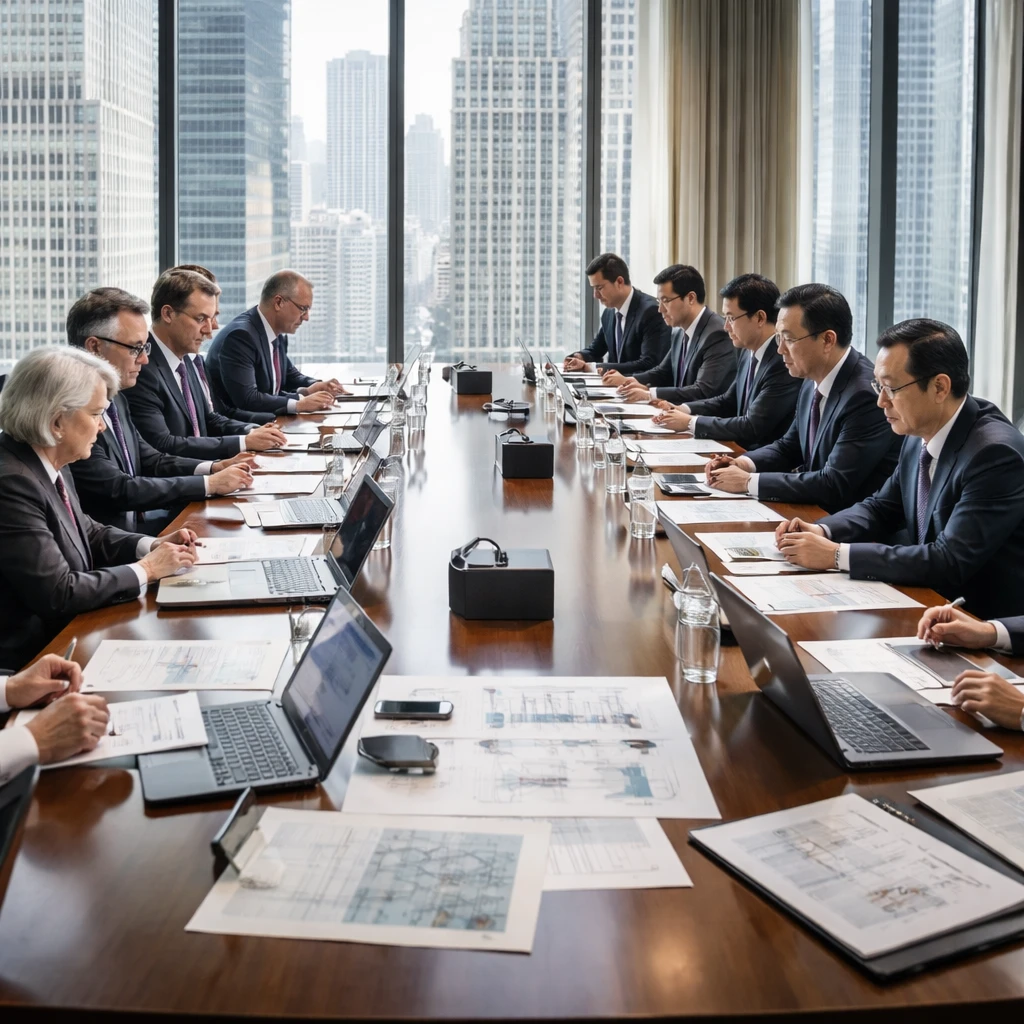
Senior representatives from Washington and Beijing will convene in Manhattan on Sunday for intensive talks intended to shape possible agreements on artificial intelligence, tariffs and critical minerals before a scheduled presidential meeting this week.
The talks will be led by US Treasury Secretary Scott Bessent and Chinese Vice Premier He Lifeng at JP Morgan Chase’s headquarters, with US Trade Representative Jamieson Greer also taking part. The sessions are set to begin at about 10:30 a.m. (1430 GMT) and are expected to continue through the day.
Participants will address several interlocking issues that have been persistent in recent US-China negotiations. Top of the agenda are the status of a trade truce between the two countries that is due to expire on November 10, the movement of Chinese rare-earth magnets and other critical minerals that US officials say remain insufficient, and potential guard rails for advanced AI systems following reports of significant security breaches involving AI models.
Analysts and observers expect the talks to produce incremental outcomes rather than sweeping breakthroughs. Anna Ashton, founder of Ashton Intelligence and a longtime China trade analyst, said she anticipated some tangible deliverables to present ahead of the presidential summit but did not foresee a major breakthrough. "I think there will be some show of deliverables because of the fact that it’s a presidential summit coming, but I don’t feel like we’re on the verge of some sort of breakthrough," Ashton said. "I think status quo is probably both sides’ general best expectation."
The agenda includes issues that trace back to discussions between Presidents Trump and Xi in Beijing in May. Those carryovers encompass efforts to reduce tariffs on non-strategic goods, Chinese commitments to increase purchases of US agricultural products by $17 billion a year and a pledge to buy more than 200 Boeing aircraft.
The Bessent-He-Greer meeting follows a pattern of preparatory talks held over the past 16 months, during which the three officials met in European and Asian cities to lay groundwork for agreements for the leaders. One milestone in that sequence was a truce reached in Busan, South Korea, in November 2025 that capped US tariffs imposed during President Trump’s second term at roughly 20% on Chinese goods, after earlier rounds of escalation had driven duties to much higher levels on both sides.
Subsequent legal and policy developments have altered the tariff landscape. The US Supreme Court struck down Trump-era tariffs that had been invoked under a national emergencies law, including duties linked to fentanyl trafficking, and the administration has moved to rebuild some measures under new authorities. Among those steps is the restoration of a 12.5% tariff on certain Chinese goods over forced labor allegations. Officials are also finalizing a separate tariff investigation aimed at addressing what they describe as excess industrial capacity in China.
Under the earlier truce, China pledged to restore flows of critical minerals to US and global users. A senior US official told reporters that China’s delivery on that promise "has not been up to par," and that the adequacy of Chinese shipments of rare-earth magnets and related materials will be a focal point in the New York talks.
Discussions on AI are taking on added urgency because the United States and China represent the dominant forces in developing advanced AI tools and in driving global adoption of those technologies. Rare earths and other critical minerals are essential inputs in the manufacture of advanced semiconductor components that underpin AI systems, linking the supply chain debate directly to technological competition and security concerns.
Bessent said he expects the AI portion of the discussions to include both "open- and closed-weight models." Open-weight models refer to AI systems whose core elements are publicly accessible and that can be downloaded and adapted for specific uses. Such Chinese open-weight models have been noted for becoming more popular among some US companies because they can be less costly than closed-weight AI products developed by US firms.
In a statement about the talks, Bessent reiterated that "the United States remains the leader in AI," while expressing willingness to engage on measures to "avoid shared risks and avoid bifurcation of our two systems." He has advocated for agreed-upon AI guard rails to help prevent powerful models from being exploited by malign non-state actors.
The trade agenda also contemplates renewed negotiations on tariff reductions and investment issues. In May, both countries agreed to begin talks to lower tariffs on non-strategic goods through a mechanism labeled a "Board of Trade," and to create a parallel forum to address specific investment concerns.
The US administration is reported to be working on rules that would likely permit US pharmaceutical companies to invest in promising Chinese drug candidates and to enter licensing arrangements for them. Those discussions form part of a broader effort to calibrate investment controls while preserving avenues for commercial cooperation in selected sectors.
China’s Ministry of Commerce said that Vice Premier He will lead a delegation of Chinese companies to the United States to take part in economic and trade consultations ahead of the leaders’ summit. That business delegation mirrors a group of US chief executives that President Trump brought to Beijing in May.
The visit and the talks come as President Trump signaled openness to Chinese automakers constructing factories in the United States. At the same time, US auto industry groups urged the administration to retain an effective ban on Chinese vehicle sales in the US on national security grounds, underscoring the competing pressures on policymakers as they weigh market access against security concerns.
Officials and analysts expect that the New York discussions will aim to produce modest but concrete measures designed to show continued efforts to avoid escalation in a complex and consequential bilateral relationship. With the truce deadline and the presidential summit framing the timetable, negotiators face pressure to shape outcomes that can be presented as progress without committing to sweeping new arrangements.
How the parties reconcile differences on critical mineral flows, AI governance and tariff rollbacks will have implications across sectors, including defense-related supply chains, semiconductor manufacturing, aerospace and automotive industries, and the technology firms that rely on access to advanced AI systems.
These talks represent another step in a protracted sequence of negotiations intended to manage competition while preserving channels for cooperation on issues that affect global markets and security.