
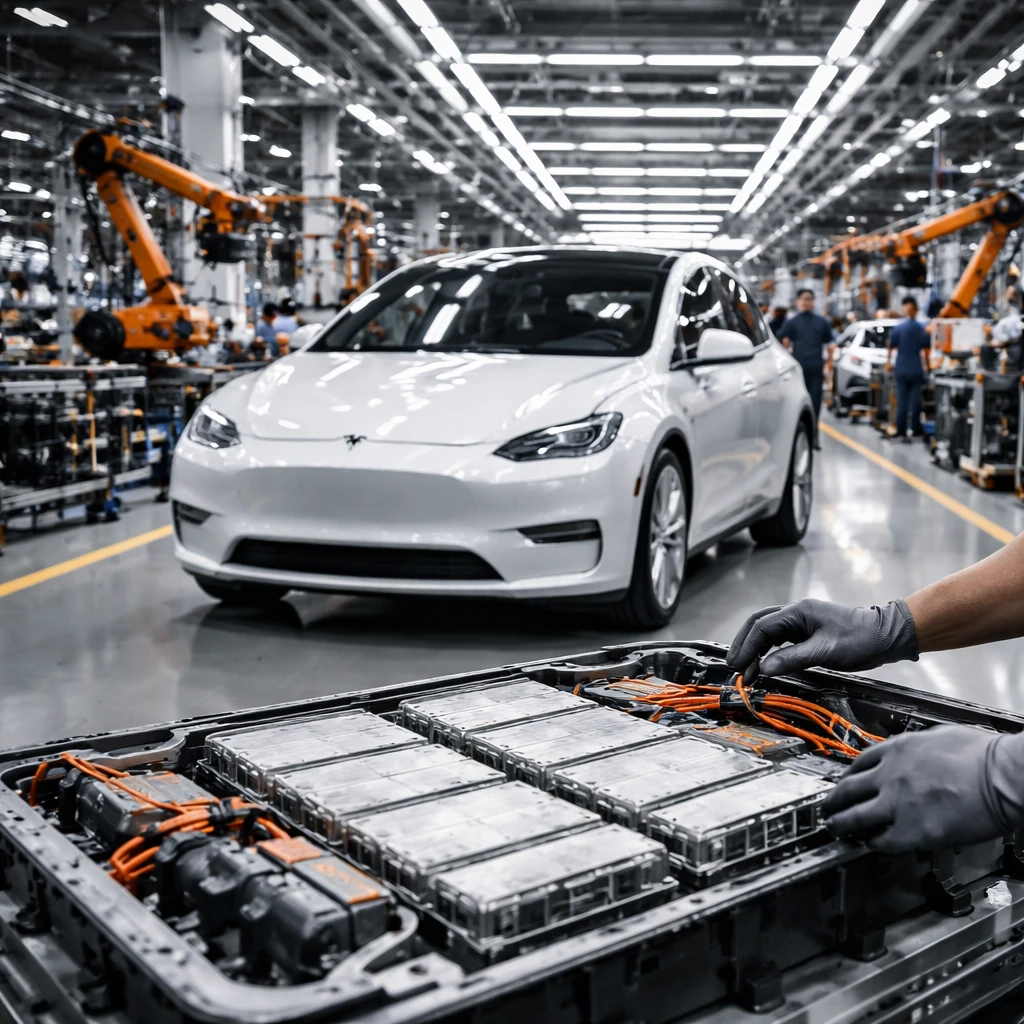
Tesla's recent delivery figures on Friday triggered a rally in its Chinese supplier stocks, reflecting a market response to what investors see as signs of a possible recovery after two consecutive years of falling sales.
In Mainland trading, parts suppliers Ningbo Xusheng, Ningbo Tuopu and Zhejiang Sanhua each climbed in the range of 5% to 9%. In Hong Kong, Fuyao Glass rose about 3%, while CATL, a major battery supplier, added 0.7%.
Delivery numbers and regional drivers
The automaker reported a record 480,126 vehicle deliveries in the June quarter. That total was supported by strong demand in Europe and only marginal growth in China, according to the company figures. Tesla also rolled out a number of lower-cost versions of its two best-selling models, the Model 3 and Model Y, which the company said helped underpin demand amid rising global fuel prices.
Production of a refreshed Model Y contributed to the increase in China-made vehicle shipments, underscoring the continued importance of China as both a production base and sales market for the electric vehicle maker.
Competitive backdrop
Tesla's delivery strength comes even as competition from major Chinese electric vehicle manufacturers, notably BYD, has intensified. Those rivals are also expanding their footprints in Europe, presenting an ongoing competitive challenge.
Market interpretation
Traders and investors appear to have rewarded suppliers with share gains following the delivery release, signaling optimism that improvements in Tesla's top-line volume could flow through to component makers and related parts suppliers. The gains were concentrated among firms tied directly to vehicle parts and battery supply chains.
What remains clear from the report
- Tesla achieved a quarterly delivery record of 480,126 vehicles.
- Europe drove much of the growth, while China saw only marginal increases.
- Lower-cost Model 3 and Model Y variants and refreshed Model Y production in China supported sales volumes.
While the delivery figures prompted immediate stock moves among suppliers, the evolving competitive landscape and region-by-region performance underline that future momentum may depend on sustaining demand in key markets and how competitors respond.