
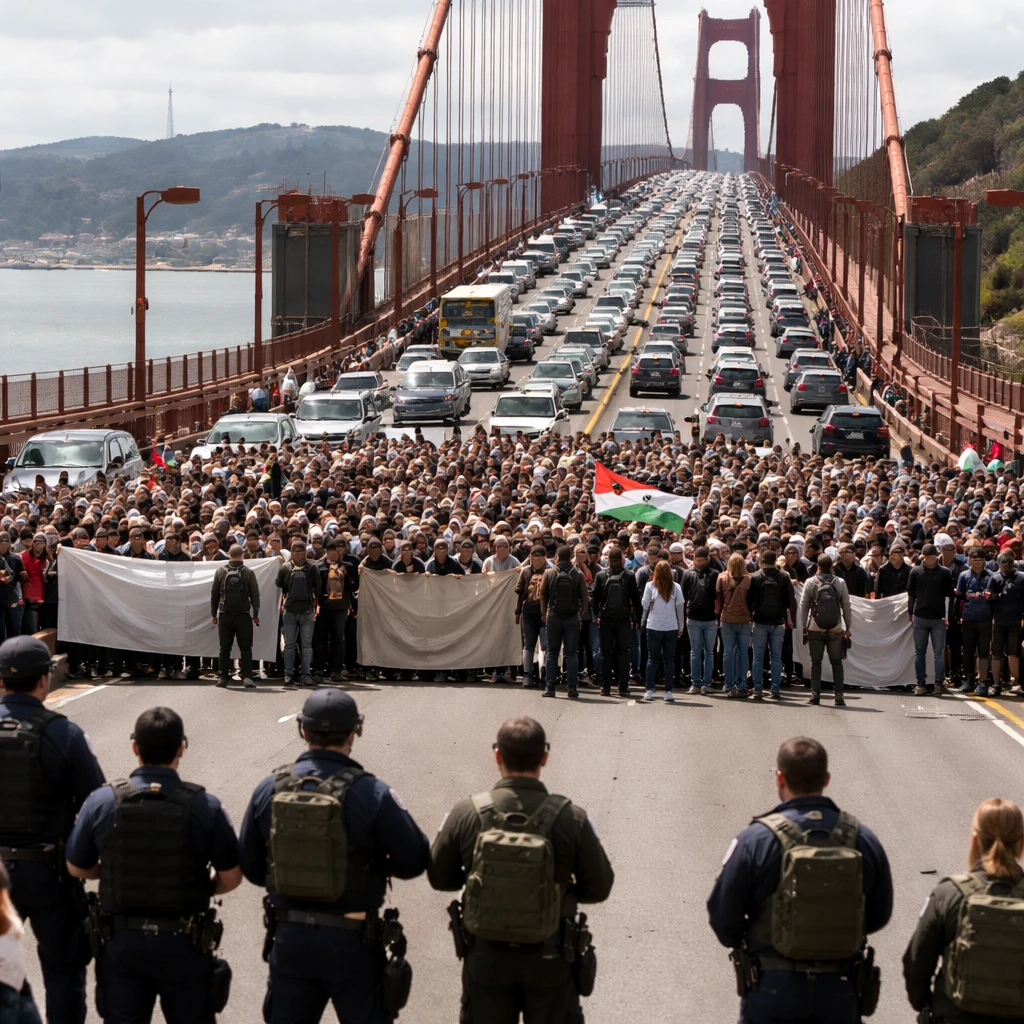
A San Francisco jury on Thursday returned guilty verdicts on six misdemeanor charges against seven individuals who took part in a pro-Palestinian demonstration that blocked traffic on the Golden Gate Bridge in 2024, according to a statement from San Francisco District Attorney Brooke Jenkins.
The panel remained deadlocked, however, on the principal felony allegation of conspiracy. The jury was unable to reach a verdict on that charge, which the indictment describes as an agreement between two or more people to commit a crime coupled with an overt act. A conviction on the felony count would have exposed defendants to a longer maximum sentence.
In the misdemeanor convictions, each of the seven defendants was found guilty on six counts that included false imprisonment, obstruction of thoroughfare and unlawful assembly. One of the defendants was also convicted on an additional misdemeanor charge of refusing to disperse, the district attorney's office said.
The seven protesters who were convicted are Bhavika Anandpura, River Allen, Rocky Chau, Sara Cantor, Conrad de Jesus, Sarah Ferrell, and Em Tillotson, local media reports said. Sentencing is scheduled for August, and the convictions carry an exposure of up to five years in county jail.
District Attorney Brooke Jenkins said in a public statement that prosecutors will "evaluate our options and consider next steps," reflecting the unresolved status of the felony conspiracy allegation.
Defense attorneys framed the actions of their clients as a moral response to the humanitarian crisis in Gaza and to U.S. policy. They said the defendants had attempted other channels of advocacy - including writing letters and appealing to congressional representatives - and turned to the tactic of blocking the bridge only after those efforts failed to produce a result.
Jenkins’ office countered that the protest halted traffic for approximately four hours and created safety hazards for motorists and other people who became trapped in the resulting congestion. The prosecution emphasized the disruption and risk caused by the prolonged blockage.
One of the defense attorneys, Nuha Abusamra, told local outlet KQED that the convictions on the lower-level charges nonetheless represented a victory for the defense. Abusamra was quoted as saying: "Taking a bridge and blocking traffic for a few hours years ago is the bare minimum that we should be doing as American citizens while our tax dollars continue to fund the mass genocide of Palestinians."
The demonstration was part of a wave of large-scale protests across the United States in 2024 that demanded an end to Israel’s military campaign in Gaza and called for Washington to withdraw support for Israel. Those demonstrations also included calls for universities to divest funds from companies perceived to be supporting Israel.
The events in Gaza that drove the protests were described in the court statement materials as having caused mass casualties and widespread displacement. The statement noted that Israel’s assault on Gaza has killed tens of thousands, contributed to a hunger crisis, and internally displaced nearly all of Gaza’s population. It also cited that rights experts, scholars and inquiries by United Nations bodies have characterized the situation as a genocide.
The statement included Israel’s response to those characterizations: Israel describes its operations as acts of self-defense following an October 2023 Hamas-led attack that resulted in 1,200 deaths and the taking of more than 250 hostages.
With sentencing set for August, legal observers and the parties involved will now confront a decision point about whether prosecutors will pursue additional proceedings tied to the unresolved felony conspiracy charge and how defense teams will respond.