
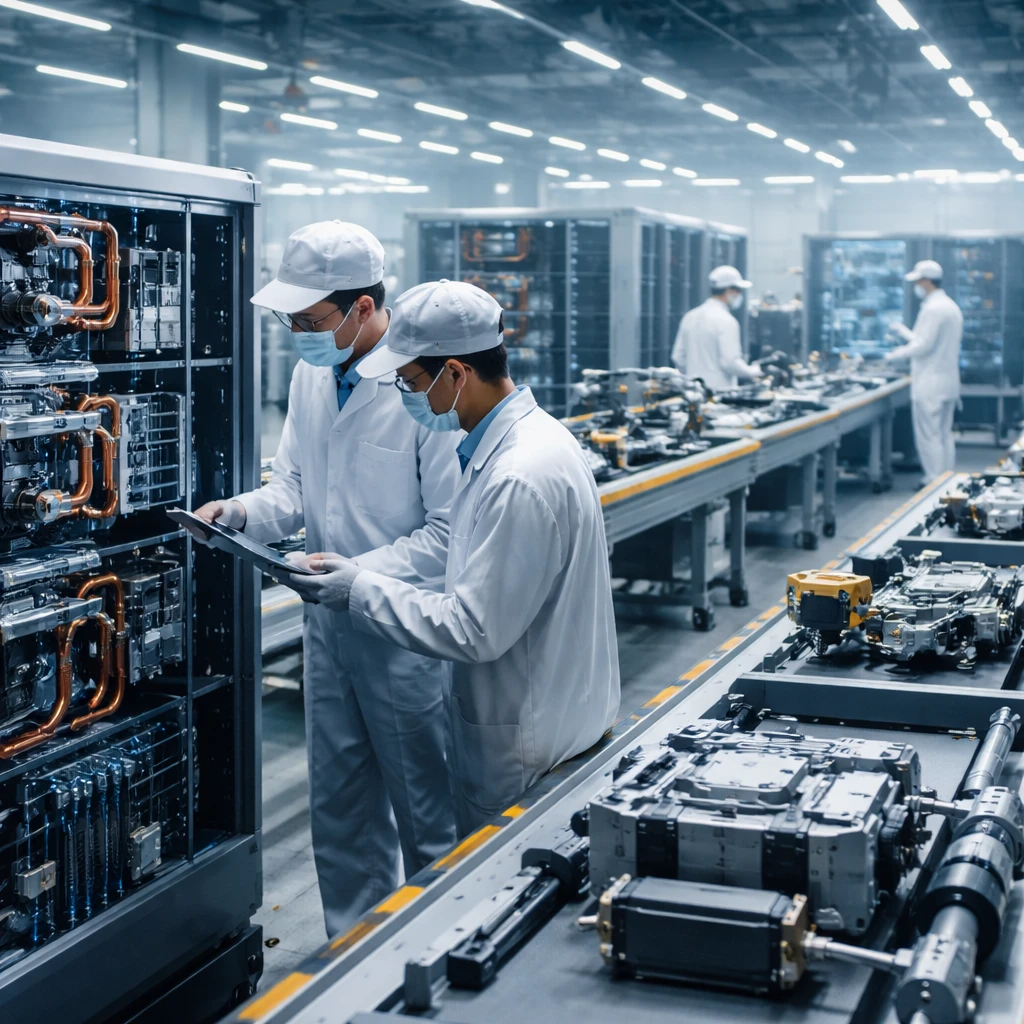
Macquarie has upgraded BYD Electronic's stock to "Outperform" from "Underperform," citing an anticipated recovery in earnings beginning in the second half of 2026 as server manufacturing and liquid-cooling businesses scale up. The brokerage also raised its 12-month target price by 18% to HK$29.22, up from HK$24.70.
The company reported a soft first half, with revenue edging up 2% year-on-year to 82.2 billion yuan while net profit dropped 75.4% to 426 million yuan. Macquarie attributed the sharp decline in profit to several factors: weakness in smart-terminal components, product-specification changes at a major overseas customer, foreign-exchange losses and heavy upfront investment in AI infrastructure.
Macquarie expects the current earnings trough to reverse in the second half of 2026, with a more meaningful inflection anticipated in the fourth quarter. The brokerage highlighted several operational drivers for this turnaround: new smartphone launches that should lift utilisation, the commencement of liquid-cooling mass production, and a ramp-up in server shipments.
AI infrastructure as the principal opportunity
Management has pointed to AI infrastructure as the largest growth opportunity within the business. The company guided 2026 server revenue in a range of 3 billion yuan to 5 billion yuan and liquid-cooling revenue of roughly 300 million yuan to 500 million yuan. Macquarie's own forecasts put AI infrastructure revenue at 3.7 billion yuan for 2026 and 6.6 billion yuan for 2027.
The brokerage expects server production deliveries to one of China's top three internet companies to begin in the fourth quarter of 2026. It also noted that under tight supply conditions, server gross margins could reach double digits. On the liquid-cooling front, BYD Electronic is preparing for volume production of liquid-cooling products for next-generation Vera Rubin systems beginning in September, with additional projects slated to enter mass production around December.
Automotive and smart terminals: contrasting trajectories
The company's automotive business provided another near-term source of growth. New energy vehicle (NEV) component revenue rose 6.4% in the first half, supported by intelligent suspension systems, flash charging technology and stronger overseas demand. Macquarie projects the NEV component segment to expand 37% year-on-year in the second half as vehicle sales recover and the company captures further supply-chain share.
By contrast, smart terminals remain a drag on near-term results. Component revenue in this segment fell about 13% in the first half, a decline linked to product-specification changes at an overseas flagship customer. Macquarie expects smart-terminal revenue to decline approximately 5% in the second half, though it said Android flagship smartphone launches from September through November should help lift utilisation and improve fourth-quarter profitability.
Profit outlook and valuation
Despite the recent downgrade in near-term profit outlooks, Macquarie expects net profit to rebound strongly in 2027, rising 83% year-on-year after two consecutive years of declines. The brokerage attributes that expected improvement to momentum in data-centre demand, steady EV-related growth and upgrades in smartphone casing materials.
Macquarie reduced its 2026 net profit forecast by 33% and its 2027 forecast by 1%, citing lower expected gross margins. It raised its 2028 estimate by 4% on assumptions of lower operating expenses.
The HK$29.22 target price is based on a sum-of-the-parts valuation. Macquarie applied 12 times 2027 earnings to smart terminals, 15 times to NEV components and 25 times to AI computing infrastructure. At the company's quoted price of HK$24.76 on Aug. 28, that target implied an expected total shareholder return of 18.6%.
Key catalysts and potential downside risks
Macquarie identified several catalysts that could influence the stock's near-term performance, including the September iPhone launch and BYD Electronic's third-quarter results. The brokerage also flagged specific risks: weaker-than-expected iPhone and iPad sales, heavy reliance on BYD for about 80% of the NEV component business, and a potential slowdown in Chinese AI capital spending.
Conclusion
The upgrade reflects Macquarie's view that BYD Electronic's near-term investments in AI infrastructure and capacity expansion will pay off by the back half of 2026, with meaningful momentum expected in the fourth quarter and into 2027. The firm nevertheless tempered its near-term profit projections and highlighted several execution and market-demand risks that could affect the timing and extent of a recovery.