
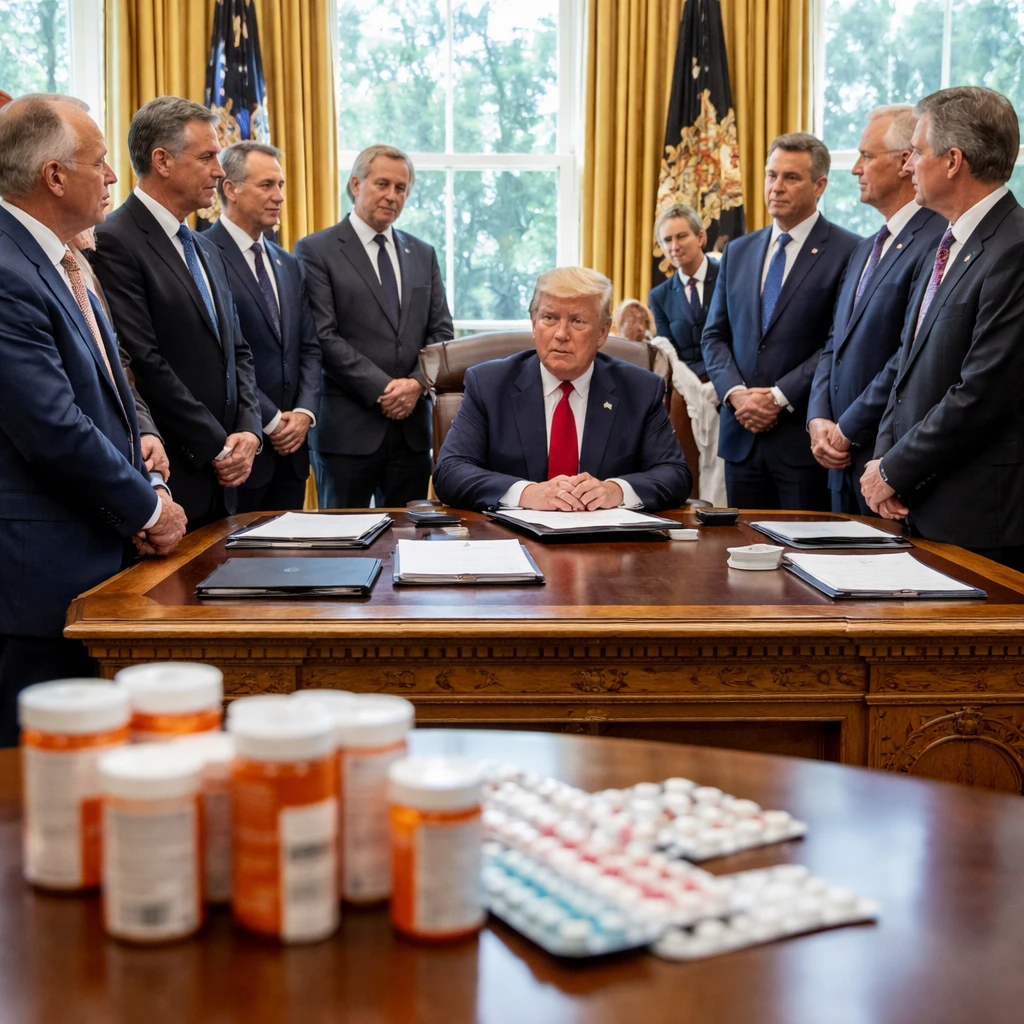
President Donald Trump on Monday announced that drug-pricing agreements have been signed with nine pharmaceutical companies as part of the administration's effort to bring down healthcare costs for U.S. patients.
At an Oval Office event attended by executives from the participating firms, Trump said the arrangements will make certain medicines available to state Medicaid programs at most-favored-nation prices. He described the change as "a tremendous discount, which should bring down the cost of your medical care by tremendous amounts."
The agreements cited by the administration name Astellas (TYO:4503), BeOne Medicines (SHH:688235), CSL (ASX:CSL), BridgeBIO (NASDAQ:BBIO), Sun Pharmaceutical (NSE:SUN), Teva (TASE:TEVA), and UCB SA (EBR:UCB) as signatories. The administration characterized the pricing structure as requiring drugmakers to offer prices comparable to those paid in other developed countries.
Officials framed the latest accords as an expansion of an earlier set of deals made beginning last year with 17 major drugmakers, including Pfizer (NYSE:PFE), Eli Lilly (NYSE:LLY), and Amgen (NASDAQ:AMGN). Those earlier arrangements included provisions to reduce some prices for federal health programs and to sell specified medicines directly to patients through a Trump-branded website in exchange for tariff relief.
The administration emphasized that Americans currently pay the highest prices for prescription medicines among developed nations, often nearly three times more than patients elsewhere. The most-favored-nation pricing model included in the new agreements was described as a mechanism to align some U.S. prices with levels paid in other developed countries.
The announcement did not provide additional operational details about how the agreements will be implemented across state Medicaid programs or the precise list of medicines covered. The public remarks focused on the expected magnitude of discounts and the administration's broader push to reduce domestic drug prices.
Context and next steps
The administration portrayed the agreements as building on prior negotiations with pharmaceutical companies. Beyond the public statements and the list of signatory companies, the announcement did not disclose further specifics on timelines, verification processes, or the full scope of medicines included in the deals.