
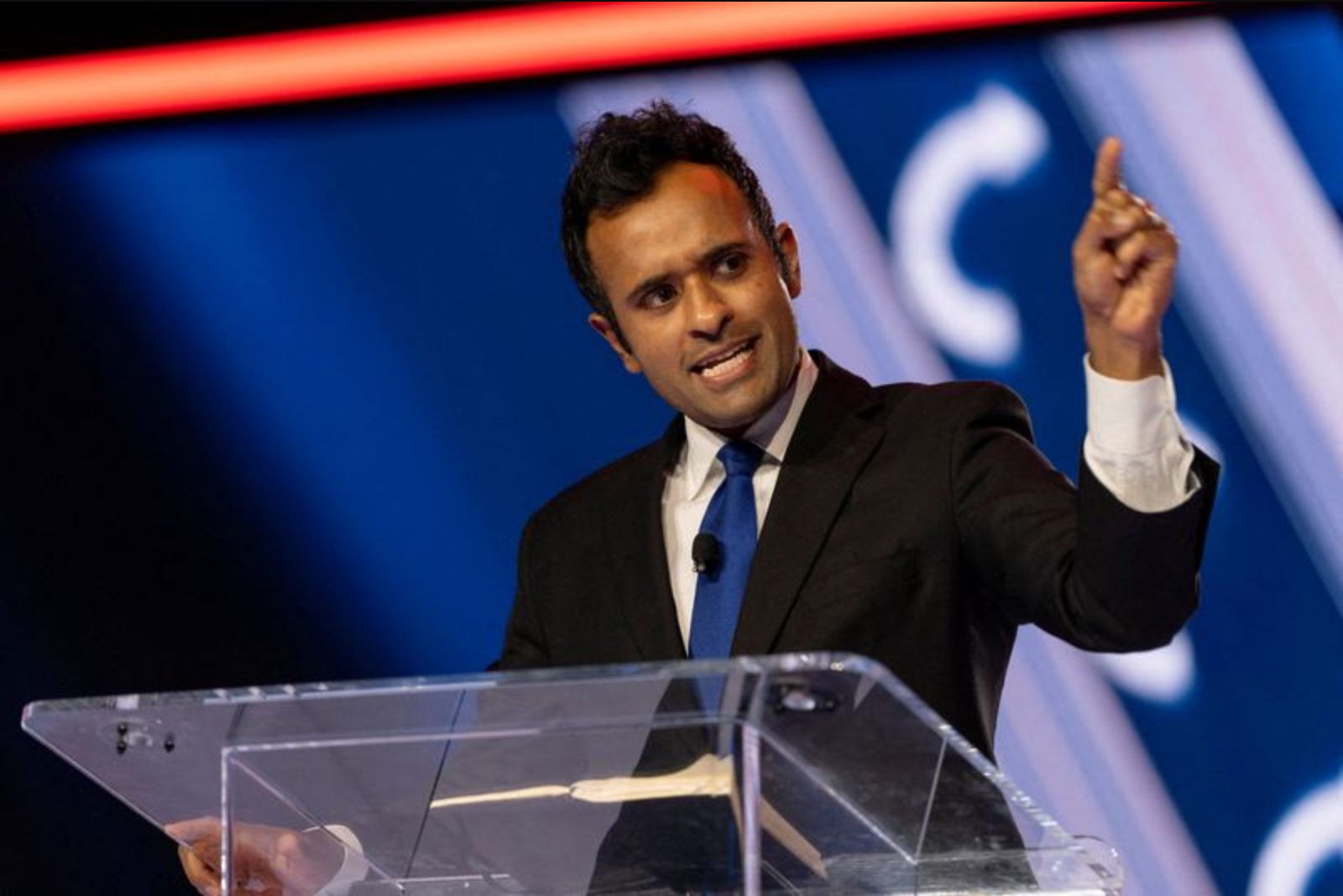
Vivek Ramaswamy secured the Republican nomination for governor of Ohio on Tuesday and is set to challenge Democrat Amy Acton in the November general election. Acton is a physician who previously served as director of the Ohio Department of Health. The Midwestern state has not elected a Democratic governor since 2006 and is the scene of a highly competitive U.S. Senate contest in this year’s midterm elections, a factor observers say could affect the governor's race.
Early life and education
Ramaswamy, 40, was born in Cincinnati to parents who emigrated from southern India. He was raised in his parents' Hindu faith but attended a Roman Catholic high school. He later earned an undergraduate degree in biology from Harvard University and went on to attend Yale Law School.
Finance and the biotech enterprise
Before graduating from Yale, Ramaswamy worked as a hedge fund investor and says he had already accumulated several million dollars. In 2014 he founded Roivant Sciences, a biotech firm that acquired patents from larger corporations for drugs that had not yet been fully developed and then pursued commercialization. He resigned as chief executive of Roivant in 2021. A 2023 estimate by Forbes placed his net worth at $630 million.
Political evolution, voting history and public persona
Ramaswamy describes himself as having been a libertarian while in college. During his time at Harvard he performed libertarian-themed rap under the stage name Da Vek. He revived aspects of that performance persona during his 2024 presidential run, including an Iowa State Fair rendition of Eminem's "Lose Yourself" that attracted attention on social media.
On voting, Ramaswamy says he supported a libertarian candidate in the 2004 presidential election but did not cast ballots in 2008, 2012 or 2016. He has donated to both Republican and Democratic candidates, and says he voted for Donald Trump in 2020.
Anti-woke advocacy and published critique
In recent years Ramaswamy has emerged as a vocal conservative critic of corporate engagement with social causes. His 2021 book, "Woke, Inc.," argues that some large companies have reshaped strategy around social justice and climate concerns, a trend he labels "wokeism." He contends that this influence undermines work ethic, capitalism, religious faith and patriotism. The book helped elevate his profile within conservative circles.
2024 presidential bid and brief federal role
Ramaswamy ran for president in 2024 as a long-shot candidate but drew notice for aggressive debate performances and policy positions that, by his account and coverage at the time, were further to the right of former President Trump on some issues. He ended the campaign after finishing fourth in the Iowa caucuses and subsequently endorsed Trump.
A week after the election, Trump named Ramaswamy to lead an entity called the Department of Government Efficiency, or DOGE, alongside billionaire Elon Musk. Ramaswamy stepped away from that role on Inauguration Day to concentrate on his bid for the Ohio governorship.
Condemnation of racism and antisemitism
In December, Ramaswamy publicly criticized rising racism and antisemitism within the political right during remarks to a gathering of conservative activists. He singled out racial slurs aimed at the second lady, Usha Vance, who was noted in his remarks as being born in San Diego to Indian immigrants.
"If you believe in normalizing hatred towards any ethnic group: toward whites, towards Blacks, towards Hispanics, towards Jews, towards Indians, you have no place in the future of the conservative movement. Period," Ramaswamy said at AmericaFest, a conservative conference organized by Turning Point USA, the organization founded by slain activist Charlie Kirk.
"And if you can’t say those things without stuttering, then you have no place as a leader at any level in the conservative movement either - certainly not in my state of Ohio," he added.
What to watch
Ramaswamy's victory in the Republican primary sets up a November contest in a state that has favored Republicans at the gubernatorial level for several election cycles. The presence of a competitive U.S. Senate race in Ohio this midterm cycle is a notable element that could influence turnout and the broader dynamics of the governor's race.