
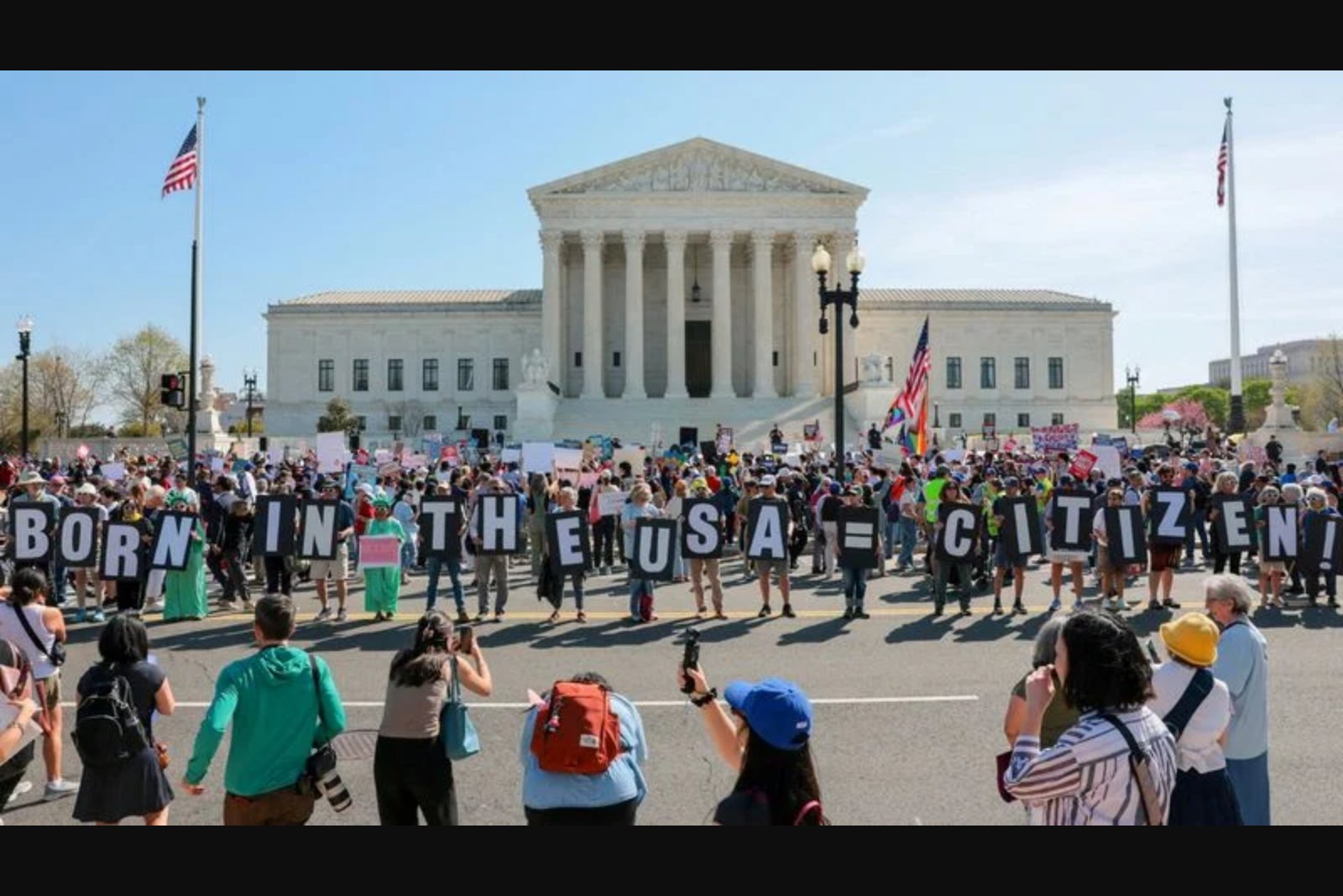
The U.S. Supreme Court is set to rule on Tuesday whether President Donald Trump may enforce an executive order that would narrow the long-standing practice of birthright citizenship in the United States. The order instructs federal agencies not to recognize children born on American soil as citizens when neither parent is either a U.S. citizen or a lawful permanent resident, commonly known as a green card holder.
A federal judge had previously enjoined the administration's directive, blocking its implementation. The case considered by the court originated as a class-action lawsuit brought in New Hampshire by parents and children who said the president's order threatened their citizenship. The court's decision will come on the final day of its current term, which began in October.
Challengers argue the executive order violates the 14th Amendment, which confers citizenship on those born in the United States who are "subject to the jurisdiction thereof." The administration, by contrast, contends that the phrase narrows eligibility for birthright citizenship and excludes children of immigrants who are in the country unlawfully or whose presence in the nation is temporary, such as students or holders of temporary work visas.
In the administration's framing, citizenship at birth is properly reserved for the children of those whose "primary allegiance" is to the United States, a status it says is established by "lawful domicile." Lawyers for the administration have defined "lawful domicile" as "lawful, permanent residence within a nation, with intent to remain."
President Trump issued the executive order on his first day back in office last year as part of a broader package of measures aimed at tightening legal and illegal immigration. The directive was a central element of the administration's immigration agenda and has drawn criticism from opponents who say the approach reflects racial and religious discrimination.
The timing of the Supreme Court's review places the issue of who qualifies as an American citizen close to the July 4 holiday, when the nation marks the 250th anniversary of its founding. Ahead of the ruling, some experts told observers the policy, if permitted, could affect the legal status of as many as 250,000 babies born in the United States each year and might force the families of millions more to document the citizenship status of newborn children.
Legal background and the class-action challenge
The case before the justices involves a class-action lawsuit filed in New Hampshire, where plaintiffs sought to block the order nationwide. The 14th Amendment's Citizenship Clause has long been read to confer citizenship at birth to almost all persons born on U.S. soil, with narrow exceptions traditionally limited to the children of foreign diplomats and members of an occupying enemy force.
The precise language at the center of the dispute reads: "All persons born or naturalized in the United States, and subject to the jurisdiction thereof, are citizens of the United States and of the state wherein they reside." The administration argues that the clause's reference to being "subject to the jurisdiction thereof" imposes a meaningful boundary on who is eligible for birthright citizenship.
Challengers counter that Supreme Court precedent has already resolved the matter. They point to United States v. Wong Kim Ark, an 1898 decision in which the court recognized that the 14th Amendment grants citizenship by birth on U.S. soil, including to children born to foreign nationals in the United States.
The administration, however, told the justices that Wong Kim Ark does not undercut its position. In its view, that decision is consistent with the administration's narrower interpretation because, it says, Wong Kim Ark's parents had a permanent domicile and residence in the United States at the time of his birth. During oral argument, some justices signaled skepticism about the administration's reliance on the 1898 precedent. Conservative Justice Neil Gorsuch told the solicitor general: "Well, I'm not sure how much you want to rely on Wong Kim Ark."
Oral argument and administration claims
The case drew extraordinary attention when President Trump attended the Supreme Court on April 1 to hear arguments — a first for a sitting president. He left before the proceedings concluded, departing not long after the lawyer arguing against the administration had begun.
At oral argument, U.S. Solicitor General D. John Sauer defended the administration's view and cited what he described as a growing industry of "birth tourism" that he said had arisen in response to the near-automatic promise of citizenship for children born in the United States. Sauer asserted that "uncounted thousands of foreigners from potentially hostile nations have flocked to give birth in the United States in recent decades" to secure citizenship for their children, though when pressed about the scope of the problem he primarily pointed to media accounts and acknowledged that "no one knows for sure."
Sauer framed the Citizenship Clause as a post-Civil War provision with a limited purpose. He told the court it was adopted "to grant citizenship to the newly freed slaves and their children, whose allegiance to the United States had been established by generations of domicile here." The 14th Amendment was ratified in 1868 after the Civil War and overruled an earlier Supreme Court decision that had excluded people of African descent from citizenship.
Procedural history and wider judicial context
In July 2025, U.S. District Judge Joseph Laplante of Concord, New Hampshire, allowed the class-action challenge to proceed and certified it as a class, enabling the plaintiffs' request to block the policy nationwide. Separately, the Supreme Court last year provided the administration with a narrower win by limiting the power of lower federal judges to impose nationwide injunctions against presidential policies. That prior decision, however, did not resolve whether the executive order itself is lawful.
The court's conservative majority has sided with the administration in several other immigration-related disputes since the president returned to office. On June 25, the justices cleared the way for the government to remove humanitarian protections from hundreds of thousands of Haitian and Syrian immigrants. On that same day, the court endorsed the government's authority to turn away asylum seekers at the U.S.-Mexico border when officials conclude crossings are too overburdened to handle additional claims.
Other rulings have allowed the administration to pursue broad deportation measures on an interim basis while legal challenges proceed. These include decisions permitting the termination of certain humanitarian protections, the deportation of migrants to countries where they may have no ties, and robust enforcement actions such as immigration raids that, according to their critics, can target individuals based on race or language.
At the same time, the court has not uniformly ruled in favor of the administration. Earlier in the term, in February, the justices struck down sweeping tariffs the president had pursued under a statute reserved for national emergencies. And in a separate recent decision the court declined to allow the president to remove a Federal Reserve governor, refusing to permit him to fire Governor Lisa Cook.
What is at stake
The immediate legal question is whether the executive branch has authority to reinterpret the Citizenship Clause to exclude children born to parents who are not citizens or lawful permanent residents. The case raises foundational constitutional issues about the reach of executive power and the meaning of citizenship in the United States.
Estimates cited ahead of the ruling suggest that the administration's policy, if allowed to stand, could have wide-reaching effects on the legal status of newborns and the administrative burdens on families and government authorities alike. How the court resolves the tensions between historical precedent, statutory text, and the administration's asserted policy goals will determine whether the longstanding practice of near-automatic birthright citizenship endures or is substantially curtailed.
Whatever the outcome, the decision is likely to reverberate through ongoing debates about immigration policy and presidential authority, and it will shape the legal landscape around citizenship for years to come.