
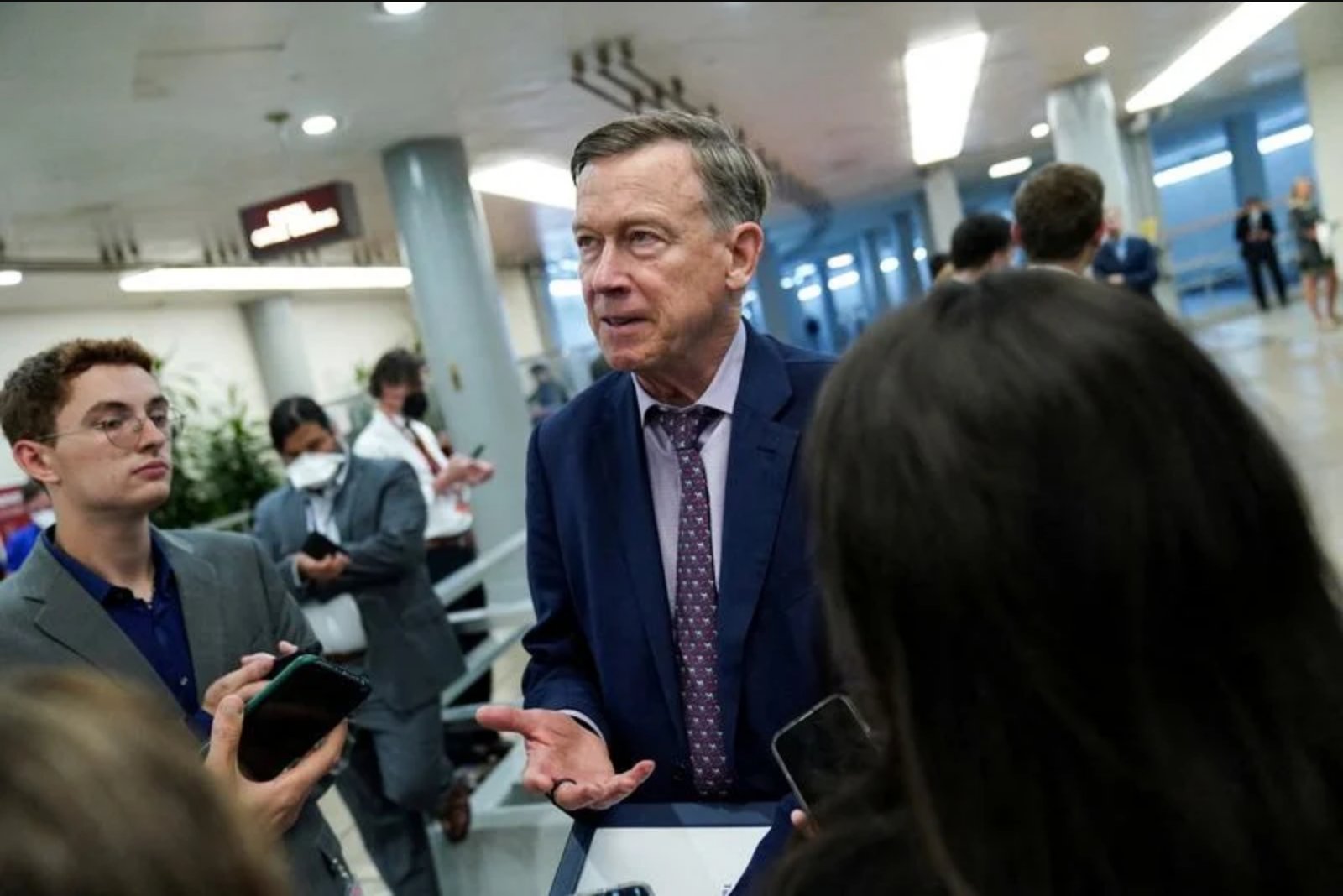
Colorado’s Democratic establishment is confronting a wave of intra-party challenges as two veteran incumbents and several statewide and congressional hopefuls face progressive opponents ahead of primary votes on Tuesday.
Senator John Hickenlooper, 74, the former Colorado governor and Denver mayor, and Representative Diana DeGette, 68, a long-serving member of the Congressional Progressive Caucus first elected in 1996 from a Denver-based House district, are each defending their records against primary contenders on the left.
DeGette is being challenged by Melat Kiros, an Ethiopia-born former New York attorney who has been an outspoken critic of Israel. Kiros, 29 and a doctoral student at the University of Denver, has secured the endorsement of Senator Bernie Sanders and has campaigned on progressive priorities including Medicare for All and abolishing Immigration and Customs Enforcement (ICE).
Hickenlooper’s opponent is state Senator Julie Gonzales, a labor organizer whose platform includes an arms embargo on Israel and proposals to rein in ICE. Gonzales’ campaign has attracted support from labor unions and progressive organizations.
Both the DeGette and Hickenlooper contests are playing out in the wake of high-profile primary upsets earlier this year in New York and Maine. Those results and the competitive nature of Colorado’s races have intensified scrutiny of whether the Democratic Party is shifting leftward.
“The energy in our party is with bold progressives willing to stand up against foreign wars, ICE and the billionaire class,” said U.S. Representative Ro Khanna, a progressive California Democrat and potential 2028 presidential candidate. “The insurgent candidates are tapping into this sentiment, and win or lose, they are pointing the direction for our party.”
The momentum behind progressive challengers has also become fodder for Republican critics, who argue the insurgents make the party more vulnerable in general elections. That debate escalated after three candidates associated with the Democratic Socialists of America and backed by New York City Mayor Zohran Mamdani won their primaries; Republicans labeled those winners radical while former President Donald Trump called them communists.
New York is a reliably Democratic state, and Maine and Colorado have tended to favor Democrats in recent statewide and national elections. Democratic presidential candidate Kamala Harris won Colorado by 11 percentage points in 2024. Still, the emergence of strong primary challengers has raised concerns about how such nominees might fare in November contests.
In terms of fundraising and polling, the challengers to DeGette and Hickenlooper face longer odds than the insurgents who prevailed in New York and Maine. Hickenlooper has raised nearly $10 million, compared with Gonzales’ roughly $870,000. A poll conducted this month by Colorado Community Research showed Hickenlooper leading Gonzales by 7 percentage points with 25% of voters undecided. That margin is markedly narrower than a February survey sponsored by the Working Families Party PAC, which placed Hickenlooper ahead by 32 points.
DeGette has reported $1.4 million in fundraising versus $660,000 for Kiros. A poll sponsored by a pair of Democratic super PACs found Kiros leading DeGette by 5 percentage points, with 18% of voters undecided. The Denver-area congressional district represented by DeGette is considered safely Democratic.
Both DeGette and Kiros back Medicare for All and support abolishing ICE, but they diverge on policy toward Israel. Kiros has called for ending wars, including by stopping military aid to Israel, while DeGette has said she supports sending only defensive weapons to Israel.
Beyond these headline matchups, Colorado’s Democratic primary for governor is also drawing attention. U.S. Senator Michael Bennet is competing against state Attorney General Phil Weiser to replace term-limited Governor Jared Polis. Weiser has outraised Bennet by nearly $2 million and has outspent him by about $1 million. Both candidates are presenting themselves as the strongest choice to defend Colorado from President Donald Trump.
On policy and record, Bennet has opposed the president’s tariffs and federal proposals to sell state public lands, and he has defended vaccine access. Weiser has taken the Trump administration to court over the freezing of federal funds and an attempt to end birthright citizenship. Four polls released this month split evenly between the two candidates, with each leading in two surveys by margins of 6 to 9 percentage points.
One of the most consequential contests for control of the U.S. House is playing out in Colorado’s 8th congressional district, a battleground that includes Denver suburbs and rural areas to the north. The seat is a potential pickup for Republicans or a place for Democrats to defend; it could help decide control of Congress.
Progressive state Representative Manny Rutinel and moderate former state Representative Shannon Bird are competing for the Democratic nomination to challenge Republican Representative Gabe Evans, who narrowly unseated Democrat Yadira Caraveo by less than one percentage point in 2024. Trump carried the district by under two percentage points in 2024. Evans enters the general election with $3.4 million on hand.
Rutinel has nearly doubled Bird’s fundraising haul, reporting $4.1 million raised and $910,000 in the bank as of June 10. Bird reported $291,000 in the bank. Immigration has emerged as a central issue in the heavily Latino district. A poll sponsored by Latino Victory Fund put Rutinel ahead of Bird by 13 percentage points. A Rutinel nomination would revive intra-party questions about whether progressive candidates can prevail in competitive districts; Democrats need a net gain of three seats to win control of the House in the November midterm elections. The 8th district was rated a toss-up heading into Tuesday’s primary.
As Colorado voters head to the polls, the state’s primaries will offer a snapshot of the balance of power within the Democratic Party and could affect the party’s strategy in competitive general election districts and statewide races. The outcomes will test whether insurgent progressive campaigns can translate their momentum into victories where incumbents have longer records and larger war chests.
Summary
Colorado faces a series of Democratic primaries in which established incumbents and conventional candidates are being challenged by progressives advocating left-leaning platforms. High-profile matchups include Senator John Hickenlooper vs. Julie Gonzales and Representative Diana DeGette vs. Melat Kiros, with additional consequential contests for governor and the 8th congressional district. Fundraising disparities, divergent policy positions on Israel and immigration, and recent upsets in other states have amplified scrutiny of these races.