
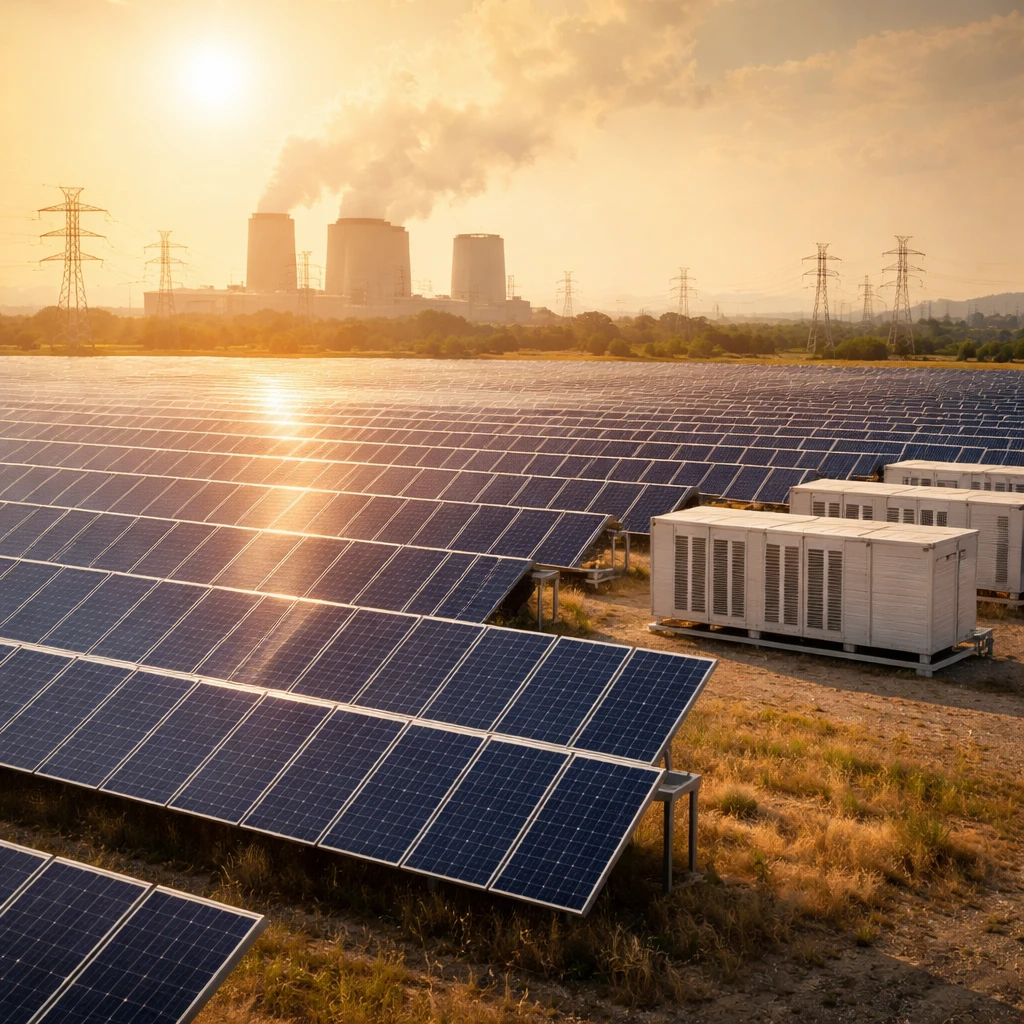
Northland Capital says a mix of elevated electricity prices, higher load growth and the ongoing El Niño event will boost demand for solar and battery storage across the US and Europe this summer. The firm singled out a basket of preferred stocks in the space, including NYSE:ENPH, NYSE:NXT, NASDAQ:SPWR, NYSE:TYGO and NYSE:TE.
According to Northland, the planet is currently in an El Niño phase that is expected to strengthen into a strong - and possibly historic - super event. The firm noted that El Niño years tend to be the hottest of any decade.
Recent heat has already put pressure on European generation. In the UK, operators of gas-fired plants curtailed output as they struggled to maintain cooling. In France, rising river temperatures forced reductions at nuclear facilities. Those supply impacts, combined with higher natural gas prices that Northland links to the war in Iran, have pushed up electricity costs across Europe.
In the United States, a heat wave affecting the eastern third of the country is expected to bring record highs and is impacting some 142 million people this week, the firm said.
Beyond weather, Northland highlighted structural drivers for higher electricity consumption in the US. Demand growth tied to data centers, onshoring and broader electrification has lifted overall usage and driven up costs. Northland projects the average summer electricity bill in the US will be $778 per month this summer, an increase of 8.5% from 2025. The firm also pointed out that the average bill has climbed 37% since 2020, representing a compound annual growth rate of 5.4%.
Northland provided a rule-of-thumb for when solar becomes economically compelling without tax incentives: when retail power costs reach between $0.22 and $0.26 per kilowatt-hour. By comparison, the current US average electricity price stands at 18.9 cents per kilowatt-hour, below that range.
The firm identified specific US jurisdictions with retail prices already above those thresholds. States and districts where electricity costs exceed $0.26 per kilowatt-hour include California, Connecticut, Hawaii, New York, Massachusetts, Rhode Island and the District of Columbia. States with retail rates above $0.22 per kilowatt-hour include Alaska, New Hampshire, Maryland, Michigan and Vermont.
In Europe the recent extreme heat has strained grids and driven wholesale prices sharply higher. Northland pointed to an instance in the UK where system operators paid $1.82 per kilowatt-hour to import electricity - roughly 15 times typical day-ahead levels. In Germany, peak prices reached $0.64 per kilowatt-hour last week, about 15 times higher than a year earlier.
As a result of these combined factors - weather-related generation constraints, rising fuel costs and structural load growth - Northland expects an acceleration in demand for solar panels and battery storage solutions across affected markets this summer.