
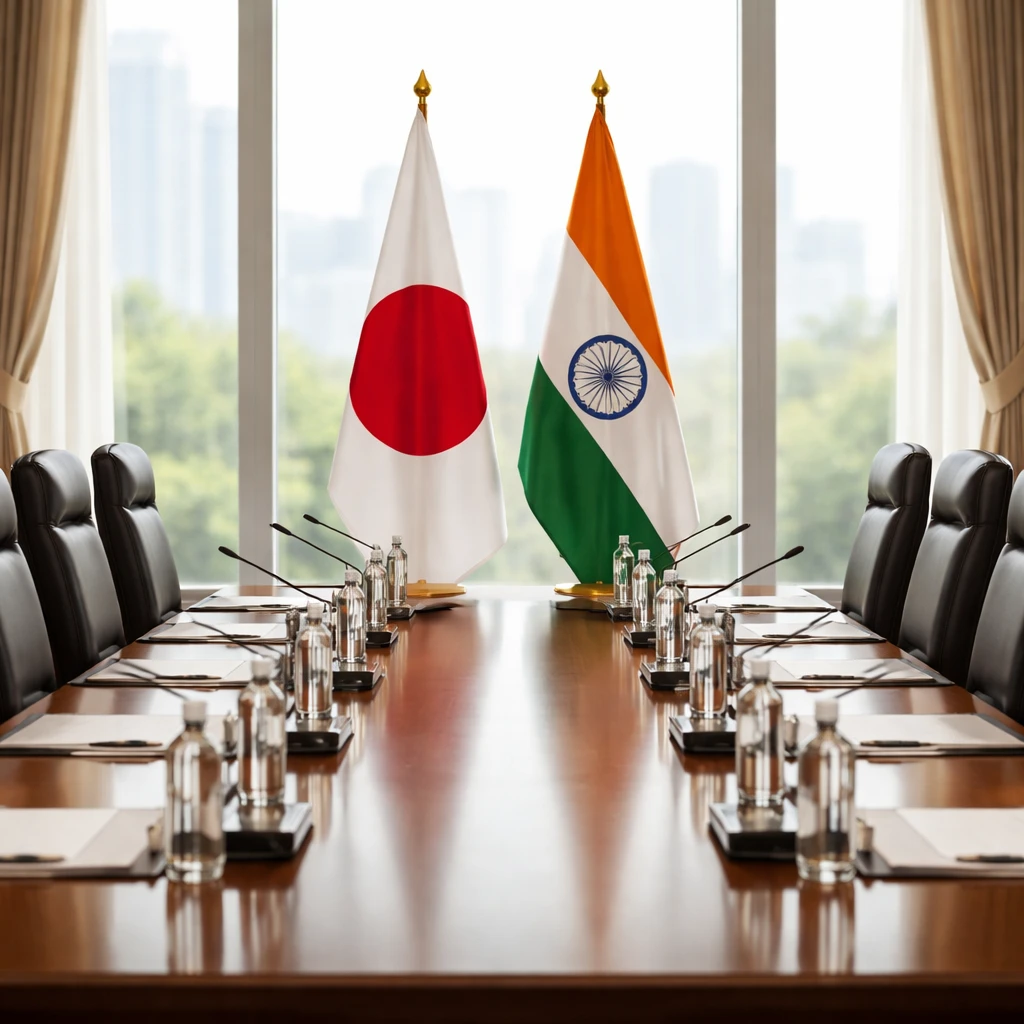
Japanese Prime Minister Sanae Takaichi is scheduled to visit India starting Wednesday for high-level talks with Prime Minister Narendra Modi, Japan's foreign ministry said. The leaders will convene for the 16th India-Japan Annual Summit, the regular forum where the two prime ministers alternate meeting locations to assess their bilateral agenda.
The summit will review progress across multiple areas, including trade, technology, infrastructure, defense cooperation and cultural exchange, according to the foreign ministry. Officials said the discussions will also touch on regional and global matters that affect both countries.
The visit follows Modi's trip to Tokyo last year, during which Japan pledged to more than double its investment in India to exceed $61 billion over the coming decade. That commitment is expected to be part of the agenda when the two leaders assess the trajectory of bilateral economic ties.
Trade between Japan and India reached $27.5 billion in fiscal year 2025/26. On the investment front, Indian government figures show Japanese direct investment into India amounted to $3.2 billion from April through December 2025.
Security and strategic cooperation are also on the table. The two leaders are expected to discuss measures to deepen security collaboration and initiatives aimed at fostering a free and open Indo-Pacific region. Both Japan and India are members of the Quadrilateral Security Dialogue - the Quad - alongside the United States and Australia, and their defense and strategic ties have been expanded in recent years.
Japan continues to be a major investor in India and is backing several large infrastructure projects. Notable among these is the high-speed rail link connecting Mumbai and Ahmedabad, which Japanese support has helped advance. Japanese firms have been increasing their stakes in Indian companies as well, exemplified by a recent $1.6 billion transaction for a 20% stake in Yes Bank.
The summit will provide a forum to measure implementation of past commitments and to consider next steps for trade, investment and strategic cooperation. Officials will also evaluate joint work on technology and cultural exchanges as part of the broader bilateral relationship.
Key points
- Prime Minister Sanae Takaichi will meet Prime Minister Narendra Modi at the 16th India-Japan Annual Summit starting Wednesday to discuss trade, investment and strategic ties.
- Japan pledged to increase investment in India to more than $61 billion over the next decade; bilateral trade was $27.5 billion in fiscal 2025/26 and Japanese investment totaled $3.2 billion from April to December 2025.
- Security cooperation and support for a free and open Indo-Pacific will be discussed, reflecting deeper defense and strategic collaboration under the Quad framework with the United States and Australia.
Risks and uncertainties
- Progress on investment pledges depends on implementation and follow-through by both governments and private firms - this affects capital markets and sectors tied to foreign direct investment such as infrastructure and finance.
- Security discussions may be sensitive to regional dynamics and geopolitical factors, creating uncertainty for defense-related industries and strategic partnerships.