
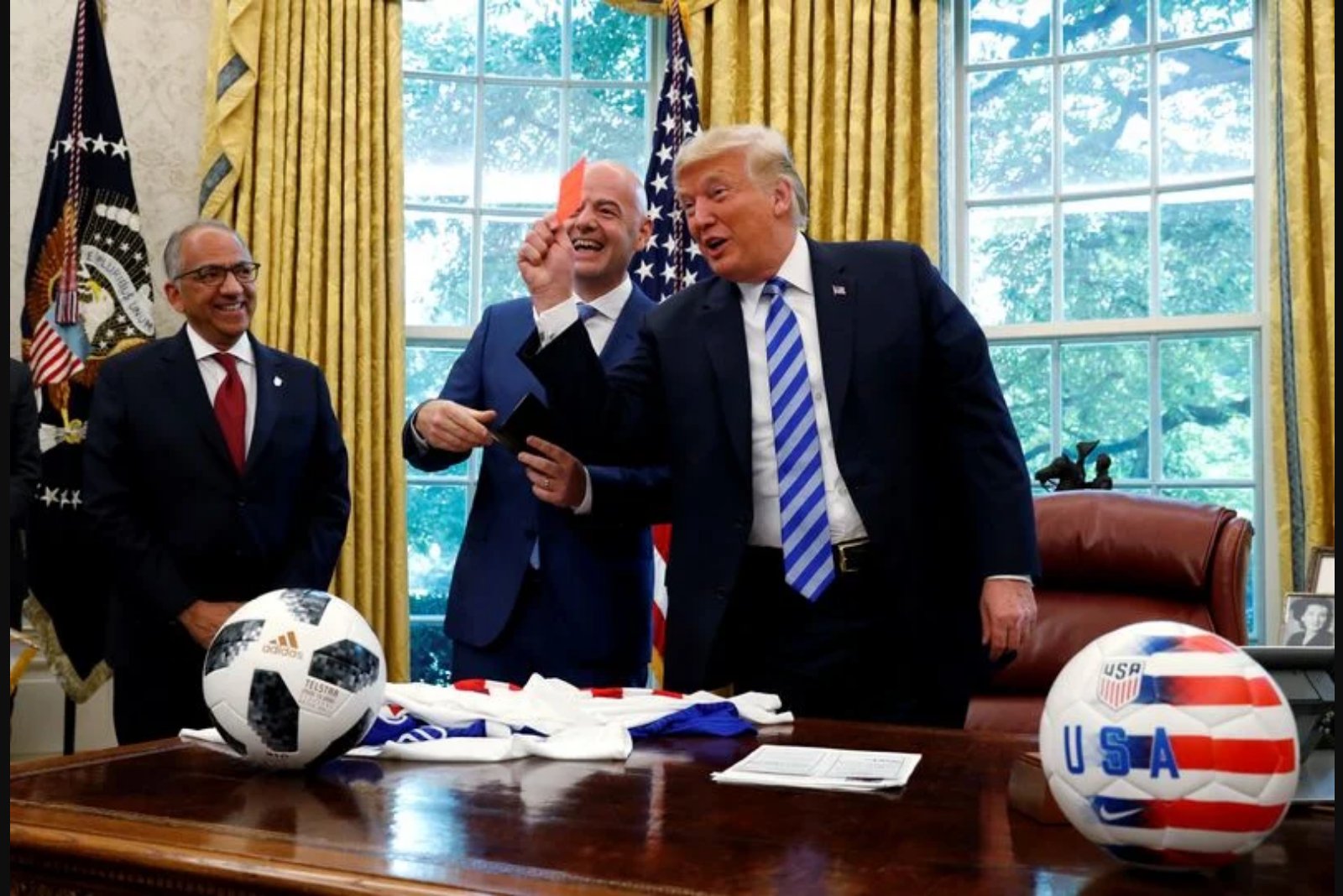
The United States' run at the World Cup took an unusual turn on Sunday when FIFA announced it would suspend the enforcement of the red-card match ban imposed on striker Folarin Balogun, making him eligible to play in Monday's last-16 tie with Belgium.
The move came after U.S. President Donald Trump called FIFA President Gianni Infantino to ask that the sending-off be reviewed, according to a person briefed on the call. FIFA said it would allow Balogun to play without rescinding the red card, placing the implementation of the suspension on hold under a probationary arrangement.
Balogun, 25, had scored his third goal of the World Cup in the United States' 2-0 win over Bosnia and Herzegovina on Thursday but was subsequently sent off after a VAR review for planting his boot into the ankle of defender Tarik Muharemovic. The dismissal prompted disagreement within and beyond the U.S. camp, with coach Mauricio Pochettino saying he did not regard the action as a red-card offense.
FIFA's statement cited the disciplinary code in explaining the measure. "In line with article 27 of the FIFA Disciplinary Code, the implementation of the match suspension is suspended for a probationary period of one year," the organization said. "If Folarin Balogun commits another infringement of a similar nature and gravity during the probationary period, the suspension shall be revoked and the sanction enforced without prejudice to any additional sanction imposed for the new infringement." The statement added that the judicial body has discretion to fully or partially suspend the implementation of a disciplinary sanction.
The decision and the circumstances around it were swiftly the subject of intense debate. Within minutes of the announcement, sports shows and pundits were discussing whether FIFA's action preserved fairness or undercut the consistency of its own rules. FIFA did not respond to requests for comment about the decision or about the reported phone call between Trump and Infantino.
President Trump posted on Truth Social, "Thank you to FIFA for doing what was right, and reversing a great injustice." The White House also celebrated Balogun's reinstatement on X with a post that read: "USA-USA-USA." U.S. Soccer accepted FIFA's decision. Balogun's teammates learned of the ruling via social media while en route to training in the build-up to the match in Seattle.
Reactions from football officials and managers highlighted the controversy. Pochettino welcomed the outcome in a Seattle press conference, saying he believed "99.9% of people in football saw it as unfair punishment" and noting "evidence from the past" that a punishment could be suspended and applied later. England manager Thomas Tuchel, while expressing that he thought Balogun did not deserve a red card, questioned the logic of suspending the punishment, pointing to his own defender Jarell Quansah being sent off in England's 3-2 last-16 win over Mexico on Sunday.
Tuchel told reporters: "Who overturns this decision then and when? And on what grounds? How far does this go now? This is strange for me." His remarks underscored uncertainty among coaches about the boundaries and precedents of FIFA's disciplinary decisions.
Belgium's football governing body reacted angrily. The Royal Belgian Football Association (RBFA) said it was "astonished" by FIFA's determination to make Balogun eligible, and said it would examine all potential options. The RBFA argued the ruling appeared to directly contradict the provisions of the tournament's regulations.
Voicing concerns outside the competing nations, German Football Association President Bernd Neuendorf said FIFA should address reports that the decision was preceded by a phone call between Trump and Infantino, adding: "The integrity of the competition and the credibility of FIFA are at stake."
The case follows other instances where FIFA has moderated the enforcement of suspensions. The governing body previously suspended the final two matches of a three-game ban for Portugal captain Cristiano Ronaldo, allowing him to play in the opening World Cup fixtures after a red card received in a qualifying match against Ireland. By contrast, Qatar midfielder Assim Madibo received a five-match ban after a red card for a tackle that seriously injured Canada midfielder Ismael Kone during a group match at this tournament.
For now, Balogun's availability shifts one of the tournament's most debated stories from the referee's report to questions about how football's global regulator balances disciplinary rules and exceptional interventions. As teams and officials prepare for the field in Seattle, the episode has placed FIFA's disciplinary procedures and decision-making squarely under the global spotlight.