
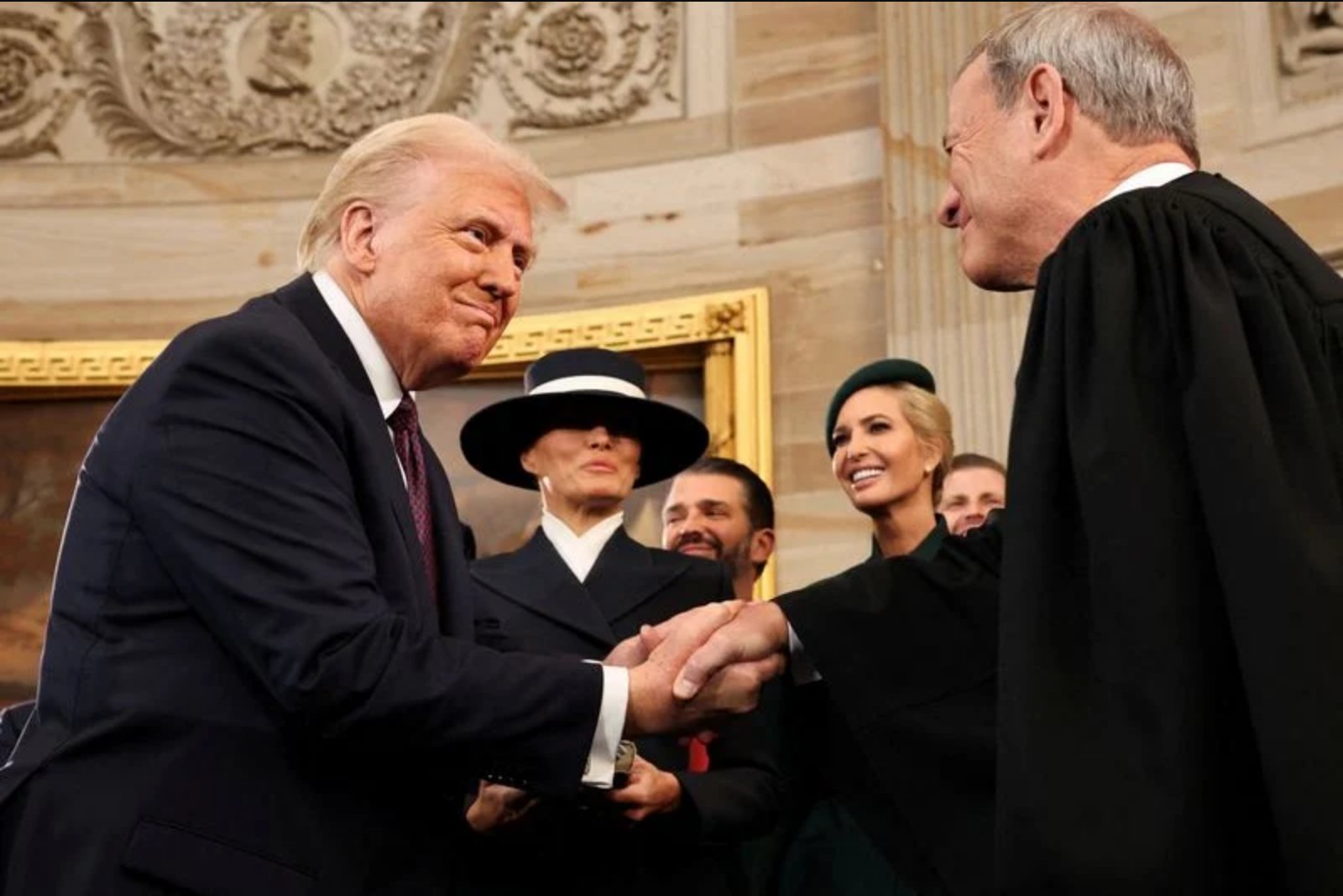
The Supreme Court's latest term, which concluded on Tuesday, highlighted a complex relationship between two of Washington's most consequential figures: Chief Justice John Roberts and President Donald Trump. Though their backgrounds and temperaments are strikingly different, the term demonstrated that when Roberts' judicial instincts and Trump's political goals overlap, the president frequently benefits. Conversely, where their aims diverged, Roberts often wrote the opinions that rejected Mr. Trump's ambitions.
On multiple high-profile matters, the court issued rulings that strengthened presidential authority. Foremost among these was a 6-3 decision authored by Roberts that removed longstanding protections shielding the leaders of independent regulatory agencies from at-will presidential removal. The case, Trump v. Slaughter, arose from the president's removal of Federal Trade Commission member Rebecca Slaughter and marked a pivotal shift in separation-of-powers jurisprudence by overturning a 1935 precedent that had recognized congressional authority to limit presidential removals.
The Slaughter ruling has been described by some legal observers as a significant bolstering of executive power under the Constitution. In returning to a framework that permits the president to fire officials leading independent agencies at will, the court consolidated presidential control over the executive branch - an outcome long associated with the so-called unitary executive theory.
At the same time, the court's term produced a set of sharp reversals for the president in areas where Roberts and Trump did not align. In three consequential cases - involving global tariffs, the question of birthright citizenship and the president's bid to remove a Federal Reserve governor - Roberts authored opinions that ruled against Trump. Each of those losses carried a 6-3 vote and, while the conservative justices played varying roles across the opinions, the court's three liberal members uniformly sided against the president in those matters.
Legal scholar John Yoo, who served in the Justice Department under President George W. Bush, said the mix of rulings undercuts the notion that the Supreme Court functions simply as an instrument of Mr. Trump's policy agenda. "This term shows that Trump wins at the court only when his agenda coincides with Roberts' agenda," Yoo said, adding that the rebukes in some cases should dispel the idea that the court is merely "an arm of the Trump agenda."
The court's ideological shift and its contemporary tilt
Roberts has presided over the court for roughly two decades and has overseen substantial shifts in its composition and jurisprudence. For much of his tenure the court operated with a narrow conservative edge, and former Justice Anthony Kennedy often served as a pivotal fifth vote. That dynamic changed radically after President Trump appointed three justices during his first term - Neil Gorsuch in 2017, Brett Kavanaugh in 2018 and Amy Coney Barrett in 2020 - creating a conservative supermajority.
Over the past decade the court's decisions have moved U.S. law in a markedly conservative direction. The justices have issued rulings that rolled back abortion and affirmative action policies, expanded gun and religious rights, and constrained the authority of regulatory agencies. The recent term continued that trend with significant outcomes in voting and campaign finance law.
In April, the court issued a 6-3 opinion authored by Justice Samuel Alito that narrowed a central provision of the Voting Rights Act, making it more difficult for minority communities to challenge electoral maps as racially discriminatory. Syracuse University College of Law professor Jenny Breen characterized the court's actions on voting as "a decades-long project for Chief Justice Roberts." The ruling cleared the way for Republican-led Southern states to reconfigure majority-Black and majority-Latino districts held by Democrats ahead of the November midterm elections.
On the campaign finance front, the court struck down federal limits on coordinated spending between political parties and their candidates, finding the restraints ran afoul of free speech protections. That decision, issued on Tuesday, removed a constraint that had previously limited some types of joint party-candidate expenditures.
Landmark expansion of presidential power
Among the rulings that drew praise from conservative legal commentators and supporters of the president was the decision in Trump v. Slaughter. The 6-3 opinion, authored by Roberts on Monday, reversed a near-century-old precedent and cleared the path for presidents to remove leaders of independent agencies without Congress-prescribed protections. The effect is a consolidation of executive authority over the administrative state.
Observers tied the Slaughter outcome to the ascendancy of the unitary executive doctrine - a conservative legal theory that envisions the president as possessing singular control over executive branch functions, including the authority to appoint and remove agency heads. American University Washington College of Law professor Elizabeth Beske said the growth of that theory has been "part of a decades-long John Roberts project." She added that Roberts "has always been a unitary executive guy, since his days in the White House Counsel's office" and suggested the chief justice long aimed to push the law in this direction. Beske also acknowledged that recent scholarly opposition existed but said Roberts appeared determined to advance that project.
Where Trump stumbled
Despite the high-profile expansion of presidential leverage, the court delivered consequential setbacks to the president in areas that touched on economic policy, constitutional protections for citizenship, and the independence of the central bank.
In February, the court issued a 6-3 decision authored by Roberts that invalidated sweeping global tariffs the president had put in place under a statute intended for national emergencies. That ruling removed a significant element of Mr. Trump's economic program.
Another major loss came when the court rejected the president's effort to terminate a member of the Federal Reserve Board of Governors, Lisa Cook. Roberts authored the opinion that preserved the central bank's independence by refusing to permit that removal. The decision underscored an institutional reluctance to permit actions that could unsettle financial markets or compromise the Federal Reserve's autonomy.
On the final day of the term, the court issued a ruling authored by Roberts that found an executive order seeking to eliminate birthright citizenship - by denying automatic citizenship to children born in the United States to certain immigrants - violated the text of the 14th Amendment. The Constitution confers citizenship to those born in the United States who are "subject to the jurisdiction thereof," and the Roberts opinion concluded the president's order conflicted with that constitutional language.
Yoo noted that the president's bid to alter birthright citizenship would have upended what he termed "an uninterrupted history of following that rule," including a prior ruling often cited on the subject. Yoo summed up the pattern observed this term: when Trump pursues outcomes that resonate politically but clash with enduring principles of the Roberts Court, he risks judicial defeat. "Where Trump seeks outcomes because of their political salience, but he comes into conflict with these long-held Roberts Court principles, he has lost," Yoo said.
Judicial calculus and market considerations
Several legal observers noted the court's dispositions in economic cases reflected a conservative concern for market stability. Breen argued that rulings like the tariff decision and the refusal to permit removal of a Fed governor reflect the court's unease with abrupt changes that might disrupt financial systems or the broader economy. "Those decisions, in other words, are entirely consistent with the conservative economic orientation of the court," she said.
Robert Luther III, a law professor at George Mason University who worked in the White House Counsel's Office during the Trump administration's first term, observed that Roberts often produces some of his most influential work when disputes test the boundaries of executive authority. "His best work has come when the limits of the executive branch have been tested by Trump's adversaries," Luther said.
What the term reveals
The term's record suggests a nuanced dynamic: the Roberts Court will advance major conservative priorities, but not all of President Trump's initiatives automatically find favor. The chief justice has authored some of the decisions most advantageous to the president, while also writing key opinions that have rebuked or curtailed elements of the president's program. In that sense, the high court has both empowered and constrained Mr. Trump's second-term agenda, depending on how closely his aims align with enduring Roberts Court principles.
What remains clear from the term is that the court's architecture - reshaped significantly by three Trump appointees - has shifted the legal landscape in ways that favor conservative outcomes on many fronts. Yet, as the recent term demonstrated, the chief justice's jurisprudential priorities continue to matter, and when Roberts' views diverge from the president's political goals, the result can be a notable judicial check.