
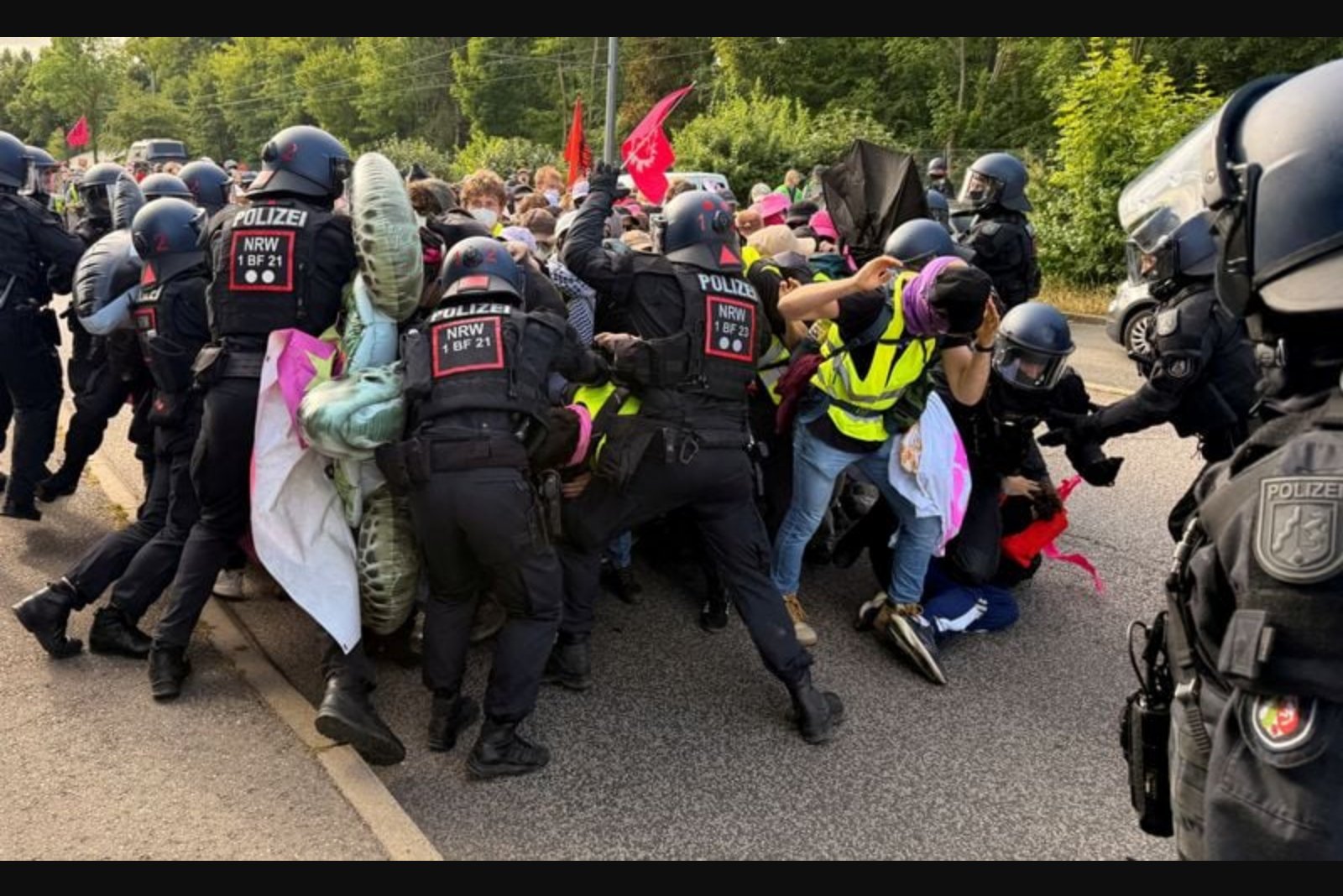
Thousands of opponents of the Alternative for Germany (AfD) filled roads in and around Erfurt on Saturday, mounting demonstrations that blocked highways and access routes to the party’s annual two-day conference as it prepares for regional elections that could see it enter state governments for the first time.
Protesters representing trade unions, civil society organisations and left-wing political groups assembled ahead of the convention, taking positions on major thoroughfares where they sat in rows watched by police in riot gear. Authorities said they brought in reinforcements from across Germany to secure the area around the convention centre.
Police estimated roughly 15,000 people participated in demonstrations in and around the eastern city. Those who organised the main umbrella protest said their aim was to show opposition to what they regard as a rise in extremist sentiment inside Germany. "We want to make it clear that we simply won’t tolerate this, that fascism is on the rise here in Germany," said Georg Becker, a spokesperson for Widersetzen, the anti-AfD coordination group leading parts of the demonstrators.
The conference itself is expected to re-elect co-leaders Alice Weidel and Tino Chrupalla. It takes place as the AfD heads into regional ballots in Saxony-Anhalt and Mecklenburg-Vorpommern. Party figures see success in those contests as a potential stepping stone toward greater influence at the national level.
Formed more than a decade ago, the AfD has, according to recent opinion polling cited at the convention, opened a notable lead over Chancellor Friedrich Merz’s conservative bloc. The party’s platform combines nationalist messaging, proposals for tougher immigration controls and appeals to voters frustrated by what it describes as years of economic stagnation under successive federal governments.
Critics accuse the AfD of advancing racist policies and attitudes that they say are incompatible with Germany’s democratic values and warn the party could pose a threat to the constitutional order. Mainstream parties have adopted a policy of no cooperation with the AfD, a so-called "firewall" designed to prevent it from joining coalition governments at state or federal level.
AfD leaders reject accusations that they oppose Germany’s democratic foundations. Earlier this year, the party secured a court injunction that led the domestic intelligence service to suspend a prior classification of the AfD as "extremist." Recent polls cited around 29% support for the AfD, compared with roughly 22% for Merz’s CDU/CSU. The party also made notable gains in two regional elections in western Germany earlier this year.
Support for the AfD is strongest in the former communist east of Germany, where polling shows higher levels of voter dissatisfaction with the established party system. In Saxony-Anhalt, the latest survey cited put the AfD at approximately 41%, well ahead of the 23% for Merz’s Christian Democrats, with the AfD aiming for an outright victory. The party also sees a path to becoming the largest party in Mecklenburg-Vorpommern.
The demonstrations in Erfurt and the party’s polling strength underline the highly contested political environment as regional votes approach. Security deployments and broad civic mobilisation reflect both the public concern about the AfD’s direction and the tense atmosphere surrounding upcoming state-level contests.