
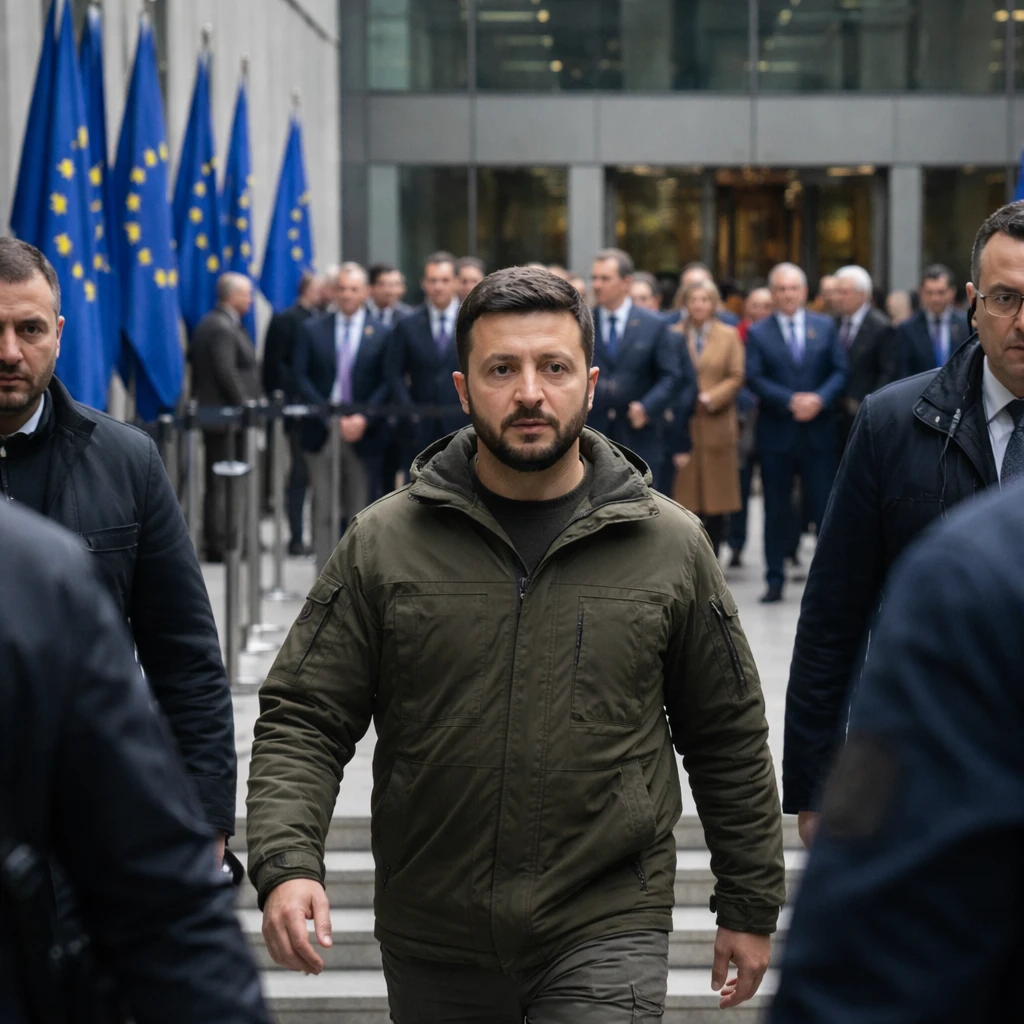
Brussels, Oct 16 - European Union leaders prepared to show solidarity with President Volodymyr Zelenskiy at a summit in Brussels on Friday as diplomatic tensions with the United States and ongoing hostilities intensify. The gathering takes place while Ukrainian cities face missile and drone attacks and questions grow over whether U.S. intelligence-sharing and arms supplies to Kyiv could be scaled back.
The summit arrival was shadowed by a fresh public rebuke from U.S. President Donald Trump, who called Ukrainian strikes on Russian refineries "a disgrace". The president’s comments followed Kyiv’s targeting of a refinery southeast of Moscow that supplies the Russian capital. Trump made his remarks in an interview with the Newsmax news outlet and has attributed higher energy prices to those Ukrainian strikes, linking them to possible political costs for him ahead of U.S. midterm elections in November.
Winter preparations and military funding
As he entered the summit, Zelenskiy framed the meeting around efforts to bring the conflict to an end and to ready Ukraine for the coming winter. "We want to end this war as quick as possible. We don’t see now signals from the Russian side that they are ready for this, to end this war, that’s why we have to prepare for the winter," he said. "The winter package is not only energy, it’s also air defence and funding," Zelenskiy added, and said he would present Ukraine’s needs both for the remainder of this year and for 2027.
Ukrainian forces struck a Russian oil refinery after Zelenskiy announced Kyiv was abandoning the energy ceasefire that President Trump had earlier put forward, and he criticised Trump’s readiness to make separate arrangements with Moscow. Trump had surprised Zelenskiy last weekend by stating that Ukraine and Russia had agreed not to target each other’s energy facilities.
Washington’s shifting posture
Beyond his criticism of the refinery strikes, Trump’s administration is reportedly examining whether to ease sanctions on so-called "shadow fleet" vessels that have been carrying oil and petroleum products from countries including Russia, according to a U.S. official. The prospect of looser restrictions, together with Trump’s public statements about energy-targeting agreements, has prompted pushback from EU leaders.
EU officials voiced disapproval of what one participant described as a diesel deal put forward by Washington, while simultaneously confronting rising energy prices that have been exacerbated by regional tensions, including the Iran war, an issue that revealed divisions among member states on the first day of the summit.
Funding gaps and military procurement
On financing, Zelenskiy previously told Reuters that Ukraine and its European partners had agreed on a plan that would close a $27 billion deficit in military spending for this year, a move intended to allow Kyiv to order drones slated for delivery at the start of 2027. Despite that plan, Finance Minister Sergii Marchenko has said Ukraine still confronts an unfunded budget gap of $32.6 billion for next year. That figure does not include an estimated $40 billion in direct military supplies provided by allies.
European leaders at the summit acknowledged the strain of ongoing support. Dutch Prime Minister Rob Jetten said, "I am unhappy with the number of countries that have been willing to pledge new financial support to Ukraine. But we will see several countries pledging more military support soon." He described the day as being focused on how to navigate the increasingly complex diplomatic picture and how Ukraine can endure the winter.
European political pressure
Belgian Prime Minister Bart De Wever framed the discussion in stark terms. He said Zelenskiy "will probably look everybody straight in the eye and say, thank you for the 90 billion, but that money is going to run out because a war is a very costly thing." He pressed EU members to consider whether they were prepared "to put your money where your mouths are" in order to sustain Ukrainian society and defence.
Responding to Trump’s remarks, Rob Jetten said, "This is not the right language. It is also in the interest of Trump to defend Ukraine in this war." The comment reflected concern among some EU leaders that public criticism by a major supplier could undermine collective support for Kyiv.
Russian response and recent violence
From Moscow, President Vladimir Putin sought to downplay the impact of Ukrainian attacks on Russian oil facilities, saying they had caused "nothing particularly significant." In parallel, Russia moved to place local assets of French, German, Swedish and Dutch companies under temporary management as a retaliatory measure for the EU’s support of Ukraine.
Hostilities on the ground have continued to exact a human toll. Russian drone strikes on the city of Kharkiv killed three people, local authorities said, while attacks on the Volyn region bordering Poland left some 370,000 people without power. In Kyiv, emergency power cuts were implemented during Russian strikes, according to private energy provider DTEK, which posted the update on X.
Context for the summit
The Brussels meeting brings together EU leaders at a moment when military, financial and energy considerations intersect sharply. Zelenskiy is seeking both immediate support for winter resilience and longer-term commitments to sustain Ukrainian defence capabilities. EU officials must weigh domestic political sensitivities, rising energy costs and the diplomatic complications raised by recent statements from the United States.
Across the agenda, energy markets and defence procurement emerged as core areas of concern. Leaders must balance short-term humanitarian and infrastructure needs with the strategic requirement to maintain Ukraine’s operational capability.
Reporting here is based on statements made by leaders, officials and local authorities at the time of the summit.