
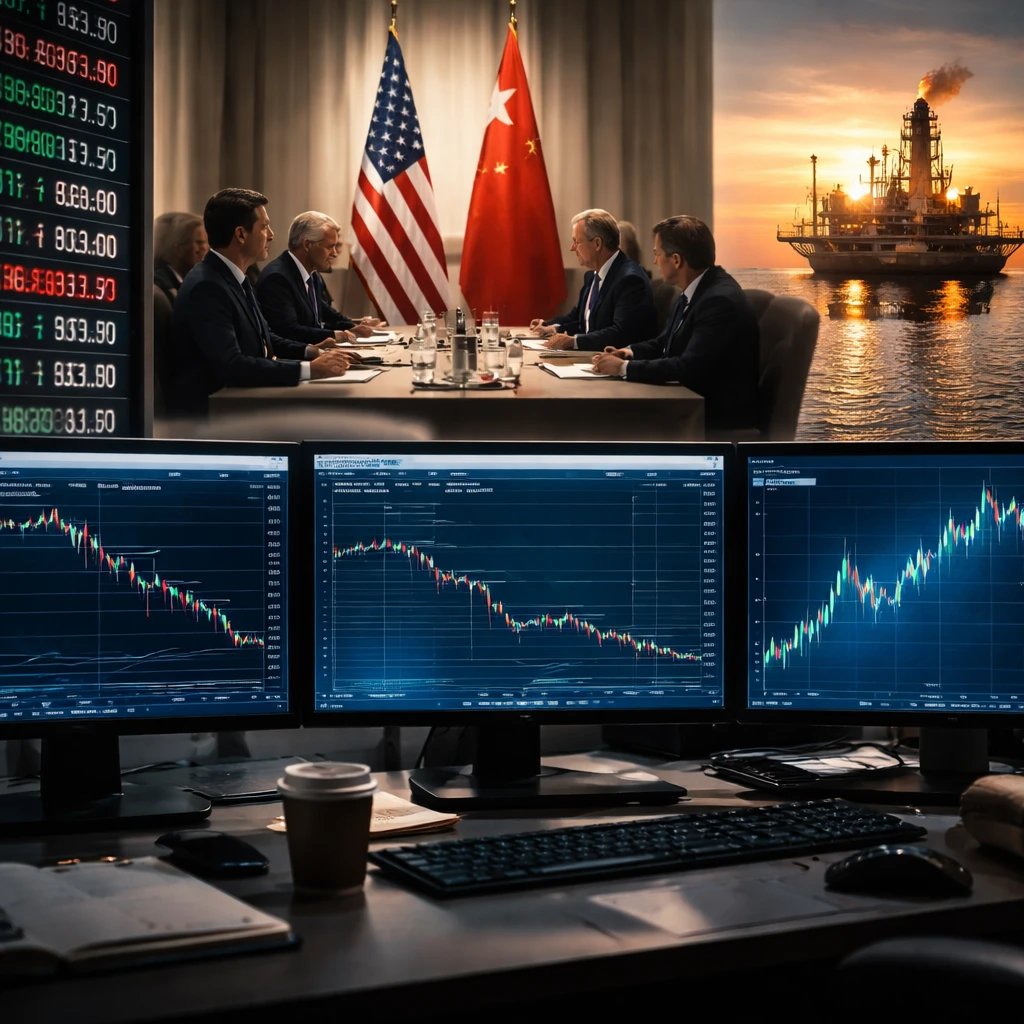
U.S. stock futures moved lower early on Thursday following a broad-based selloff in global bond markets, a shift that market participants attributed to unexpectedly strong business activity readings and a renewed climb in oil prices. The pullback in fixed income has amplified speculation that central banks may tighten policy further before year-end, a dynamic that has weighed on risk assets.
At 02:55 ET (06:55 GMT), futures on the Dow were down by 155 points, or 0.3%, S&P 500 futures were lower by 37 points, or 0.5%, and Nasdaq 100 futures had slipped by 211 points, or 0.7%. Those moves followed declines by the main U.S. equity benchmarks during the prior session, when stock performance was undercut by a fresh wave of selling in sovereign debt markets.
The backdrop to the market action includes two central developments: a high-profile diplomatic meeting in Asia and renewed pressure on bond prices spawned by robust economic survey data. Traders are also watching energy markets closely after Brent crude returned to trade above the $100-a-barrel threshold.
Diplomatic spotlight - Trump-Xi summit
The planned summit between U.S. President Donald Trump and Chinese President Xi Jinping is expected to draw close scrutiny from investors because of its potential implications for trade policy and technology competition. Officials have signaled that trade will be a central topic, alongside deliberations over artificial intelligence cooperation and safety.
U.S. Treasury Secretary Scott Bessent said on Wednesday that the two countries had agreed to extend, by two months, an existing tariff ceasefire that was due to expire in November. That agreement, originally signed last year, halted an escalating tit-for-tat tariff battle that had threatened global growth. According to Bessent, the extension provides both sides with additional time to negotiate what could become a broader trade truce.
Bessent made the remarks following a meeting with Chinese Vice Premier He Lifeng - their second meeting in four days - as Washington and Beijing prepared for the leaders' face-to-face discussions. He also cautioned that it remained uncertain whether a new, more comprehensive trade deal could be completed before the extended deadline of January 10.
Artificial intelligence is set to feature prominently in the talks as both nations race to secure advantages in the development and governance of the technology. Bessent said Chinese counterparts had agreed to establish a notification system to handle AI safety incidents, though he added that Beijing's response to the proposal was unclear. Chinese state media, meanwhile, reported only that negotiators discussed AI.
Bond market turbulence
Hanging over these diplomatic negotiations is a surge in volatility across global bond markets. A significant portion of the recent selloff in sovereign debt appears to have been sparked by preliminary U.S. business activity data from S&P Global released on Wednesday.
The composite reading of the S&P Global survey climbed to its highest level in more than five years, while the indices tracking manufacturing and services exceeded economists' forecasts. Market participants interpreted the results as evidence of greater resilience in the American economy despite energy-driven inflationary pressures.
Deutsche Bank analysts characterized the move as part of a broader global trend, pointing to a rise in Eurozone composite PMI figures that reached a three-year high. "So if anything, the initial signal from the PMIs suggested that growth was accelerating in September across many of the world’s biggest economies," the analysts said.
Traders reacted to the stronger growth signal by re-pricing expectations for future interest-rate moves, increasing bets that central banks - including the Federal Reserve - could move again to raise borrowing costs before year-end. The Fed had lifted rates by a quarter percentage point the prior week, and the recent data and market moves have added to speculation of further tightening.
Oil's resurgence and geopolitical friction
Energy markets also contributed to the risk-off tone. Brent crude rose more than 3%, breaking a five-day losing streak and closing back above $100 a barrel. Earlier in the week Brent had dipped below that level amid reports Saudi Arabia was restarting operations at an east-west pipeline damaged recently, a development that had eased some concerns about supply.
However, optimism that representatives meeting at the United Nations General Assembly might broker a swift deal to end the Iran conflict faded after an Iranian Foreign Ministry spokesperson set out a stringent checklist for restarting mediated negotiations. The conditions included U.S. acceptance of a shipping route through the Strait of Hormuz pre-approved by Iran and Oman, lifting of a U.S. naval blockade, and the release of frozen Iranian assets.
Iran's President Masoud Pezeshkian emphasized that Tehran would not allow unrestricted navigation through Hormuz while what he described as a U.S. blockade and sanctions remained in place. Those comments dimmed prospects for a rapid restoration of Gulf oil flows and revived concerns about potential shipping disruptions in a key transit corridor for global crude supplies.
Deutsche Bank analysts linked the combination of stronger-than-expected PMI data and the oil price rebound to increasing market expectations of faster rate hikes, a shift that has exerted pressure on equity markets.
Corporate calendar - Costco
On the corporate front, the calendar is light but includes fiscal fourth-quarter results from membership retailer Costco. Earlier this year, in May, the company beat third-quarter sales estimates, a result the firm attributed largely to demand for its lower-cost gasoline during a period of elevated energy prices.
Costco's historical results have suggested that while U.S. consumers remain cautious about large-ticket purchases amid persistent inflation, they continue to gravitate toward value-focused retail options offered by warehouse chains. The company has also taken steps to limit food-price inflation - notably for beef - a strategy that helped consumers but weighed on the retailer's third-quarter margins.
Shares of Costco have risen by more than 5% so far this year, reflecting investor interest in defensive, value-oriented retail exposure amid ongoing macroeconomic uncertainty.
In sum, early trading activity reflected investor unease as stronger activity data, geopolitical developments and oil-market dynamics combined to push bond yields higher and increase speculation about additional central-bank tightening. The Trump-Xi meeting, and the details that emerge from it on trade and AI, will likely remain a focal point for markets already grappling with renewed rate-path concerns and energy-related supply risks.