
Economy July 14, 2026 08:41 AM

Warsh Signals Fed's Resolve to Prevent Persistent Inflation as Economy Shows Mixed Strength

In first House Financial Services testimony, Fed chair outlines growth, strong business investment tied to AI, and five task forces to review policy practices

By Jordan Park
Share
Twitter Reddit Facebook LinkedIn

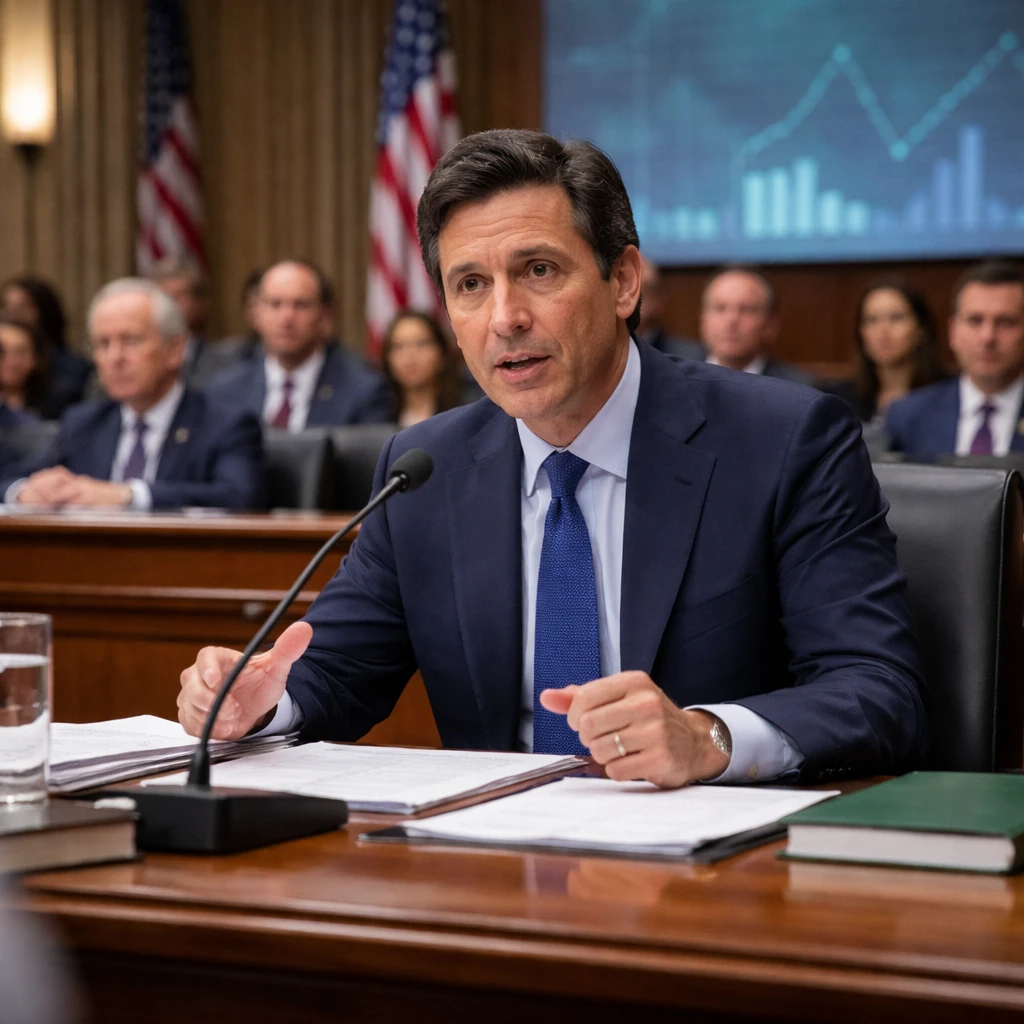
Federal Reserve Chairman Kevin Warsh told members of the House Financial Services Committee that the central bank will not accept persistently high inflation and is committed to reestablishing price stability. In his first congressional testimony, Warsh submitted the Board's semiannual Monetary Policy Report and described an economy expanding at a solid pace with particularly rapid business investment in technology-related areas, while noting a lagging housing sector and broad stability in the labor market. He also announced five task forces to reassess key Fed practices.

Warsh Signals Fed's Resolve to Prevent Persistent Inflation as Economy Shows Mixed Strength
Summarize with
ChatGPT Perplexity Claude Grok Gemini

Key Points

  • Chairman Warsh told the House Financial Services Committee the Fed has no tolerance for persistently elevated inflation and is committed to restoring price stability - impacts monetary policy expectations and fixed-income markets.
  • The FOMC kept the federal funds target range at 3-1/2 to 3-3/4 percent at the June meeting - relevant for borrowing costs across the economy.
  • Economic backdrop shows solid expansion with moderate household consumption, steady manufacturing output, a lagging housing sector, and rapid business investment driven by data center construction and AI-related equipment - affecting technology, construction, housing, and capital goods sectors.

Federal Reserve Chairman Kevin Warsh told lawmakers on Tuesday that the central bank will not tolerate inflation that remains persistently high, reaffirming the Fed's priority of restoring price stability.

Delivering the Board's semiannual Monetary Policy Report in his first appearance before the House Financial Services Committee, Warsh reiterated the Federal Open Market Committee's recent decision. The FOMC kept the target range for the federal funds rate at 3-1/2 to 3-3/4 percent at its June meeting.

"The members of our Committee have no tolerance for persistently elevated inflation," Warsh said. "And we share a resolute commitment to restoring price stability."

Warsh acknowledged the burden that elevated inflation has placed on American households and businesses over the past five years. He emphasized that while month-to-month price swings are to be expected, the path of underlying inflation over longer horizons is largely shaped by monetary policy actions.

On the economic backdrop, Warsh described overall expansion as solid and resilient. Household consumption growth was characterized as moderate, and manufacturing output has risen steadily this year. In contrast, he noted that the housing sector continues to lag behind other areas of the economy.

One of the most notable features Warsh highlighted was the rapid pace of business investment. He said that investment activity appears to be accelerating, citing construction of data centers and strong demand for AI-related equipment and software as drivers. On a measured basis, investment in equipment rose by about 8 percent for the year ending in the first quarter, while high-tech spending increased nearly 25 percent on a four-quarter basis.

Turning to labor market conditions, Warsh described the situation as broadly stable. Job creation has kept pace with growth in the labor force, the unemployment rate remains low and has changed little over the past year, and the economy has experienced relatively few layoffs. He also pointed to only slight variation in job vacancies and solid growth in nominal wages.

To examine and potentially refine the Fed's own operations and frameworks, Warsh announced the creation of five task forces. These groups will review the central bank's communications, balance sheet policies, data sources, the productivity and jobs impacts arising from new technologies, and inflation frameworks.


Warsh's testimony combined a firm stance on inflation with an assessment of an economy showing varied momentum across sectors and a labor market that remains resilient. The announced internal reviews signal a deliberate effort to scrutinize both policy tools and the information that informs them.

Risks

  • Persistently elevated inflation remains a central concern that could sustain pressure on monetary policy tightening - relevant to consumer spending, bond markets, and interest-sensitive sectors.
  • A lagging housing sector could weigh on residential construction and related industries if weakness persists - relevant to real estate, construction, and mortgage markets.
  • The evolving impact of new technologies on productivity and jobs introduces uncertainty in labor-market dynamics and sectoral employment patterns - relevant to labor-sensitive industries and technology-adjacent markets.

More from Economy

U.S. Consumer Inflation Eases More Than Forecast in June, but Uncertainty Remains Jul 14, 2026 Australia to Create Central Office for AI Policy and Standards Jul 14, 2026 Australia to centralise AI regulation with new Office of AI in PM's department Jul 14, 2026 U.S. Consumer Inflation Sees Sharp Monthly Drop in June, Led by Lower Gas Prices Jul 14, 2026 Citi Posts 45% Rise in Quarterly Profit as Trading and Deal Fees Surge Jul 14, 2026