
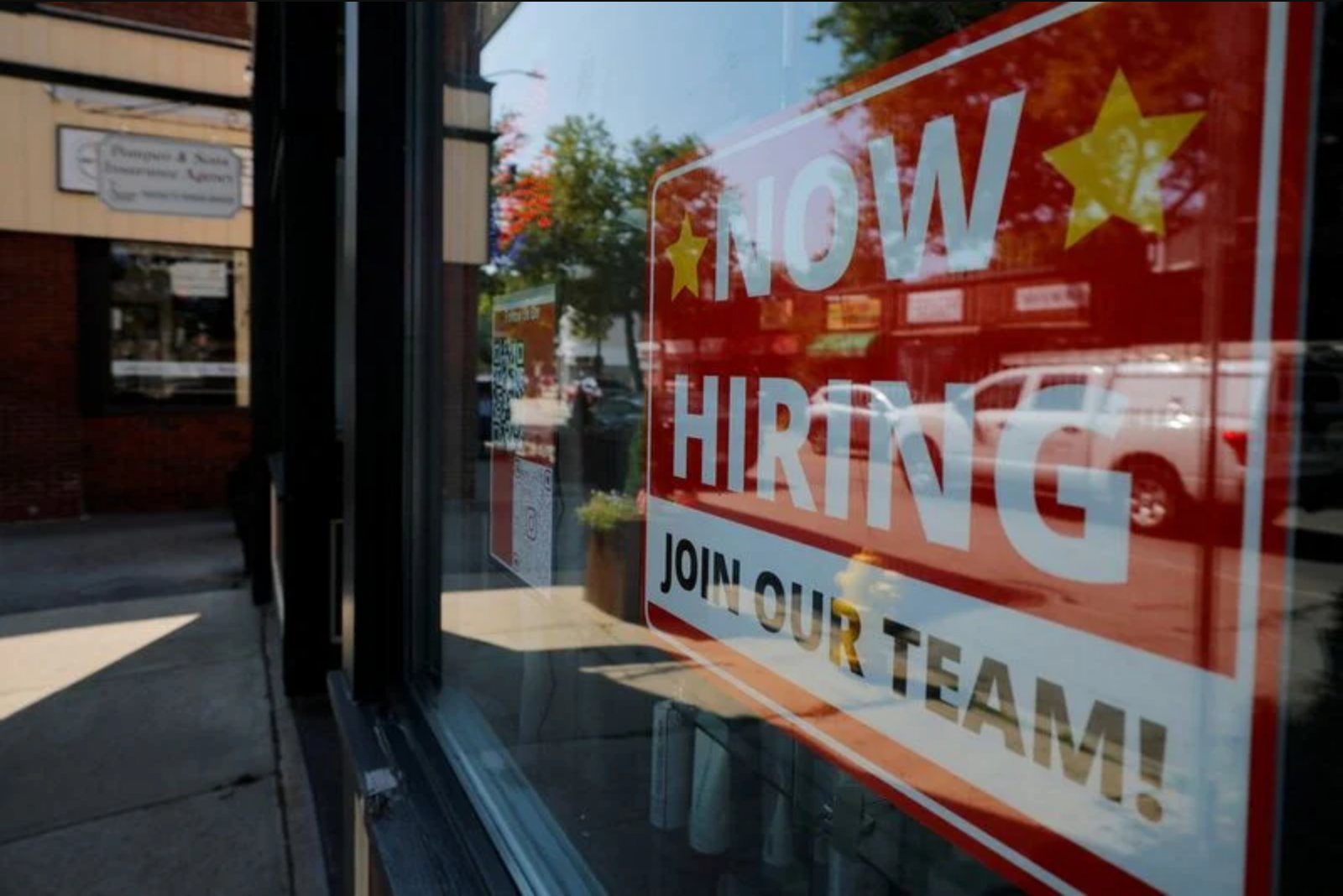
The U.S. labor market is expected to show slower, but still-solid, job growth in June while the unemployment rate likely remained unchanged at 4.3% for a fourth month running - a sign of continued stability despite a recent run of outsized payroll gains.
After three consecutive months of stronger-than-expected increases in nonfarm payrolls, economists surveyed by Reuters forecast payrolls rose by 110,000 in June, following a 172,000 gain in May. Forecasts in the survey ranged widely, from as few as 25,000 to as many as 200,000 new jobs. The report is being released a day early because Friday is a public holiday marking the United States' 250th anniversary of independence on Saturday.
Analysts said the expected moderation would still leave the labor market consistent with stability and would not rule out the Federal Reserve considering another interest rate increase in September amid concerns about inflation tied to the U.S.-led war with Iran.
"A few months ago, I was actually worried because we had lost jobs in five months," said Dan North, senior economist at Allianz Trade Americas. "We’ve seen the labor market firm up over the past three months, and I don’t see any particular imbalance. We’re in this very tiresome phrase of 'no hire, no fire' labor market."
Recent payroll history and the break-even rate
Payrolls had climbed by 214,000 and 179,000 in March and April, lifting the three-month average job gain through May to 188,000 - a notable rise from the 63,000 average recorded during the same three-month span in 2025. Economists have pointed to an unusually low level of layoffs as a key driver of the stronger payroll numbers.
Estimates for the number of jobs the economy needs to create to keep pace with working-age population growth - the so-called break-even rate - range from zero to 50,000 per month. That threshold has shifted downward in part because an immigration crackdown has reduced the size of the labor force, helping to keep the unemployment rate steady.
Mixed signals across labor indicators
While payrolls have strengthened, other measures of the labor market have been less robust. Hiring plans reported by small businesses and other survey-based indicators have not shown the same degree of vigor. A Conference Board survey released on Tuesday found the share of consumers saying employment is "hard to get" was near a 5-1/2-year high in June.
"The rather confusing thing is that the jobs numbers have been pretty strong, while all the other labor market indicators haven’t been anywhere nearly as robust," said James Knightley, chief international economist at ING. "There is a little bit of caution that it could come to an end at any point; it could be that the relative softness in the business surveys starts to materialize in the payrolls numbers."
Geopolitics, oil prices and downside risks
Some economists judged downside risks to the labor market had receded after the U.S. and Iran agreed to a ceasefire, which pushed oil prices back toward pre-war levels. Those economists expected the recent pattern of job growth - which has broadened beyond healthcare into other industries - to continue through the year.
"The downside labor risks that prompted last year’s rate cuts have not materialized," said Shruti Mishra, an economist at Bank of America Securities. "Combined with sticky inflation, that strengthens the case for reversing those cuts."
Financial markets assigned roughly a 50.7% probability to a Fed rate increase at the September 15-16 meeting, according to CME Group’s FedWatch tool. The U.S. central bank last month held its benchmark overnight interest rate in the 3.50%-3.75% range but projected policymakers expected to raise borrowing costs this year in their quarterly outlook.
Sectoral payback risks and the World Cup effect
Economists said the anticipated slowdown in headline job growth for June likely reflected payback after some sectors posted outsized gains in May, including local government. Leisure and hospitality payrolls surged by 70,000 in May, and analysts remain divided on how much of that increase was driven by the FIFA World Cup tournament, which the United States is jointly hosting with Canada and Mexico.
Economists at Goldman Sachs estimated that a historical analysis implies the World Cup could add roughly 40,000 jobs to June payroll growth, concentrated in leisure and hospitality, professional and business services, and trade and transportation. By contrast, JPMorgan analysts argued the May jump in leisure and hospitality might instead reflect an early Memorial Day holiday this year versus 2025, although they still expected World Cup-related hiring to limit the extent of any payback in those sectors.
Wages and inflation considerations
Wage trends remain a focal point for policymakers. Average hourly earnings were forecast to rise 3.5% year-on-year in June, up from a 3.4% increase in May. The ongoing absence of substantial acceleration in wages has prompted some economists to argue the Fed may not need to tighten policy further.
"Wage trends and the unemployment rate will be the two most important signals regarding whether stronger job growth is leading to a retightening in the labor market, putting upward pressure on wages and price inflation," said Veronica Clark, an economist at Citigroup. "So far, there are limited signs that this is the case."
What to watch
- June's nonfarm payroll figure and the unemployment rate, which together will help determine whether recent robust gains were a temporary spike or the start of a sustained pattern.
- Average hourly earnings for signs of upward pressure on wages that could alter Fed policy expectations.
- Sectoral details - notably leisure and hospitality, professional and business services, trade and transportation, and local government - to assess whether gains were concentrated and subject to payback.
The coming data will help clarify if the labor market's recent strength persists and whether that persistence, combined with inflation dynamics influenced by geopolitical developments, keeps the prospect of tighter monetary policy alive for the autumn.