
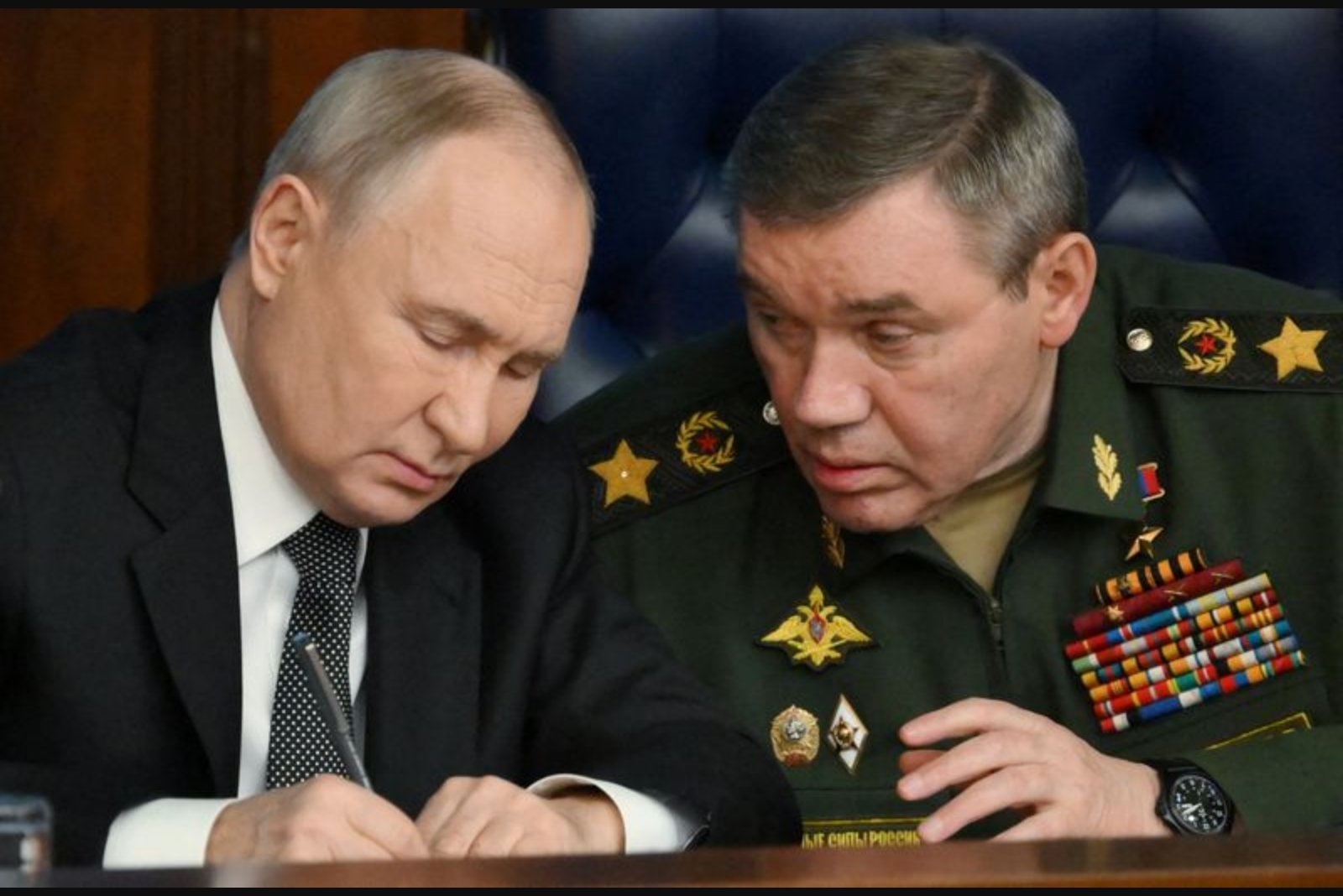
Russian military leadership on Tuesday said its forces have captured over 1,700 square kilometres of Ukrainian territory and 80 settlements since the start of this year, and are advancing on a so-called fortress belt in the Donbas region.
Valery Gerasimov, Chief of the General Staff of the Russian Armed Forces, made the assessment while inspecting units, and was quoted in footage released by the Russian defence ministry. "Since the beginning of this year, a total of 80 settlements and more than 1,700 square kilometres of territory have come under our control," he said.
Gerasimov described continued operations by what he termed the Southern Grouping of forces, saying they were attacking the Donetsk area he identified as the fortress belt, which includes the cities of Sloviansk, Kramatorsk and Kostiantynivka. He said Russian forces were approximately 7 to 12 km from Sloviansk and Kramatorsk and that Russian units were already fighting in parts of Kostiantynivka.
In addition to the reported Donetsk advances, Gerasimov said Russian forces were pushing forward in the Sumy region to the north and in Kharkiv in the northeast with the stated objective of creating what he called "a security zone".
The Russian military's statements on territorial control sit alongside different figures circulated by Ukrainian sources. Top Ukrainian commander Oleksandr Syrskyi announced in mid-April that Kyiv's forces had reclaimed nearly 50 square kilometres in March. Pro-Ukrainian maps published in relation to ongoing fighting indicate that Russia has taken 592 square kilometres this year.
Reuters said it was unable to verify the battlefield accounts independently, and the general staff of the Ukrainian armed forces did not immediately respond to a request for comment on the Russian claims.
Separately, Russian estimates cited in Gerasimov's remarks place Russian control at about 90% of the Donbas region, roughly 75% of Zaporizhzhia and Kherson regions, and smaller portions of the Kharkiv, Sumy, Mykolaiv and Dnipropetrovsk regions. The remarks also referenced Crimea, which Russia controls following its 2014 annexation; the peninsula is internationally recognised by most countries as part of Ukraine.
Pro-Ukrainian mapping cited in reporting indicates that Russia controls 116,793 square kilometres of Ukrainian territory, equivalent to 19.35% of the country, while also noting that Russia's territorial advance has slowed this year.
Reporting and verification limitations are evident in the differing tallies of territory gained or held. The Russian general staff's figures, Ukrainian commanders' statements and pro-Ukrainian maps present divergent accounts, and independent confirmation of frontline changes was not available at the time of reporting.
The situation described by Gerasimov places particular emphasis on operations around Sloviansk, Kramatorsk and Kostiantynivka, with the distances he gave to Sloviansk and Kramatorsk indicating how close Russian forces say they are to those cities. The extent of fighting in parts of Kostiantynivka was explicitly noted.
This account preserves the differing claims and the caveats around verification while documenting the specific territorial figures and regional descriptions provided by Russian military leadership and cited Ukrainian statements.