
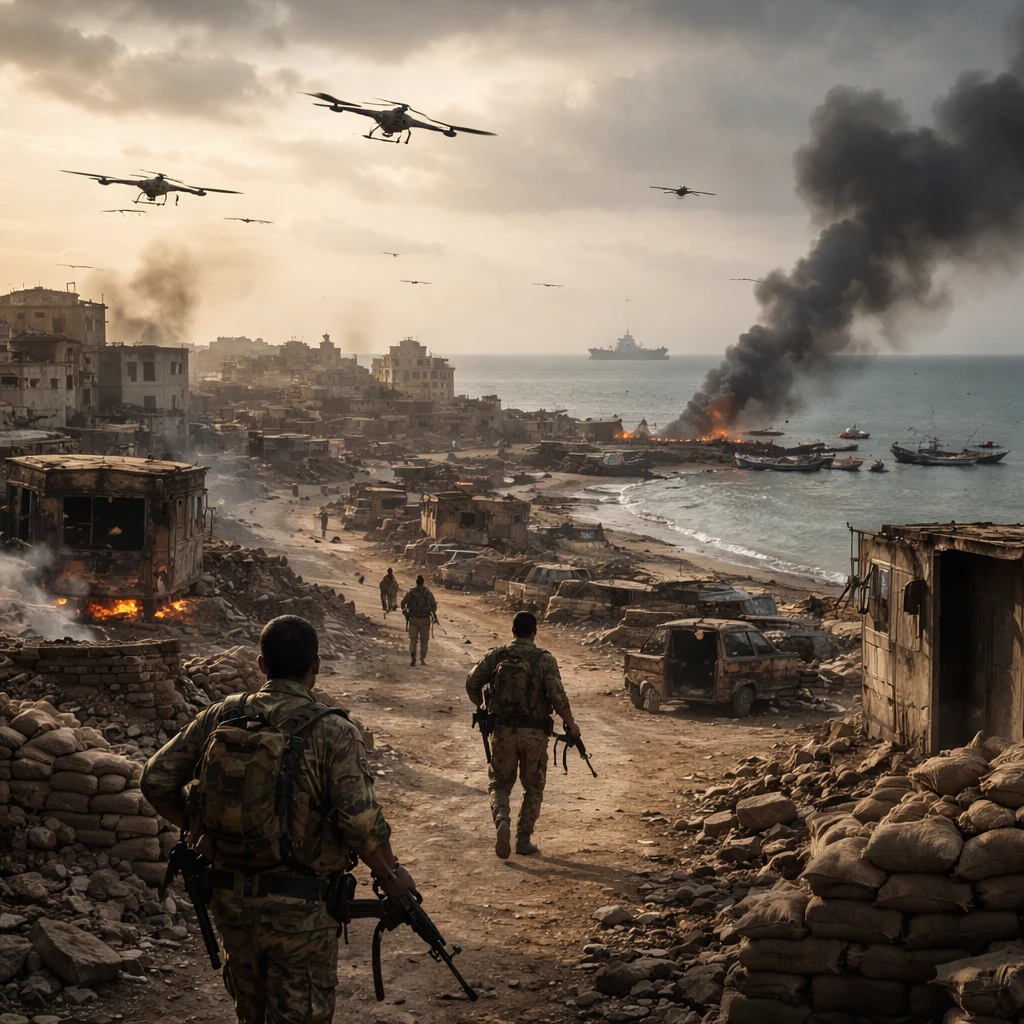
The capture of Mocha by Houthi forces this week came after what multiple Yemeni, Iranian and regional sources described as direct operational guidance from Iran's Islamic Revolutionary Guards. The seizure has intensified Houthi control over access to the Bab el-Mandeb Strait, a chokepoint for global shipping and energy supplies, and appears to form part of a wider strategy of pressure in the broader regional confrontation that has pitted Iran and its allies against the United States.
Sources with ties to the Yemeni government, Iranian informants and regional diplomats described a picture in which Tehran urged the Houthis to expand their campaign, promising increased funding, weaponry and the presence of senior Guards officers to support a stepped-up offensive. Iran, while referring to the Houthis as an ally, has publicly rejected characterising the group as a proxy and denies providing direct military command.
Within Iran, two sources said officials had instructed the Houthis to intensify attacks on Saudi Arabia and had committed to deliver additional resources and personnel. A regional diplomat with briefings from Tehran added that several senior Revolutionary Guards commanders had already traveled to Yemen to oversee and coordinate Houthi operations aimed at Saudi targets after weeks of strategic consultations. Another Iranian official acknowledged Tehran held meetings with allies including the Houthis and said the operation to take Mocha was a decision made by the Houthis themselves, though he observed the action nonetheless served Iranian interests by contributing to upward pressure on oil prices and creating difficulties for the United States and Saudi Arabia.
Five military figures aligned with Yemen's Saudi-backed and internationally recognised government stated that the Revolutionary Guards had been directing the new western coastal campaign that moved along the Tihama plain, beginning with an intense barrage of rocket fire and a ground push toward Mocha. Those officials said their assessment was informed by intercepted communications and the testimonies of captured Houthi fighters, and they named Abdolreza Shahlaei, a senior commander in the Guards' Qods Force, as the principal Iranian figure believed to be directing the effort. Iranian sources did not immediately verify Shahlaei's role, though some have previously indicated he has spent time in Yemen in recent years.
Despite an aerial and maritime blockade aimed at Houthi-controlled areas, Iranian sources said the Guards retained the ability to move weapons and personnel into and out of Yemen. They did not provide details on the mechanisms used to sustain that flow. Analysts tracking the conflict noted that the recent offensive bore hallmarks of a campaign built over time rather than improvised last-minute action.
"If we look at their offensive on the west coast, it is not something prepared just last week or last month," said Ahmed Nagi, a Yemen analyst at the International Crisis Group. He described the fall of Mocha as a major development and linked it to the acquisition of new weapons, whether delivered directly by Iran or through smuggling networks relied upon by the Houthis. Nagi highlighted the emergence of drones as a key factor in the latest phase of the campaign.
As fighting approached Mocha last week, the Yemeni government asked Saudi Arabia for enhanced military assistance, including expanded air operations. Two Yemeni officials said the government had requested Saudi strikes not only against Houthi frontlines but also on strategic Houthi assets in and around Sanaa, as well as on facilities such as oil depots. In response, Saudi support was described by Yemeni officials as concentrated on logistics, arms deliveries and intelligence; Riyadh carried out only limited air strikes and focused those strikes primarily on northern battlefronts in Jawf and Marib provinces.
The Yemeni officials said their view was that Saudi leadership was hesitant to broaden its aerial campaign against Houthi targets out of concern that such escalation could provoke more intense drone strikes on Saudi territory. Saudi authorities did not provide an immediate comment on questions about their operational priorities or the apparent decision to focus on northern fronts rather than the Red Sea coast.
Assessing the military balance in Yemen is complicated by the country's recent history of intermittent fighting and a ceasefire agreed in 2022 that had reduced large-scale hostilities for a period. Both Iran and Saudi Arabia, however, have continued to invest in the forces they back in Yemen while the pro-government coalition has suffered from internal divisions that analysts say weaken its cohesion.
Previous campaigns across the Tihama have involved sudden advances followed by withdrawals, and it is not clear whether Saudi-backed government forces can reverse the latest Houthi gains easily. Nagi said some government advances might be possible if the necessary Saudi support were provided, but he cautioned that such an outcome could be more difficult to achieve this time.
Summary
Multiple Yemeni, Iranian and regional sources report that Iran's Revolutionary Guards provided tactical direction, funding and weaponry to Houthi forces in the campaign that resulted in the capture of Mocha, reinforcing Houthi leverage over the Bab el-Mandeb Strait. Iran publicly rejects the label of proxy and has denied directing operations, while some Iranian officials acknowledge meetings with allies and note secondary benefits to Tehran. The Yemeni government sought greater Saudi air support, but Riyadh limited direct strikes and concentrated on northern fronts amid concern about escalation. The overall military outlook remains uncertain given long-standing ceasefire dynamics, external sponsorship of forces and fractures within the pro-government coalition.
Key Points
- Iranian Revolutionary Guards are reported by several sources to have provided operational guidance and additional weapons and personnel to the Houthis in the campaign that led to Mocha's capture. Sectors impacted: defense, regional security.
- The Houthi takeover of Mocha strengthens their control over the Bab el-Mandeb Strait, a strategic maritime chokepoint whose disruption further constricts global energy supplies and can influence oil markets. Sectors impacted: energy, shipping.
- Saudi Arabia has provided logistical, armament and intelligence support to the Yemeni government but has limited its air strikes and concentrated operations in northern provinces, reflecting concerns about provoking wider escalation. Sectors impacted: defense, regional geopolitics, aviation.
Risks and Uncertainties
- Escalation risk: Expanded Houthi activity along the Red Sea coast and potential for wider retaliation could further threaten shipping in the Bab el-Mandeb Strait, creating volatility in global energy flows. Affected sectors: energy, maritime transport.
- Command and control ambiguity: Conflicting accounts from Iranian and regional sources about the extent of Tehran's direct command of Houthi operations leave uncertainty about future operational tempo and the scale of external support. Affected sectors: defense, intelligence.
- Pro-government cohesion: Internal divisions within the Saudi-backed coalition could limit the ability to mount a sustained counteroffensive, making the duration and outcome of the current Houthi gains unpredictable. Affected sectors: defense, regional stability.